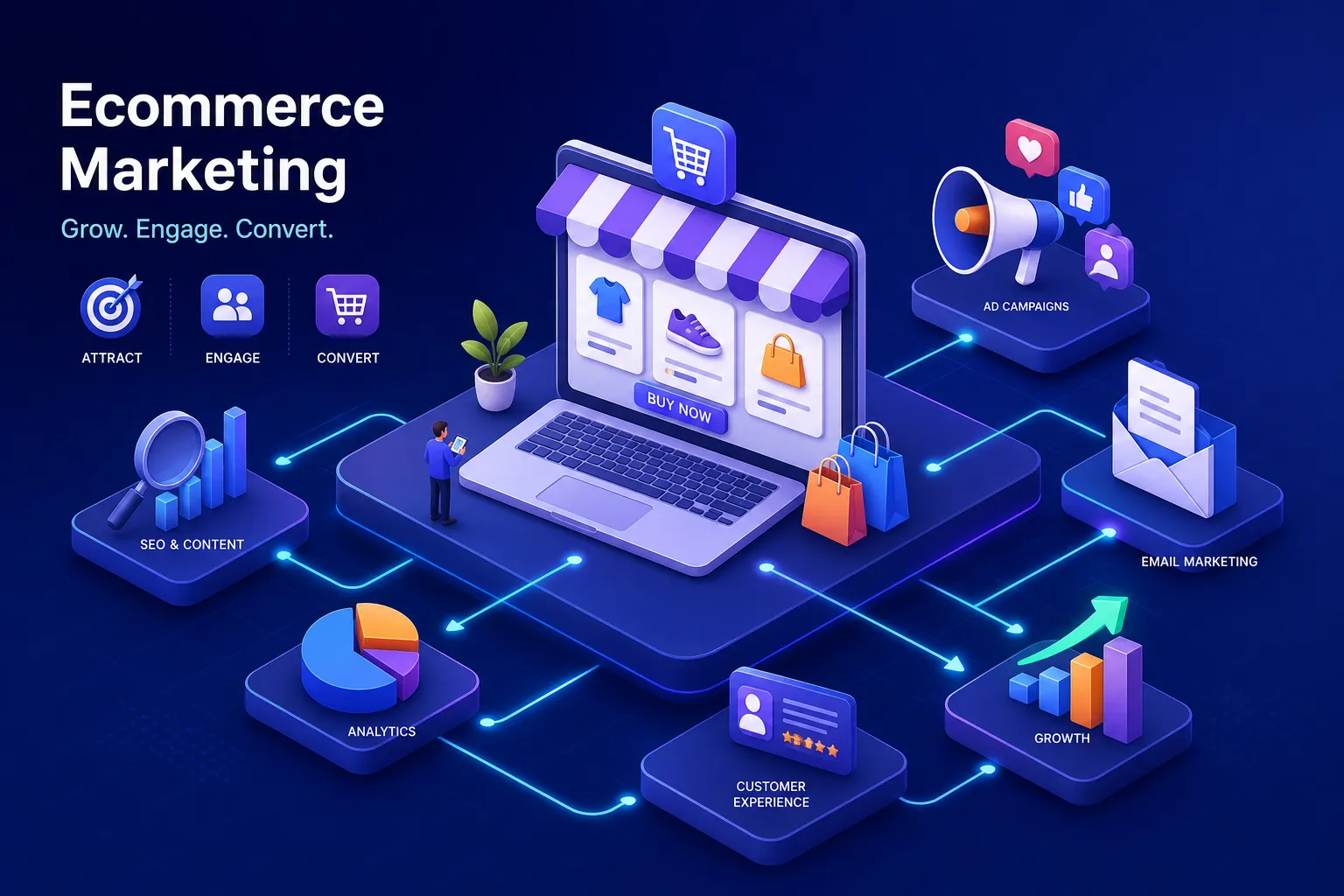
Most online store owners aren’t short on ecommerce marketing services, they’re drowning in options. SEO, Google Shopping, email automations, social content, CRO testing: every agency promises that its particular channel is the one that will unlock your growth, but almost none of them explain what to prioritize at which stage of your store’s revenue curve. For many merchants, navigating this crowded landscape is the actual bottleneck.
This guide cuts through that noise. You’ll get a clear breakdown of which ecommerce marketing services actually drive revenue, what they realistically cost in 2026, and how to hold any agency you hire accountable to results. Full-service ecommerce marketing agencies now bundle these channels into cohesive programs that growing stores can access without enterprise-level budgets, making the integrated approach more accessible than it has been in previous years. Brandleap Agency, for example, is built around exactly this model: integrated, revenue-focused growth marketing designed for stores that need enterprise-caliber strategy without the enterprise price tag.
By the time you finish reading, you’ll have a working checklist, realistic benchmarks, and the right discovery questions to find the right agency partner with confidence.
Ecommerce Marketing Services That Drive Real Revenue
Not every marketing channel deserves your attention at the same time. The mix that works for a $500K Shopify store looks very different from what a $10M DTC brand needs. Start with the ecommerce marketing services that have the clearest, most measurable connection to revenue.
SEO for Product Pages and Category Structure
Ecommerce SEO is structurally different from standard website SEO, and many generalist agencies overlook this distinction. Ranking an ecommerce store requires optimizing product pages, category hierarchies, internal linking patterns between collections, and faceted navigation, a set of technical requirements that generic SEO playbooks simply don’t address. For Shopify marketing services specifically, URL structure constraints, auto-generated canonical tags, and indexing behavior require specialized knowledge that goes well beyond basic on-page optimization.
The case for investing in ecommerce SEO comes down to compounding returns. Unlike paid media, organic rankings don’t stop delivering when you cut the budget. A well-optimized category page that ranks for high-intent queries keeps generating revenue month after month, gradually reducing your cost per acquisition across the entire channel mix.
Ecommerce SEO and PPC: Google Shopping, Paid Search, and Performance Max
Paid media, specifically Google Shopping, Performance Max, and Meta Ads, is the fastest path to high-intent traffic and immediate revenue generation. For stores that need results now, PPC is the right lever to pull. According to 2026 benchmark data, the blended ROAS across ecommerce verticals sits at approximately 3.4x, with beauty and cosmetics reaching 6x or higher and supplements pushing to 8x in subscription-driven models.
Paid campaigns without strong SEO and CRO foundations burn budget quickly. If your product pages convert at 1.2% and your brand has no organic presence, you’re paying full price for every customer indefinitely. Paid media works best as an accelerator on top of a solid organic and conversion foundation, not as a replacement for it. A well-structured ecommerce SEO and PPC strategy, managed cohesively, closes that gap faster than running either channel independently.
Email Marketing and Retention Flows
Email consistently delivers the highest ROI of any ecommerce marketing channel. Industry benchmarks place email ROI between $36 and $42 for every $1 spent, with top-performing U.S. merchants on Klaviyo reaching approximately $72 per $1. The median Klaviyo brand attributes about 15% of total revenue to email, while best-in-class programs drive 30% or more. Those numbers make email impossible to ignore regardless of your store’s size.
The core automations every store needs are welcome sequences for new subscribers, abandoned cart flows, post-purchase series, and win-back campaigns for lapsed customers. Getting these four flows live and optimized is one of the highest-leverage actions most small ecommerce brands can take, some programs attribute 20% or more of automated revenue directly to these four sequences alone. Retention-focused email marketing also directly lowers your customer acquisition cost over time, which changes the math on your paid media profitability significantly.
What Ecommerce Marketing Services Actually Cost in 2026
Budget conversations are where most agency relationships go sideways before they even start. Knowing the real numbers gives you a baseline for what’s reasonable and what’s a red flag.
The Three Pricing Models Agencies Use
Monthly retainers are the most common pricing model, used by roughly 62% of agencies based on industry surveys. They offer predictable costs for ongoing services like SEO, email management, and content. Percentage-of-ad-spend pricing, typically 10 to 20% of your media budget, is the standard for paid media management. Performance-based pricing, tied to ROAS or revenue targets, is the fastest-growing segment, increasing approximately 7% year over year as brands demand tighter ROI alignment, according to agency pricing trend reports.
The hybrid model gaining the most traction in 2026 is a base retainer plus a performance bonus, which aligns agency incentives with client outcomes without transferring all financial risk to the agency. One thing to watch: agencies charging a straight percentage of ad spend have a structural incentive to grow your media budget rather than improve its efficiency. Always understand how your agency’s fee structure influences their recommendations.
Cost Ranges by Store Size and Service Scope
Monthly agency costs vary widely based on the revenue stage of your store and how many channels you need managed. Here’s a realistic breakdown for 2026:
- Small stores under $1M revenue: $1,500 to $5,000 for one or two channels
- Growing SMBs at $1M to $5M: $5,000 to $10,000 per month
- Mid-market stores at $5M to $50M: $10,000 to $50,000 per month
- Enterprise DTC brands above $50M: $15,000+ for full multi-channel management
For individual services, ecommerce SEO typically runs $1,000 to $10,000 per month depending on catalog size and competition. Email and SMS retention management runs $3,000 to $10,000 monthly. Paid media management ranges from $8,000 to $25,000 per month, on top of your actual ad spend. Many paid media agencies also require minimum monthly ad budgets of $5,000 to $10,000 before they’ll take on an account.
Performance Benchmarks to Hold Your Agency Accountable
Benchmarks are only useful if you apply them to your specific vertical. A 3x blended ROAS that looks healthy for an electronics retailer is actually a profitability problem for a low-margin consumer goods brand.
ROAS and Conversion Rate Targets by Product Category
The 2026 blended ROAS benchmarks by vertical give you a realistic starting point for evaluating agency performance. Beauty and cosmetics typically land between 3x and 6x, fashion and apparel between 2.5x and 5x, home and garden between 2.5x and 4.5x, electronics between 2x and 4x, and food and beverage between 2.5x and 5x. Google Shopping campaigns across all ecommerce verticals average approximately 5.1x, notably higher than blended search or Performance Max numbers.
Conversion rate benchmarks follow a similar pattern by vertical. Food and beverage leads at 3.0%, beauty at 2.74%, apparel at 1.97%, and consumer electronics at 1.52%. Brands with 50% or higher gross margins should target a blended ROAS of 3x to 5x, while lower-margin stores need 5x to 8x to stay profitable. Use these figures to set minimum acceptable performance thresholds in any agency agreement you sign.
AOV, CAC, and What They Mean for Your Channel Mix
Average order value benchmarks vary dramatically by category. Luxury and jewelry stores average $328 per order, home and furniture average $264, apparel averages $82.50, and beauty sits between $67 and $72. Customer acquisition costs follow a different pattern: apparel median CAC is $36, beauty $41, electronics $46, and food and beverage $47.
One benchmark worth close attention is the desktop versus mobile AOV gap. Desktop orders average $192, while mobile averages $133, a 44% difference. That gap points directly to where ecommerce CRO services pay off fastest: if a significant share of your traffic comes from mobile but mobile AOV lags desktop by that margin, checkout optimization and mobile UX improvements should be among your first agency priorities.
Platform Expertise: What Your Agency Must Know About Your Store
Platform knowledge isn’t optional. An agency that treats your Shopify store like a generic website will make expensive mistakes that take months to correct.
Choosing Ecommerce Marketing Services for Shopify Stores
Shopify’s closed ecosystem creates a specific set of technical constraints that affect both SEO and CRO outcomes. Checkout limitations, URL structure restrictions, and auto-generated canonical tags behave differently than on open-source platforms, and agencies that don’t account for these nuances introduce problems that aren’t immediately visible in dashboards. Duplicate content from faceted navigation and filter combinations, for example, is one of the most commonly missed technical issues in Shopify stores, and it directly dilutes ranking signals across entire product categories.
Data integrity is equally critical. An agency working on your Shopify store must know how to audit and optimize the Shopify Pixel and Conversion API, because flawed tracking leads to poor bidding decisions in paid campaigns and misleading attribution data across all channels. For Shopify Plus brands specifically, agencies also need working knowledge of Flow automation, Script Editor capabilities, and Shopify Audiences to unlock the platform’s full marketing potential. These are the non-negotiables any credible Shopify marketing services provider should meet before you sign an engagement.
WooCommerce, Magento, and BigCommerce Differences
WooCommerce requires WordPress-specific SEO knowledge, plugin compatibility management, and server-side performance optimization that Shopify handles natively. Agencies working on WooCommerce stores need to manage caching, database performance, and PHP-level integrations that simply don’t exist in Shopify’s environment. These aren’t minor differences, they require a fundamentally different technical approach.
Magento, now Adobe Commerce, demands enterprise-level expertise: multi-store configurations, B2B catalog structures, and ERP integrations that most general marketing agencies have never worked with. BigCommerce’s native multi-channel selling, including direct integrations with Amazon, Google, and social platforms, requires agencies familiar with the Stencil template engine and the platform’s specific API limits for checkout customization. The takeaway is straightforward: ask every agency you evaluate for platform-specific case studies in your tech stack, not just general ecommerce wins.
How to Evaluate Ecommerce Marketing Companies Before You Sign
Most agency vetting processes are too shallow. A polished deck and a few impressive revenue numbers don’t tell you whether an agency will actually perform for your store at your stage of growth.
The Shortlist Checklist for Ecommerce Brands
Before you move any agency to a shortlist, verify these five things:
- Confirm they have verified case studies in your specific product vertical, not just a generic “ecommerce” win.
- Confirm they demonstrate platform-certified expertise that matches your tech stack.
- Confirm they have transparent attribution and GA4 reporting capabilities.
- Get clarity upfront on asset ownership: your ad accounts, email lists, and domain authority should remain yours if you part ways.
- Make sure KPIs are tied to revenue metrics, not vanity numbers like impressions or follower counts.
The bundled-service advantage is worth highlighting here. Agencies that manage SEO, paid media, and email under one roof can reduce attribution gaps and lower the coordination overhead that comes from managing three separate vendors. That’s the model Brandleap Agency is built around: keeping growth marketing integrated and accessible for stores that need strong strategy across every channel without managing multiple agency relationships.
Questions to Ask During Discovery Calls
These are the questions that reveal how an agency actually operates, not just how it presents itself. Ask what their minimum ad spend requirement is and how management fees are structured. Ask for a case study from a store in your vertical with comparable revenue. Ask specifically how they handle attribution across paid, organic, and email channels simultaneously. Ask who owns the ad accounts and creative assets if the engagement ends. Ask what onboarding looks like and how long before you should expect measurable results.
Agencies that deflect on attribution or asset ownership are red flags, regardless of how impressive their case study numbers look. Attribution transparency and clean asset handover terms are non-negotiable in any agency relationship worth entering.
Putting It All Together
The ecommerce marketing services that move real revenue follow a clear logic: SEO builds compounding organic growth, paid search and Shopping campaigns capture high-intent traffic immediately, email drives retention and delivers the best ROI of any channel, and ecommerce CRO services maximize the revenue you’re already earning from existing traffic. None of these channels works optimally in isolation.
Cost is relative to results. The right ecommerce marketing services at $5,000 per month will consistently outperform the wrong ones at $20,000 per month if benchmarks aren’t tracked and accountability isn’t baked into the engagement from day one. Use the benchmarks in this guide as your performance baseline, the checklist as your agency filter, and the discovery questions as your final screen before signing anything.
For growing stores that want these channels managed cohesively, without building out multiple agency relationships, it’s worth comparing a bundled, full-service ecommerce marketing agency against a fragmented vendor stack. Integration reduces overhead, simplifies attribution, and typically improves cross-channel performance. To find out which channels deserve your attention first and how Brandleap Agency approaches that conversation, reach out to start a discovery call.