
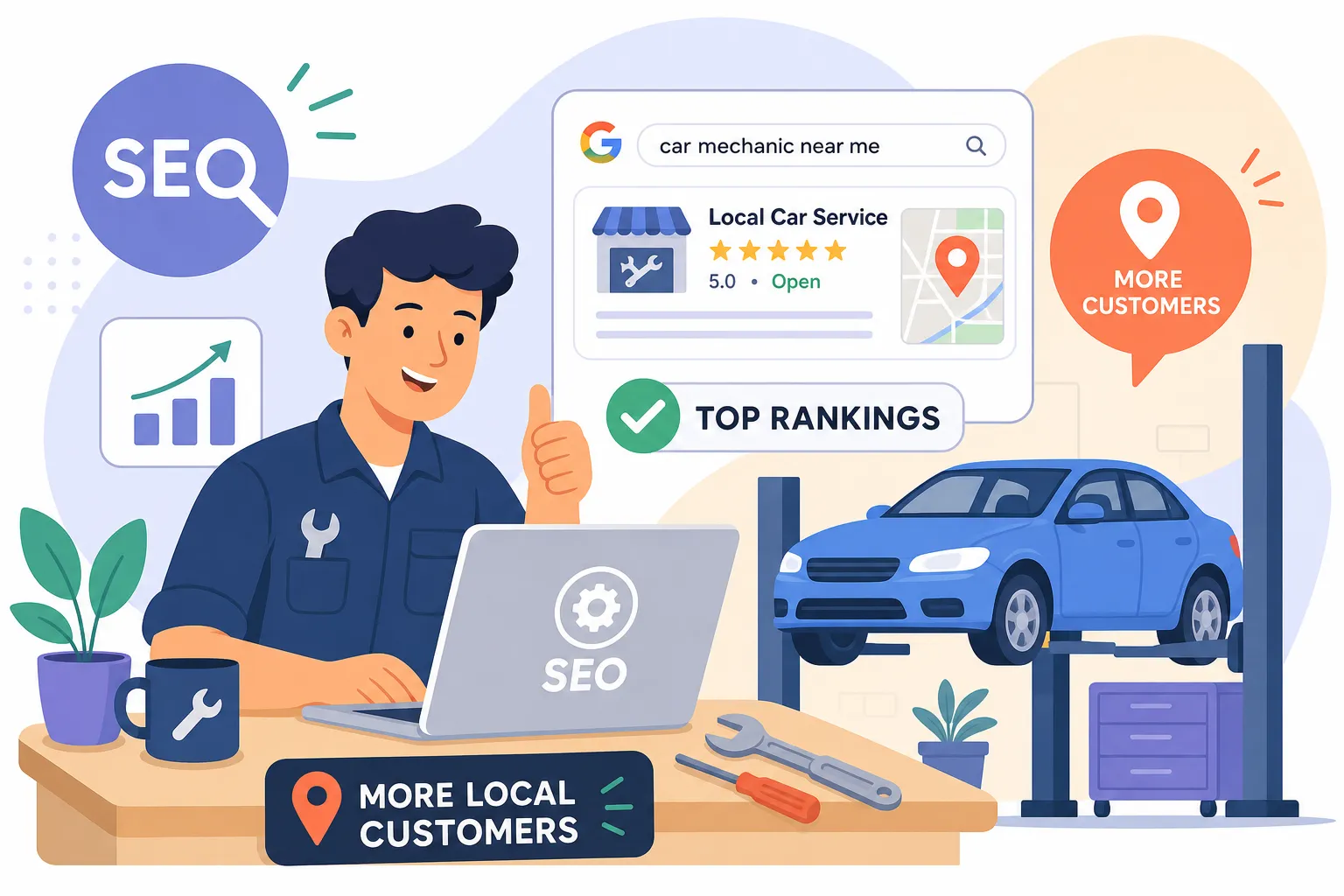
SEO for car mechanics is the local-first strategy that determines whether your shop shows up when a driver nearby types “mechanic near me”, or whether a competitor gets that call instead. “Mechanic near me” pulls over 1.2 million searches every month, yet a large share of those clicks flow to the handful of shops sitting at the top of Google’s local pack. The shops holding those positions haven’t necessarily been in business longer or invested more in equipment. They’ve simply made their online presence a priority and executed the right tactics consistently.
The core strategy isn’t complicated. It comes down to five high-impact actions, Google Business Profile optimization, dedicated service pages, citation building, review generation, and mobile performance, applied in the right order and maintained over time. This guide walks you through each one, with the practical detail you need to start this week.
This complete local SEO framework for auto repair shops covers keyword targeting, Google Business Profile setup, service page structure, citation building, review generation, mobile performance, and KPI tracking. By the end, you’ll have a prioritized action plan ready to execute.
Finding the right keywords for your auto repair shop
A common mistake mechanics make is targeting how they describe their services rather than how customers search for them. You might call it “wheel alignment,” but your next customer is typing “car pulling to one side near me.” That gap between industry language and search behavior costs shops real traffic every month.
Broad, location-anchored phrases dominate search volume and belong on your homepage. “Mechanic near me” pulls 1.22 million monthly searches nationally. “Auto repair near me” drives between 340,000 and 673,000. These terms capture the widest audience and should anchor your homepage title tag, H1, and meta description.
Service-specific terms carry lower volume but higher purchase intent, and that distinction matters enormously for auto repair SEO. “Brake repair near me” gets roughly 12,400 searches per month. “Oil change near me” ranges from 22,000 to 110,000 depending on seasonality. A person searching for “brake repair near me” has already decided they need that specific service, and they need it soon. These high-intent queries belong on dedicated service pages, not the homepage, where they can target their own keyword cluster and convert at a higher rate.
City-modifier keywords like “auto repair Miami” show modest national search volumes, around 4,400 for that example, but they convert at higher rates because the searcher’s intent is hyper-local. Shops in larger metros should consider building neighborhood-level pages if they serve multiple zones within the city. A page targeting “mechanic in Midtown Atlanta” will outperform a generic citywide page for searchers in that specific area.
SEO for Car Mechanics: Setting Up Your Google Business Profile the Right Way
Your Google Business Profile is the single most important local SEO asset you control, and most shops leave significant ranking potential on the table by treating it as a one-time setup task. The fields you choose, the content you write, and the consistency of your information all feed directly into where you appear in the local pack.
Primary category and business description
Start with the fields most shops leave incomplete or get wrong. Your primary category must be “Auto Repair Shop”, not “Mechanic” or “Car Repair.” Those distinctions affect the algorithm. Add up to nine secondary categories that reflect services you actually offer: Brake Shop, Transmission Shop, Oil Change Service, and so on. Write a full 750-character business description that opens with a localized keyword phrase, covers your vehicle specialties, and lists your core services. Every field you leave blank is a signal you’re not sending.
Services section and NAP consistency
Fill out the Services section completely, with a short description for each repair type you perform. NAP consistency is non-negotiable. Your business name, address, and phone number on your GBP must match your website exactly, including formatting. If your website lists “St.” and your GBP says “Street,” that inconsistency creates confusion for Google and can suppress your local rankings.
Photos, posts, and messaging
GBP rewards active profiles with better placement. Upload new photos weekly: exterior shots, interior images, and team working on vehicles. Post two to three times per week using updates, offers, or job photos as trust signals. Activate Google Messaging and commit to responding within an hour, enabling this feature can give you a visibility edge in markets where many competitors haven’t turned it on. Add a booking button to reduce the friction between a searcher and an actual appointment.
Building service pages that rank and convert
The single most common website mistake in auto repair SEO is piling all services onto one page. Google rewards specificity. A dedicated brake repair page, a separate oil change page, a transmission service page, each one targets its own keyword cluster, carries its own schema markup, and sends clearer topical signals to the algorithm. One service, one page is the rule.
Each service page needs a clear structure to rank and convert. Lead with an H1 that includes the target service and your city name. Write 300 to 500 words that answer the questions customers actually ask: what does this service cost, how long does it take, what’s included, and when do they need it. Put a clear call to action, a phone number or booking link, above the fold so a mobile user doesn’t have to scroll to reach you.
Make-specific pages consistently outperform generic ones. A page targeting “Toyota repair shop in [city]” converts at 16 to 22 percent compared to 4 to 6 percent for a generic “auto repair” page. That’s a four to five times improvement in conversion rate for the same traffic. If you specialize in certain makes, build those pages.
Schema markup is what translates your page content into structured data Google can read directly. Use AutoRepair schema on your homepage to establish business identity, hours in 24-hour format, NAP, and geo-coordinates. On each service page, use a unique Service schema block with the serviceType, provider, areaServed, priceRange, and aggregateRating fields. Most WordPress sites can generate this automatically with an SEO plugin. The critical rules: hours in 24-hour format, exact match with your GBP data, and one unique Service block per page.
Citations and reviews for mechanics: the trust signals Google checks first
Citations are mentions of your business name, address, and phone number across the web. The more consistent and widespread they are, the more confident Google becomes that your business is legitimate and located where it claims to be. Start with Tier 1 directories: Google Business Profile, Yelp, Bing Places, Apple Maps, and the Better Business Bureau. These are the foundation, claim them, verify them, and keep them accurate.
After the Tier 1 foundations, prioritize niche automotive directories. RepairPal and AutoMD carry the highest category relevance for auto repair businesses and send qualified traffic. CarGurus Service Center and Mechanic Advisor are worth adding as secondary targets. Inconsistent NAP data across any of these listings confuses Google and suppresses your ranking, so audit your existing citations before building new ones.
Reviews drive clicks and rankings in ways that most shop owners underestimate. Shops with 4.7-star ratings or higher receive six to eight times the click-through rate of shops rated 4.2 stars. In mid-sized cities, you generally need 40 to 80 reviews at 4.5 stars or better to appear consistently in the local pack. In large metros, that threshold climbs to 100 or more. Build a review workflow that runs automatically: send a review request text or email within 24 hours of a completed job, use a direct link to your GBP review page, and respond to every review within 48 hours.
Negative reviews handled well actually build trust. Acknowledge the issue publicly without admitting fault, offer to resolve it offline, and keep your tone calm and professional. A shop with 200 reviews and one thoughtful response to a complaint looks far more credible than a shop with 12 perfect reviews and no engagement.
Mobile-first website basics and the KPIs worth tracking
Over 68 percent of auto repair searches happen on a smartphone, and that number climbs to 80 percent for emergency searches like breakdowns and warning lights. A website that loads slowly or requires pinching to navigate loses those customers before they ever see your phone number. Aim for a page load time of three seconds or less on mobile, a commonly cited benchmark for acceptable user experience. A click-to-call number must appear above the fold on every single page. Your contact form has to work without zooming.
Google’s Core Web Vitals now directly influence local search rankings, so site speed isn’t a nice-to-have. It’s a ranking factor. Run your site through Google’s PageSpeed Insights tool and address any issues flagged under the mobile tab first. A fast, clean mobile experience is one of the highest-ROI website improvements a shop can make.
Tracking results doesn’t require an analytics certification. Monitor five numbers every month: Google Business Profile views and calls from GBP Insights, organic traffic to service pages from Google Search Console, average position for your target keywords, and your total review count plus star rating trend. These data points tell you whether your local SEO program is working and where to focus next.
DIY or hire help: where your time is best spent
Be realistic about what a shop owner can handle independently. GBP setup and full optimization, basic citation building across Tier 1 directories, and a review request workflow are all manageable for most owners, the upfront work typically runs a few hours, with lighter ongoing maintenance each week. These actions deliver the highest return per hour when done consistently, and they cost nothing beyond your time.
Service page creation with proper schema, technical website audits, citation cleanup across dozens of directories, and an ongoing content strategy are a different matter. These tasks get complex quickly, require specific technical knowledge, and compound in value over time. This is where working with a local SEO specialist starts to make clear financial sense. Freelancer rates for local SEO for mechanics typically run between $500 and $1,500 per month, while full-service agencies often start higher. Either way, once organic rankings are established, the ongoing cost per lead tends to drop well below what paid search requires to maintain the same visibility.
Brandleap Agency works with local service businesses, including auto repair shops, to build competitive local SEO strategies without the overhead of a large traditional agency. For mechanics who want to grow their local presence while staying focused on running their shop, a dedicated SEO partner removes the guesswork and accelerates the path to results. The shops at the top of the local pack got there because they started earlier and stayed consistent. The mechanic who builds this foundation now has a meaningful competitive advantage over many competitors who delay optimization.
Your next steps
The prioritized action plan for shop SEO for car mechanics comes down to five things:
- Claim and fully optimize your Google Business Profile, complete every field, add photos weekly, and activate Google Messaging.
- Build dedicated service pages with proper schema markup, one page per service, structured to rank and convert.
- Get listed on the right directories with consistent NAP, start with Tier 1, then add automotive-specific directories.
- Set up a review request workflow that triggers automatically after every completed job.
- Make sure your site loads fast on mobile, run PageSpeed Insights and fix what it flags.
None of these require a large marketing budget. All of them compound over time.
Local SEO for auto repair shops is a long game. The shops that build this foundation now will hold their local pack positions for years, while competitors who rely on word-of-mouth alone may see fewer search-driven calls over time relative to shops investing in local SEO. The investment in visibility pays dividends on every single customer search your market generates.
Start implementing these SEO for car mechanics steps today to capture more local customers. If you’d rather have an expert handle the technical side while you focus on the work in the bay, Brandleap Agency offers local SEO services built specifically for small businesses that need real results at a realistic price point. Start with what you can control today, and build from there.