If you’re hiring an auto part SEO company, the first thing to understand is that auto parts SEO is not just eCommerce SEO with a different logo on the report. The product catalog is massive, the technical complexity is intense, and the buyer’s search behavior is highly specific: people search by year, make, model, part number, and OEM crossover, not by a generic product name. A good auto parts SEO agency understands this distinction from day one and builds strategy around it, not around a recycled checklist from their last retail client.
Agencies that genuinely adapt to niche industry demands treat auto parts very differently than they’d treat, say, a clothing store. The fitment data, the catalog architecture, and the local buyer intent all demand a different playbook. At Brandleap Agency, our stated philosophy is exactly that: strategy built around the specific mechanics of each client’s sector, not pasted in from a template. Here’s what that playbook should actually include, and how to tell whether the agency you’re evaluating knows it cold.
Why most SEO agencies are the wrong fit for an auto parts business
Most general-purpose SEO agencies rely on the same core framework regardless of industry: keyword research, on-page optimization, link building, monthly reporting. That framework works reasonably well for service businesses and simple product stores. Auto parts businesses break it almost immediately.
The fitment complexity problem
A single SKU in an auto parts catalog can fit hundreds of vehicle configurations, spanning multiple years, trim levels, and engine types. Each combination can generate a unique URL, creating thousands of near-duplicate pages that confuse search engines and split ranking authority. Many generalist agencies struggle to recognize this problem, let alone resolve it. When a catalog has 750,000-plus SKUs, this isn’t a minor issue, it’s a structural crisis that undermines everything else the agency touches.
Where niche expertise starts to matter
An automotive SEO company with real experience in the space will know the difference between OEM replacement parts SEO and aftermarket parts SEO, how to handle YMM-filtered URLs, and why vehicle fitment data is the single largest ranking and conversion lever for parts eCommerce. Without that foundation, everything else they do is built on the wrong assumptions. You end up paying for work that actively competes against itself in search results.
How an auto part SEO company handles local inventory SEO
If your business sells parts locally through a storefront or a will-call counter, local SEO is not optional. A significant share of auto parts buyers are searching for same-day availability, not just the cheapest online price. Your SEO company should actively work to capture that local demand through both your Google Business Profile and location-specific landing pages.
What a well-optimized Google Business Profile does for a parts business
Your GBP should reflect accurate inventory categories, hours, and service attributes like “in-store pickup” or “wholesale availability,” alongside consistent NAP data across every directory listing. Reviews that mention specific parts or vehicle types may influence click-through rates and local perceived relevance in ways that generic reviews don’t, Google’s own GBP best-practices guidance encourages businesses to respond to reviews with relevant, specific language. Responding to every review within 24 hours, using your shop name and a relevant parts keyword in the reply, is a measurable local ranking signal.
For categories, select “Auto Parts Store” as your primary, then add secondary categories that reflect what you actually offer, whether that’s oil change service, tire shop, or auto repair. Each additional category expands your eligibility in local search results. Your business description should mention specific brands, part types, and your location within the 750-character limit.
For multi-location auto parts retailers, each store needs its own optimized landing page, not a duplicate template with the city name swapped in. These pages should reference local fitment demand, specifically, the vehicle models most popular in that market, carry structured data, and connect to the GBP for that specific location. This is where auto parts digital marketing gets granular. Many agencies omit this level of local research because it requires genuine analysis of local vehicle ownership patterns rather than a copy-paste workflow. If you want to see how showroom and location-focused SEO differs in practice, review our approach to Car Dealer SEO Services: Drive More Showroom Leads, 2026 for comparable local strategy principles.
What your product pages need to actually rank
This is where parts catalog SEO diverges furthest from standard eCommerce SEO. Product pages for parts have to do something most product pages don’t: prove to both the search engine and the buyer that this exact part fits their specific vehicle before they click. A page that fails that test loses the buyer immediately, regardless of where it ranks.
Fitment-aware content, schema markup, and vehicle landing pages
Your SEO company should implement JSON-LD Product schema that includes isAccessoryOrSparePartFor and Vehicle structured data, connecting the part to the specific year, make, model, trim, and engine. (See automotive schema markup best practices for examples of how to structure product and vehicle data.) Beyond schema, vehicle-fitment SEO techniques like building dedicated landing pages around queries such as “2018 Ford F-150 brake pads” represent one of the highest-converting content strategies in the parts catalog space. Case studies from established auto parts eCommerce sites show substantial click increases after launching well-built vehicle landing pages. These pages work because they match the exact search intent of a buyer who already knows their vehicle and needs fitment confirmation before purchasing.
OEM crossover numbers and part-number discoverability
Buyers searching for OEM numbers, SKUs, and interchange part numbers are high-intent, they already know exactly what they need. Your product titles, metadata, and structured data should surface those numbers explicitly so the page appears when that search happens, not a competitor’s page. This is a fundamental requirement for both aftermarket parts SEO and OEM parts SEO services. An agency that hasn’t asked about your crossover number data early in the engagement isn’t operating at the right level for this industry.
The technical SEO foundation many agencies overlook
Even if product pages are well-written and schema is in place, a poorly structured parts catalog will undermine everything. Technical SEO for eCommerce auto-parts SEO has a short list of non-negotiable requirements that a competent agency should address within the first few months. These aren’t optional refinements, they’re the structural work that determines whether everything else performs.
Solving faceted navigation and URL sprawl
Faceted navigation SEO filters for year, make, model, and price range generate enormous volumes of thin, duplicate URLs. An SEO company working on your catalog should implement fitment-aware canonical tags that consolidate these variants to the primary model or category page, preventing ranking dilution and crawl budget waste. For filters that carry no unique search value, such as sort order or pagination, the solution is either JavaScript-based filtering that doesn’t generate new URLs or a noindex directive. For high-value combinations like a specific make and model with strong search volume, the right answer is a unique, optimized landing page, not blocking.
Canonicalization, pagination, and Core Web Vitals for mobile shoppers
Pagination pages are often indexed as unique content when the top-of-page elements repeat across them. Proper canonicalization points paginated results back to the first page unless the content is meaningfully distinct. Auto parts shoppers frequently browse on mobile, often from garages or parking lots, so Core Web Vitals need to perform on mobile, not just desktop. Specifically, LCP should hit 2.5 seconds or under, INP should stay at 200 milliseconds or less, and CLS should be 0.1 or lower. Image-heavy product detail pages are a consistent bottleneck on mobile. Sites that pass Core Web Vitals benchmarks see up to 29% increases in organic traffic compared to sites that fail them. That’s not a minor optimization. That’s the foundation your entire catalog ranking sits on. Recent analyses show many large auto groups still struggling to meet these mobile metrics in 2025, something to watch for in vendor audits (Core Web Vitals research).
Realistic results and what you should expect to pay
Before you sign a contract, you need a clear picture of both the investment range and what measurable outcomes look like. Legitimate case studies in the auto parts eCommerce space show a wide but consistent range of results from well-executed campaigns.
What good auto parts SEO actually delivers
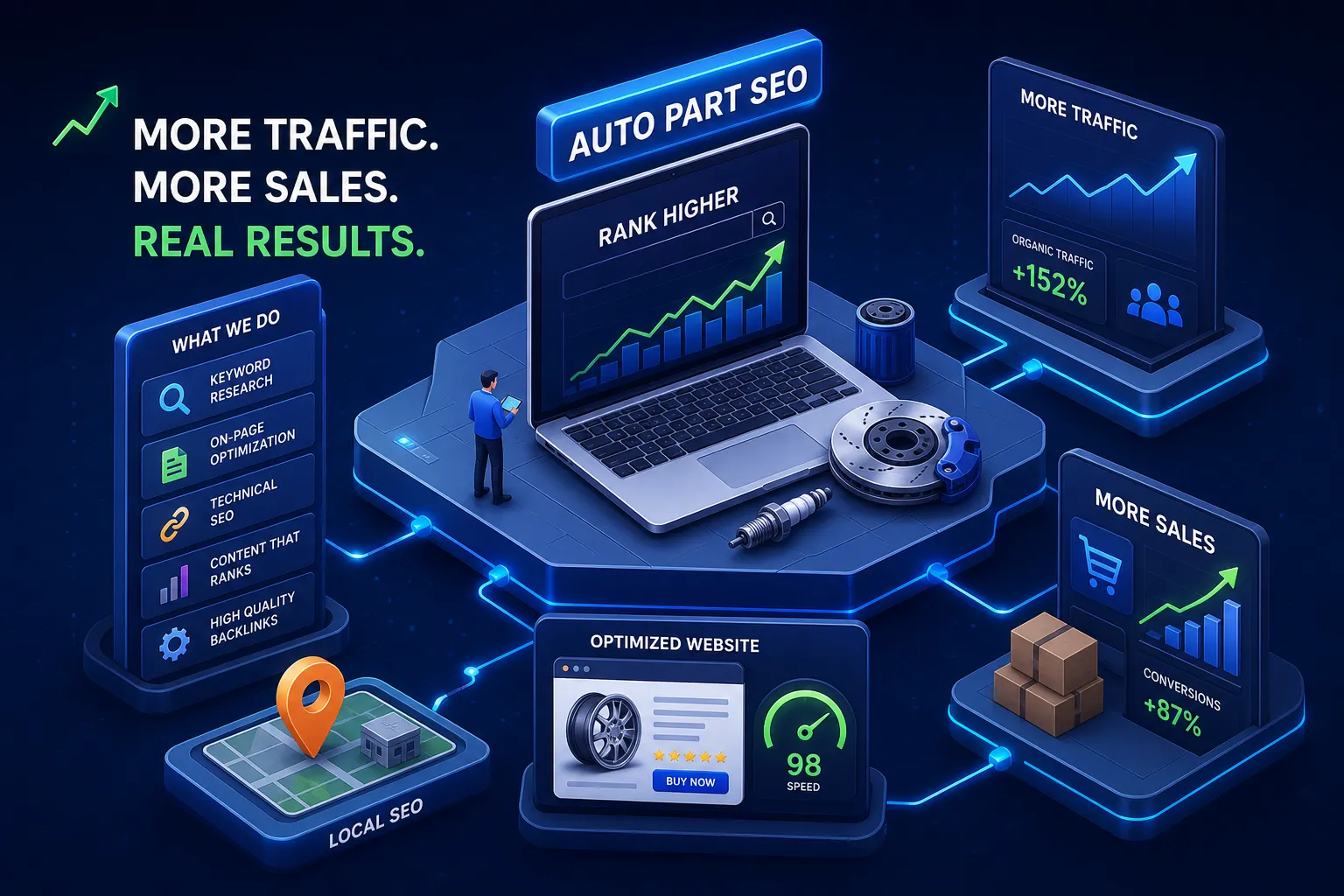
Documented results from real auto parts clients, including campaigns detailed by Full Throttle SEO case studies, include 29% to 134% increases in organic revenue year-over-year, 150% to 530% increases in organic traffic, and conversion rate improvements in the 5, 9% range after sustained campaigns. One major auto parts eCommerce brand saw a 134% organic revenue increase even as total top-10 keyword placements decreased, because the remaining rankings were optimized for purchase intent rather than broad visibility. These results typically take 4, 6 months to show meaningful traffic movement and 8, 12 months to reflect clearly in revenue.
What the investment range looks like, and the red flags to watch
For a single-location auto parts retailer or mid-size parts eCommerce site, monthly retainers in 2026 run from $1,000 to $7,000, depending on catalog size and competition. Large multi-rooftop operations should expect $8,000 to $15,000 per month. Any agency quoting under $750 per month for ongoing parts SEO is likely automated, offshored, or operating without meaningful oversight. That’s not a risk worth taking with a catalog as technically complex as auto parts. Multi-location businesses can sometimes negotiate lower per-store rates when content infrastructure is shared across locations, but per-store minimums should still reflect genuine work, not templated reports.
Questions that separate serious auto part SEO companies from pretenders
When you’re evaluating proposals, the agency’s answers to a few targeted questions will reveal quickly how well they actually understand the automotive space. Generic answers to specific technical questions are a definitive red flag.
What to ask during the RFP stage
These five questions require real hands-on experience to answer with confidence, they’re not answerable through generalist SEO knowledge, and they’ll separate genuine automotive SEO specialists from agencies that treat your catalog like any other product feed:
- How do you handle YMM faceted navigation from an SEO standpoint?
- What schema types do you implement for vehicle fitment?
- Do you build vehicle landing pages as part of the strategy, or only optimize existing pages?
- Have you worked with ACES or PIES data standards?
- Can you walk me through a parts catalog audit you’ve done for a previous client?
Green flags, red flags, and what a confident agency should already know
A strong auto part SEO company answers these questions without hesitation. They reference fitment data, canonicalization strategy, and intent-based content in the same breath. They ask about your ACES feed before they ask about your target keywords. A weak agency gives generic answers about “on-page optimization” and “content marketing” without connecting those concepts to your catalog’s specific architecture. That gap is the difference between an agency that grows your organic revenue and one that spends your budget learning on the job. Ask for schema examples and vehicle landing page case studies, not just a pitch deck with traffic screenshots.
What to do next
Finding the right auto parts SEO agency is not about finding the one with the most polished presentation. It’s about finding one that already understands why your product catalog is technically unique, what local inventory SEO requires for your specific market, and how to build product pages that convert part-number searches into transactions.
Use the questions in this article as your filter. Require schema examples, ask for vehicle landing page case studies, and push for specifics on how they handle faceted navigation. If an auto part SEO company can’t answer those questions with confidence and specifics, they’re not the right fit for an auto parts business, regardless of how impressive their general case studies look.
If you’re still evaluating your options, look for an SEO consultancy built around adapting strategy to industry-specific needs rather than applying a universal template. That’s the approach Brandleap Agency takes across every client engagement, starting with your catalog architecture, your local market, and your buyer’s actual search behavior. Review our broader methodology in Find Your Ideal Top B2B SEO Agency for 2026 Growth, 2026, or contact us to discuss a tailored plan rooted in parts catalog realities. For work that focuses on dealership-level inventory and multi-location optimization, see our Auto Dealer SEO Services, Brandleap Agency.