Volusion checks the boxes on paper: search-friendly URLs, canonical tags, an auto-generated sitemap. But “checks the boxes” and “competes effectively in organic search” are two very different things. If you’re running a Volusion store and organic traffic has plateaued, the platform’s architecture is often a significant contributing factor, though keyword strategy and content gaps can compound the problem. If you’re evaluating a Volusion SEO company to help you break through that ceiling, what you need first is an honest picture of what you’re actually hiring them to solve.
This article gives you that picture. We’ll walk through what Volusion provides natively, the technical limitations baked into its architecture, the Volusion technical SEO fixes that genuinely move rankings, and a sharp vetting framework for separating real Volusion specialists from generic e-commerce agencies. Consultancies that focus on platform-specific SEO, like Brandleap Agency, build entire frameworks around exactly this kind of platform-gap problem, and the difference in outcomes between a platform-aware approach and a generic one tends to be substantial.
What Volusion gives you for SEO natively (and what’s missing)
Volusion’s built-in SEO tools are functional, but they require deliberate configuration. Leaving the default settings untouched is one of the most common and costly mistakes Volusion store owners make. Understanding what’s available and how to use it correctly is the first step toward building a search-visible store.
The built-in tools worth configuring
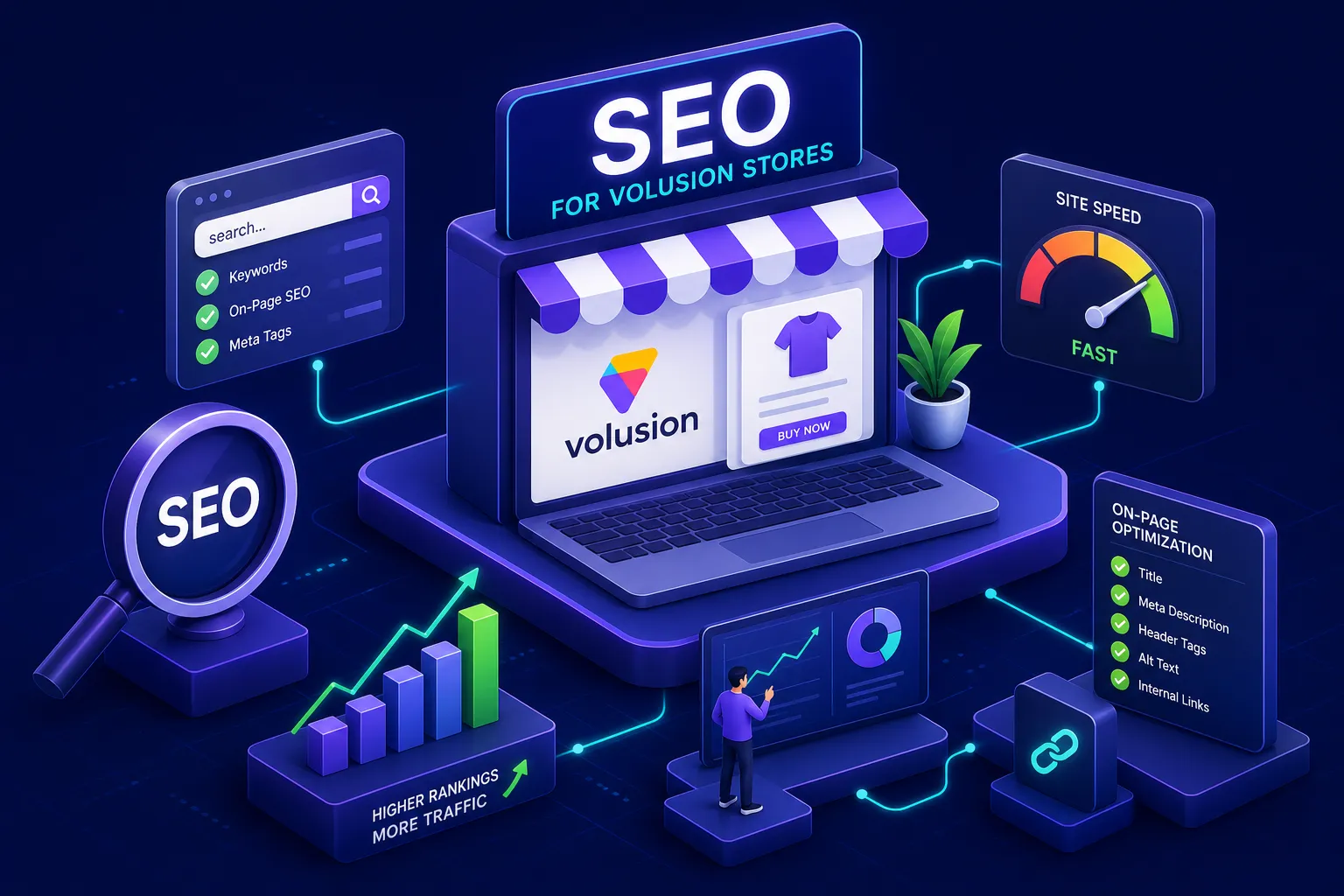
Volusion provides four core SEO features inside the Marketing > SEO admin section: Search Engine Friendly URLs, canonical link configuration, an automatically generated XML sitemap updated once daily, and a Default Values feature for auto-generating meta tags across pages with blank fields. Each matters for different reasons. Clean URLs improve both crawlability and click-through rates by surfacing keywords directly in the SERP snippet and making URLs easier for both crawlers and users to parse. Canonical tags tell Google which version of a URL to treat as authoritative, preventing duplicate content from diluting ranking signals. The Default Values feature is particularly useful for stores with large catalogs where manually writing meta tags for every product isn’t practical.
The challenge isn’t that these tools don’t exist, it’s that many store owners never enable them. Search Engine Friendly URLs and Enable Canonical Links both require manual activation in the Volusion backend, and neither appears to be turned on by default in standard installations. Any competent agency should address these in the first week of an engagement.
The structured data gap that limits rich results
This is where Volusion falls measurably behind competing platforms. Shopify and Magento both ship with native JSON-LD schema markup for Product, Breadcrumb, and Organization types, as documented in their respective developer references. Product pages on those platforms can earn star ratings, price snippets, and availability callouts directly in Google’s search results without any custom development. Volusion’s core feature documentation does not include native JSON-LD support.
The practical consequence is straightforward: your Volusion product pages are competing against Shopify stores that display rich results, and your listings look comparatively bare. Volusion also updates its XML sitemap once daily, while Shopify and BigCommerce offer dynamic, near-real-time sitemap updates. For stores that add or update products frequently, that 24-hour delay slows Google’s discovery of new content. These aren’t catastrophic problems individually, but together they represent structural disadvantages that require deliberate Volusion technical SEO fixes rather than standard optimization tactics.
The technical limitations that hold Volusion stores back
Understanding the platform’s native features is one thing. Understanding the problems baked into its architecture is another. The technical limitations below aren’t the result of misconfiguration, they’re inherent to how Volusion was built, and resolving them requires a specialist who knows where to look.
How a Volusion SEO company handles duplicate content and canonical URL problems
Volusion’s overlapping product and category URL structures create duplicate content risks that canonical tags alone don’t fully solve. Sub-category filter parameters generate URL variations that Googlebot treats as separate pages, diluting crawl equity and splitting ranking signals across multiple versions of the same content. Even with the canonical variable enabled in the Marketing > SEO admin, filter-based duplication typically requires additional robots.txt management and a deliberate 301 redirect strategy to consolidate properly.
This is a platform-level issue, not a store-owner error. A thorough duplicate content audit should be one of the first deliverables from any Volusion SEO engagement, because you can’t Achieve Better Rankings on a foundation where Google is uncertain about which pages you actually want indexed.
Page speed, code bloat, and Core Web Vitals
Volusion is frequently reported to produce heavier page loads than modern platforms, largely due to an absence of native image compression tools and accumulated code bloat. Merchants must manually optimize every asset. JavaScript-heavy Volusion stores frequently struggle with INP (Interaction to Next Paint) scores, the metric that replaced FID as a Core Web Vital. The industry benchmark is 200ms or under for an acceptable INP score, and reaching that on a Volusion store requires deliberate script minimization and fetchpriority attribute management on critical page elements.
For context, only about 62% of mobile pages across the web achieve the “good” threshold for LCP (Largest Contentful Paint) of 2.5 seconds or under. Without proactive speed optimization, Volusion stores are at risk of missing that mobile LCP benchmark. Core Web Vitals scores directly influence Google’s assessment of page experience, which feeds into rankings for competitive commercial queries.
JavaScript rendering and crawl blind spots
When key product content, prices, descriptions, and reviews, loads via client-side JavaScript, Googlebot may crawl an incomplete version of the page. What you see as a user in the browser isn’t necessarily what Google’s crawler sees on its first pass. This matters enormously for Volusion product page SEO, because if your descriptions and pricing aren’t in the initial HTML response, they may not be indexed at all.
Identifying which elements render after the initial crawl requires a structured crawl analysis using tools like Screaming Frog or a comparable crawler configured to differentiate between rendered and non-rendered content. Visual inspection of your store in a browser tells you nothing about this problem. It’s one of the more technically involved diagnoses in Volusion optimization, and one of the most consequential.
Volusion SEO services: optimization tactics with documented impact
Some of these fixes are fast admin-level changes. Others require outside expertise and custom implementation. Knowing the difference helps you evaluate what an agency is actually proposing to do for your budget.
Admin-level fixes to prioritize first
Start inside the Volusion backend. Enable Canonical Links and Search Engine Friendly URLs in Marketing > SEO. Submit your auto-generated sitemap.xml directly to Google Search Console and monitor for crawl errors. Use the 301 Redirect tool under Maintenance settings to consolidate broken link traffic. Set Default Values for meta tags so that pages with blank fields don’t get indexed with empty or duplicate title tags.
These are fast, high-impact changes. None of them require development work, custom scripts, or third-party tools. They’re typically quick to implement and can often be completed early in an engagement. If an agency doesn’t mention these specific admin configurations in their proposal, that’s a signal worth paying attention to.
Where specialist expertise fills the platform’s gaps
Beyond admin settings, the real optimization work lives in territory Volusion doesn’t natively support. Manual schema injection via the product page SEO tab or external scripts is required to earn rich results in Google. GA4 ecommerce tracking requires custom configuration in Volusion’s HTML files because standard analytics setup doesn’t capture the ecommerce events you need for conversion reporting. Structured content architecture, mapping topic clusters to buyer intent stages, is the difference between ranking for transactional queries and only appearing for informational ones.
This is the work that separates a Volusion specialist from a generalist agency. Brandleap Agency’s semantic SEO framework was built around exactly this type of problem: where the platform imposes constraints and the optimization strategy needs to work around those constraints intelligently, rather than retrofitting a one-size-fits-all approach. Schema injection, crawl gap remediation, and semantic content architecture are not plug-and-play fixes on Volusion. They require someone who has actually worked inside the platform’s structure.
How to vet a Volusion SEO company before you hire
The most important distinction to make when evaluating agencies is between genuine Volusion expertise and generic e-commerce SEO experience. A firm that does excellent work on Shopify isn’t automatically qualified for Volusion. The platforms have different admin structures, different technical constraints, and different optimization pathways. The questions below will expose the difference quickly.
Questions that expose real platform knowledge
Ask the agency to walk you through the exact steps to enable Canonical Links in the Volusion backend. A real Volusion specialist will immediately reference Marketing > SEO and explain the four configuration variables available in that section. Ask how they install GA4 ecommerce tracking on a Volusion store, specifically which HTML file they modify and why. One that has worked inside Volusion answers these without hesitation or vague language. One that hasn’t will default to general SEO theory.
Also ask how they handle duplicate content generated by sub-category filter parameters using Volusion’s canonical settings alongside robots.txt configuration. Then add one more: ask how they approach INP optimization on a JavaScript-heavy Volusion store. The correct answer involves diagnosing rendering issues, minimizing scripts, and managing fetchpriority attributes to achieve sub-200ms responsiveness. If they’re unfamiliar with INP as a Core Web Vital, Google replaced FID with INP as of March 2024, or can’t articulate the practical difference between the two metrics, they are not a 2026-ready SEO partner for any platform.
Red flags that signal a generic agency
Watch for agencies that pitch Volusion SEO using Shopify-centric language: references to Liquid templates, Shopify app integrations, or their Shopify-specific case studies as proof of e-commerce SEO capability. These are different platforms with fundamentally different underlying architecture. Be skeptical of proposals that don’t mention schema markup, Core Web Vitals diagnostics, or GA4 ecommerce event configuration as specific deliverables.
Also watch for agencies that can’t articulate a strategy for bot governance in robots.txt, specifically how to allow beneficial AI search crawlers while blocking non-beneficial scrapers. This is a 2026 SEO competency that affects search visibility across AI-powered result features. Generic agencies recycle the same proposal template regardless of platform. You’ll recognize it by its vagueness on platform-specific configuration and its heavy reliance on deliverables like “keyword research” and “content optimization” without specifics on how those work inside Volusion’s architecture.
What to expect from pricing, timelines, and results
Before you sign a contract, you need realistic expectations on what Volusion SEO costs and what it delivers. The benchmarks below are intentionally grounded in what available data and practitioner experience actually support.
Pricing benchmarks and what they cover
Monthly retainers for Volusion SEO generally fall into two tiers. Entry-level retainers run $1,500 to $2,500 per month and typically cover keyword research, on-page optimization for a rotating set of pages, and basic reporting. These are appropriate for small catalogs with limited competition. Comprehensive retainers run $2,500 to $5,000 per month and add technical SEO work, content strategy, link building, and GA4 conversion tracking. For highly competitive verticals or large catalogs with national targeting, expect $5,000 to $10,000 or more per month.
One-time technical audits, covering crawl analysis, Core Web Vitals diagnostics, schema audit, and canonical structure review, typically run between $3,000 and $15,000 depending on catalog size and architectural complexity. If you’re not ready for an ongoing retainer, an audit is a legitimate starting point. It gives you a documented roadmap you can use to evaluate agency proposals or guide internal implementation. For broader context on typical SEO pricing structures and ranges, reputable industry breakdowns can help frame expectations as you compare proposals.
Realistic milestones for organic growth
Technical fixes deliver the fastest returns. Canonical configuration, sitemap submission, and structured data injection often show measurable crawl improvement within 30 to 60 days, visible in Google Search Console’s coverage and indexing reports. Ranking movement on commercial terms is commonly observed in the 90- to 180-day range with consistent execution. Meaningful organic traffic growth is generally a 6- to 12-month horizon. These windows reflect typical industry patterns rather than guaranteed outcomes, your specific catalog size, competition level, and starting technical state will all affect the timeline.
It’s worth being candid about one thing: the most dramatic, publicly documented traffic gains from Volusion stores tend to come from merchants who migrated off the platform entirely. Migration case studies show substantial gains, while public long-term success stories for stores that remained on Volusion are comparatively rare. Claims of specific percentage gains from unnamed sources should be treated with appropriate skepticism until independently verified. A store that stays on Volusion and works with a qualified specialist can achieve meaningful organic growth, but the ceiling is lower than on a platform with native structured data and dynamic sitemaps. That’s a factual limitation of the platform’s architecture, and any agency that tells you otherwise isn’t being straight with you.
The path forward for Volusion store owners
Volusion’s platform limitations are real and well-documented, but they aren’t insurmountable. The admin configurations are accessible, the Volusion technical SEO fixes are executable, and the specialist expertise to bridge the platform’s gaps is available. What determines your outcome is whether the agency you hire actually understands the specific architecture they’re working with, and can prove it.
Use the vetting questions in the section above before you sign anything. Ask explicitly about structured data implementation and Volusion admin experience. Hold the agency accountable to platform-specific deliverables from day one: canonical configuration, sitemap submission, GA4 ecommerce tracking setup, and a duplicate content audit. If they can’t speak to those specifics, they’re billing you for generic work on a platform that needs the opposite. (If you need a concise guide on How to Choose the Right Partner, that resource covers questions you can ask to assess platform expertise.)
If you’re evaluating a Volusion SEO company, ask for a duplicate content audit and a schema implementation roadmap up front, any specialist worth hiring should produce both without hesitation. Brandleap Agency offers Volusion SEO services built around semantic frameworks and platform-specific technical expertise rather than recycled strategy templates. If you’re ready to assess your store’s current technical state and map out a realistic growth roadmap for your catalog, that’s precisely the kind of platform-gap work we’re built to handle. Reach out to get started, or review our SEO Services for Bloggers: What You Actually Need, 2026 for additional insights on content-first frameworks that translate well to e-commerce content strategy.