
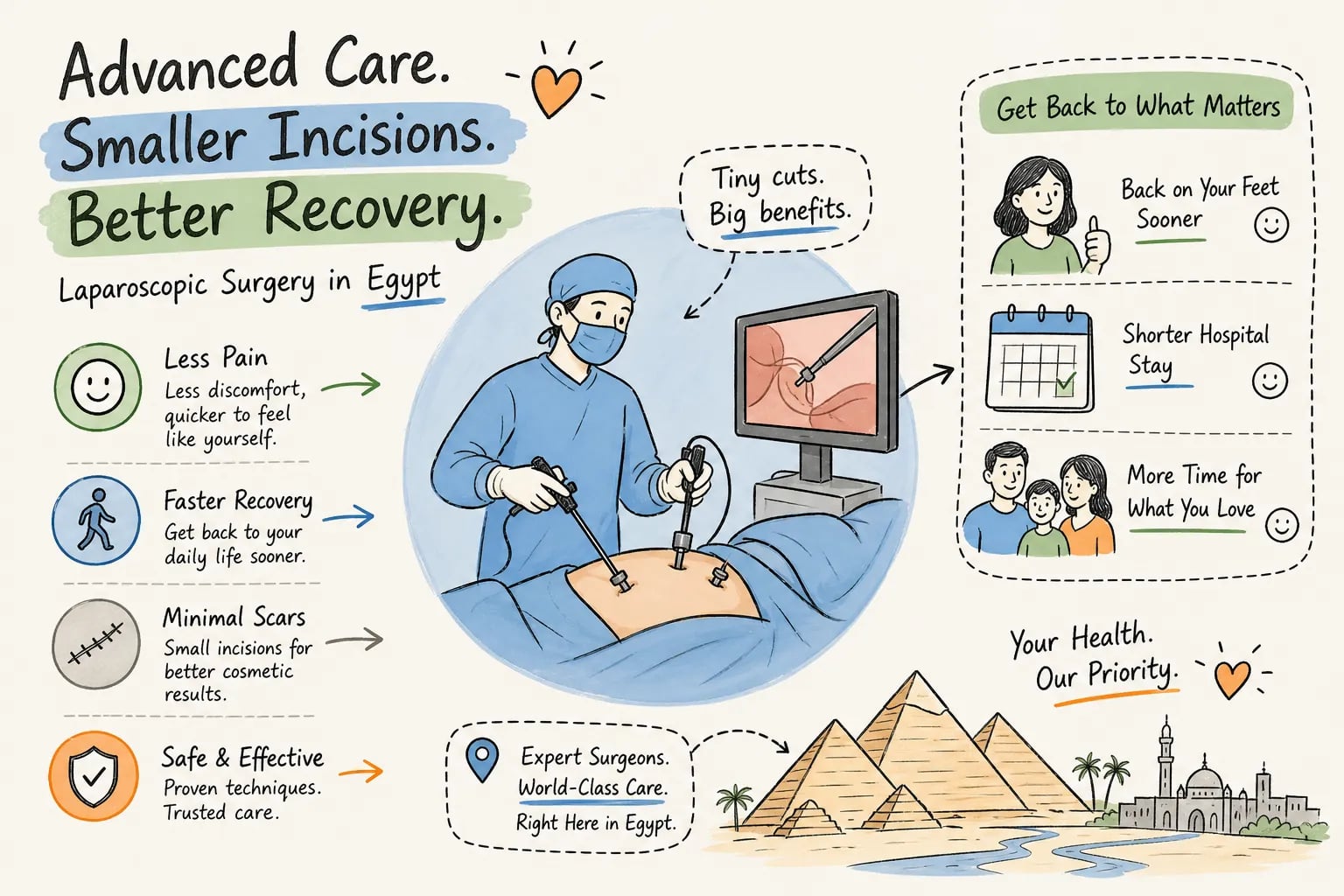
Laparoscopic surgery in Egypt has moved well past the experimental phase. At major hospitals across Cairo, Giza, and Alexandria, keyhole surgery is now the first-choice approach for dozens of common procedures, with patients leaving hospital within 24 to 48 hours, for routine procedures like cholecystectomy, instead of spending a week recovering from a large open incision. Egyptian surgical data supports this shift, and directories from bodies such as MISSEGY and ESLS reflect a growing pool of credentialed minimally invasive surgeons practicing across the country.
This article covers the most common laparoscopic procedures available in Egypt, which hospitals and surgeons have the strongest track records, what these procedures typically cost, and the exact credentials to verify before you commit to any surgeon or clinic, because those details are what separate a confident decision from an expensive guess.
Why laparoscopic surgery is now the preferred approach
Fewer incisions, faster recovery, less pain
The core advantage of minimally invasive surgery over open surgery comes down to access. Instead of one large incision, a laparoscopic procedure uses three to five small ports, each roughly a centimeter wide. That means less tissue damage, significantly less postoperative pain, a lower risk of wound infection, and a much shorter hospital stay. Egyptian surgical series document these advantages concretely: one laparoscopic common bile duct exploration series from Egyptian centers reported a 2.88% conversion-to-open rate, 99.03% stone clearance, and minor complication rates of around 6.73%. Separate Egyptian series examining combined ERCP and laparoscopic cholecystectomy report minor complication rates in the 5 to 6% range and no procedure-related deaths in well-run programs. These figures come from Egyptian hospitals treating Egyptian patients, not from European or American benchmarks transposed onto a different context.
Who makes a good candidate
Most adults with gallbladder disease, hernias, appendicitis, gynecologic conditions like endometriosis or ovarian cysts, or obesity-related comorbidities are well-suited for a laparoscopic approach. Procedure type and patient anatomy still matter: severe adhesions from previous surgeries or unexpected intraoperative findings may require conversion to open surgery, which is exactly why choosing an experienced, high-volume center is not optional. Conversion is a safety measure, not a failure, understanding that before you start comparing hospitals sets the right expectations.
Common laparoscopic procedures available across Egypt
General surgery: gallbladder, appendix, and hernia
Laparoscopic cholecystectomy, removal of the gallbladder, is the most frequently performed laparoscopic procedure at Egyptian hospitals, both private and university-affiliated. Egyptian surgical series place completion rates at 90 to 97%, with bile duct stone clearance approaching 99% in specialized centers (figures consistent with the laparoscopic common bile duct exploration data cited above).
Laparoscopic appendectomy and hernia repair, both inguinal and ventral, are equally well-established across Cairo’s private hospital network and government university hospitals. For patients researching a specific procedure, it is worth confirming directly with each center whether their surgical team handles that exact case type regularly, volume at the procedure level matters more than the hospital’s general laparoscopic reputation.
Bariatric and gynecologic laparoscopy
Several Cairo centers offer laparoscopic bariatric procedures, including sleeve gastrectomy and gastric bypass, with some surgeons holding active IFSO membership. Gynecologic laparoscopy covers endometriosis resection, ovarian cystectomy, myomectomy, and laparoscopic hysterectomy. The breadth of minimally invasive subspecialty expertise available in Egypt means most patients can find the right specialist domestically without traveling abroad.
Oncologic and advanced minimally invasive procedures
Specialized university hospitals and select private centers in Cairo also offer laparoscopic surgical oncology, covering hepatic, colorectal, and upper GI procedures. Many leaders of these programs hold MRCS England, FACS credentials, or doctoral degrees in surgical oncology from Ain Shams or Cairo University, credentials worth confirming with individual surgeons before booking. If your procedure falls into this category, the credential question is not a formality.
Where to have laparoscopic surgery in Egypt: hospitals worth knowing
Cairo and Giza: where the highest concentration of centers is
The Cairo and Giza metro area holds the widest selection of laparoscopic programs in the country. Hospitals with recognized laparoscopic surgery departments include Cleopatra Hospital in Heliopolis, As-Salam International Hospital in Maadi, Dar Al Fouad Hospital in Giza, Andalusia Hospital Al Maadi, Ain Shams University Specialized Hospital, Misr International Hospital, and Saudi German Hospital Cairo. Each covers general laparoscopic surgery, and several have dedicated bariatric and gynecologic laparoscopy units with subspecialists on staff. Contact each hospital’s surgical department directly to confirm current program scope and surgeon availability.
Outside Cairo: options in Alexandria, Hurghada, and Sharm El Sheikh
Strong options exist beyond the capital. In Alexandria, Dr. Hany ELBarBary brings over 30 years of experience in advanced laparoscopic surgery, colorectal procedures, and hernia repair, with an MD from Ain Shams University and a laparoscopy diploma from the University of Strasbourg. On the Red Sea coast, Nile Hospital and Royal Hospital Hurghada both offer general laparoscopic services, and MISR Hospital in Sharm El Sheikh provides similar coverage. These locations are particularly relevant for patients outside Cairo or those planning to recover in a quieter setting after surgery.
What laparoscopic surgery costs in Egypt
Procedure-by-procedure cost breakdown
Pricing for laparoscopic cholecystectomy at Egyptian private hospitals ranges from roughly $788 to $6,000, with several Cairo clinics quoting around 21,000 EGP for standard cases. Laparoscopic appendectomy typically falls between 15,000 and 40,000 EGP depending on urgency and hospital grade. Laparoscopic hernia repair ranges from approximately 15,000 to 50,000 EGP based on hernia type and complexity. For bariatric laparoscopy, the 2026 range at Cairo centers sits at roughly $3,200 to $4,500 for sleeve gastrectomy and $3,500 to $4,500 for gastric bypass, with some all-inclusive packages available from $2,400 upward. These figures reflect quoted prices from clinic directories and published hospital rate cards, actual costs vary by center, anesthesia type, and length of stay. Always request an itemized quote from at least two centers before committing.
Why prices vary and what drives the difference
The gap between a university hospital quote and a high-end private center reflects several factors: anesthesia team structure, the seniority and volume of the surgical team, hospital room grade, and the quality of post-op monitoring. A lower price at a high-volume center with an experienced surgeon can represent significantly better value than a higher price at a facility that performs fewer annual laparoscopic cases. Surgical literature consistently links higher procedural volume to better outcomes, a relationship that applies in Egypt as it does elsewhere. Ask every clinic how many of your specific procedure the surgical team performs each year, not just what their general laparoscopic caseload looks like.
Recovery timeline: what to expect after a laparoscopic procedure
The first week after surgery
Most patients undergoing straightforward procedures like laparoscopic cholecystectomy are discharged within 24 to 48 hours; acute or complex cases may involve a longer stay of three to six days. Shoulder tip pain caused by residual CO2 gas typically lasts one to three days and resolves on its own. Mild incision soreness continues for up to a week, and fatigue is common for the first seven to ten days. Light walking is encouraged from day one. Most surgeons advise avoiding driving for about five to seven days after straightforward laparoscopic procedures, confirm the exact guidance with your surgical team before discharge.
Return-to-work and activity milestones
Desk workers typically return within one to two weeks. Physical labor or jobs requiring heavy lifting take three to six weeks, depending on the procedure and the patient’s baseline health. Bariatric patients follow a separate dietary and activity progression managed by their surgical team, with dietary stages spanning several weeks. Egyptian laparoscopic series report no mortality in well-run programs and minor complication rates of around 5 to 7%, which means a smooth, uneventful recovery is the realistic expectation at experienced centers.
How to verify a laparoscopic surgeon and find the right one in Egypt
Credentials that signal genuine laparoscopic expertise
Before booking any laparoscopic procedure in Egypt, confirm the following from your surgeon directly:
- Board-level surgical training in the relevant specialty: general, bariatric, gynecologic, or oncologic surgery, depending on your procedure
- Laparoscopy-specific credentials such as FLS (Fundamentals of Laparoscopic Surgery), EDGES program certification, MIFLEX advanced fellowship, or a laparoscopy diploma from a recognized institution like the University of Strasbourg
- Active society membership in MISSEGY (Minimally Invasive Surgery Society Egypt), ESLS (Egyptian Society of Laparoscopic Surgery), or IFSO for bariatric surgeons
- Annual procedure volume in your specific operation: ask directly how many cases the surgeon performs each year, not just how many years the surgeon has been in practice
Questions to ask the clinic before you book
Four questions separate well-run laparoscopic programs from under-resourced ones. Convert them into a numbered list and work through them with every clinic you contact:
- What is the surgeon’s conversion-to-open rate for your specific procedure?
- What does the total quoted cost include, and what is billed separately?
- Who manages post-op complications, and does the team have 24-hour coverage?
- Is the hospital accredited for laparoscopic surgery, and does the surgical team meet regularly for case review?
A clinic that answers these questions confidently and specifically has the infrastructure to back it up. One that deflects or gives vague answers is worth walking away from.
How patients find reputable clinics online
Most patients in Egypt begin their search for laparoscopic care on Google, using procedure-specific searches to find nearby centers. The clinics that consistently appear at the top of those results are the ones with detailed, well-structured procedure pages built around exactly what patients are searching for. Clinics without that kind of search presence simply don’t appear when it matters most, and patients end up at less qualified facilities by default.
Healthcare providers looking to close that visibility gap can work with a digital marketing agency experienced in the Egyptian medical sector. Brandleap Agency works with healthcare providers on search presence and content strategy, contact the team directly for details on current services and to discuss whether the approach fits your clinic’s needs.
Making the right choice for your procedure
Laparoscopic surgery in Egypt is genuinely advanced and widely available. The clinical outcomes data from Egyptian hospitals is strong: high completion rates, low complication rates, and short recovery times are the norm at experienced centers. Egypt’s cost profile also compares favorably with many regional alternatives, though formal cost-effectiveness comparisons across countries vary by procedure and source, so it is worth verifying current pricing independently before drawing conclusions.
The key decisions become straightforward once you know what to look for. Prioritize hospitals with active laparoscopic programs and meaningful volume in your specific procedure. Confirm that your surgeon holds procedure-specific credentials and active society memberships. Get a full itemized cost breakdown before signing anything. Whether you’re in Cairo, Alexandria, or on the Red Sea coast, the options are there, use the credential checklist and questions in this article as your starting framework.