
Hiring freelancer SEO services sounds simple until you realize you’re not just picking a price point. You’re choosing between two fundamentally different operating models, each with real advantages and real failure modes. A freelancer gives you direct access to one expert who owns the work completely. An agency gives you a team, a process, and a broader service set, but with more layers between you and the actual work being done. Neither is the default right answer.
What actually matters is your business size, your budget, the scope of work you need, and how much management overhead you’re willing to absorb. Some business owners have built strong organic channels with a well-chosen independent SEO specialist. Others burned their budget hiring cheap contractors who disappeared after onboarding, a pattern that shows up consistently across small business SEO forums and agency intake calls alike. This article breaks down the real differences, lays out 2026 rate benchmarks, and gives you a practical framework to decide. And if both options feel like a compromise, there’s a third model worth knowing about before you sign anything.
What freelancer SEO services actually cost in 2026
Understanding the rate landscape helps you shop smarter and recognize when a quote is suspiciously low or surprisingly reasonable. U.S. freelance SEO rates span a wide range because experience, specialization, and project complexity all push the number in different directions. The figures below are aggregated from multiple 2026 industry pricing surveys and freelance marketplace data, so treat them as benchmarks rather than fixed rules.
Rates by experience level
Entry-level freelancers charge $20 to $60 per hour, with project work ranging from $1,000 to $3,000. At this tier, you’re getting someone who can handle basic on-page edits, simple audits, and support tasks on smaller sites. They’re not the right fit for a competitive national campaign, but they can execute well-defined tasks competently if you’re supervising the strategy yourself.
Mid-level freelancers run $60 to $125 per hour, with project ranges of $3,000 to $10,000. This is the most practical range for growing businesses that need ongoing optimization and content support. Senior and specialist consultants start at $125 per hour and can exceed $300 per hour for complex technical engagements, migrations, or recovery work. At that tier, you’re paying for judgment and depth, not just execution.
How freelancer SEO services are priced by service type
The type of work drives the rate as much as experience level does. Technical SEO commands the highest rates, $150 to $300 per hour, because diagnosing crawl architecture issues, Core Web Vitals problems, or indexation failures requires a different skill set than writing optimized blog posts. Content strategy runs $125 to $250 per hour, local SEO falls in the $100 to $175 range, and general SEO work sits at $75 to $150 per hour.
If you’re in a competitive niche where technical crawl health or site architecture is the actual bottleneck, the premium for a technical specialist is usually worth it. Paying $75 per hour for someone who can’t read a log file when that’s exactly the problem you’re solving is a false economy.
Hourly vs. project-based pricing: what works for which situation
Project pricing protects you when the scope is clearly defined and one-time, like a technical audit or a site migration review. You know the deliverable and the cost, and there’s no meter running. Hourly or retainer pricing makes more sense for ongoing monthly optimization, where the workload shifts based on what’s happening in the campaign. For most long-term SEO programs, a monthly retainer with agreed deliverables gives both sides predictability without the friction of re-scoping every few weeks.
The honest trade-offs of working with an independent SEO specialist
Freelancers aren’t just a cheaper version of an agency. They’re a different model entirely, with a distinct set of advantages and risks that have nothing to do with price.
Why freelancer SEO services appeal to small businesses and startups
The most obvious advantage is cost: a focused freelancer delivers more execution per dollar than a full agency retainer when your needs are narrow. Beyond cost, you get direct communication with the person actually doing the work. There’s no account manager translating your feedback or buffering the relationship. For local service businesses, early-stage startups, and companies with a single focused SEO priority, that directness produces faster decisions and faster adjustments.
Where a solo SEO contractor creates risk
The same directness that makes freelancers efficient also creates a single point of failure. Most freelancers manage a handful of clients at once, which means your project competes for attention. If your specialist gets sick, takes on a bigger client, or simply burns out, your SEO program stalls with no backup. Skill silos are a related problem: a strong content SEO may have limited experience with technical crawls, and a technical specialist may produce audits that never get translated into a content strategy.
What “direct accountability” really looks like in practice
When a freelancer owns the engagement fully, there’s no team to catch errors or absorb the blame when something goes wrong. That accountability cuts both ways. It creates sharp focus and genuine ownership, which is valuable. But it also means the entire engagement lives on one person’s availability, skill range, and professional judgment. The businesses that succeed with freelancers are the ones that have matched the scope of work tightly to what one skilled person can realistically own.
What a full-service SEO agency brings to the table
More people doing more of the same thing isn’t what separates an agency from a freelancer. The structure itself changes what’s possible, especially for complex or multi-channel programs.
The team advantage: more than one specialist on your account
A full-service agency fields a technical SEO, content strategist, link builder, and account manager working in coordination on the same campaign. For businesses running concurrent paid and organic programs, or managing SEO across multiple locations, that structure removes bottlenecks that a single specialist creates. When one team member is out, work continues. When the content strategy needs to coordinate with technical fixes, the team handles that internally, without the client acting as the relay.
Agency pricing and what drives the cost
Small to mid-market businesses should expect to pay $1,500 to $5,000 per month for a solid agency retainer, with mid-market campaigns in competitive verticals running $5,000 to $10,000 monthly. (Industry pricing studies suggest the $2,000 to $5,000 range is where most small business retainers cluster.) That fee covers strategy, execution, reporting, and ongoing optimization across the program. Not all agencies include the same things at those rates: some are execution-heavy but strategy-light, and others run strong strategy with thin execution. Ask for a detailed scope breakdown before signing.
When the agency structure pays off
The agency model earns its fee in specific scenarios: multi-location businesses that need consistent local SEO across many markets, e-commerce brands running organic and paid campaigns simultaneously, growth-stage companies that need both a content engine and technical SEO running in parallel, and organizations that need formal vendor agreements and compliance-friendly contracts. If your SEO program is large enough that one freelancer’s bandwidth becomes a bottleneck within months, you’re already past the point where a freelancer is the right answer.
The decision framework: when each option actually wins
The right choice depends less on budget and more on how well your needs match each model’s strengths.
Situations where hiring a freelancer is the smarter call
A local plumbing company that needs Google Business Profile optimization and local citation cleanup doesn’t need a ten-person agency. A startup with one clear SEO priority, like a technical audit before a site launch, doesn’t need an ongoing retainer. A business that already has an in-house content writer and just needs a specialist to direct keyword strategy is a strong candidate to outsource SEO services to a single freelancer. Small to mid-sized businesses spending under roughly $2,000 per month on SEO often get more execution per dollar from a focused freelancer than from a full agency retainer, where account management and overhead consume a meaningful portion of the fee.
Situations where an agency is the better fit
Businesses that need SEO coordinated with PPC, social media, and content marketing need a team that can talk across those channels internally. Companies scaling into new markets or multiple locations need execution capacity that one freelancer can’t sustain. Organizations that require formal vendor agreements, documented processes, or compliance-friendly contracts almost always need an agency structure. If you’ve outgrown the freelancer model, you’ve likely outgrown the freelancer model as well.
The question to ask yourself before you decide
“Can I define the scope of this work in a single paragraph, and does it require only one type of SEO expertise?” If the answer is yes, a freelancer is the right call. If your honest answer is no, or if you hesitate, consider a team. Treat it as a compass, not a rule. If you find yourself qualifying the answer, that hesitation is diagnostic.
How to vet an SEO contractor before you sign anything
Vetting matters more than rate negotiation. Hiring the wrong provider at any price is the most common and most expensive SEO mistake small businesses make.
Red flags that should stop you cold
Walk away immediately from anyone guaranteeing specific rankings. No credible SEO professional can promise a Google position in advance, and the ones who do are either uninformed or planning to use tactics that will eventually hurt your site. Other non-negotiables: tactics they refuse to explain, promises of major results in weeks, no willingness to share client references, and reports that only highlight wins and bury problems. Legitimate SEO work is transparent by nature because the metrics live in tools you also have access to.
The verification process that separates strong candidates
Request a portfolio with before-and-after metrics tied to business goals, not just ranking screenshots. Speak with at least one or two past clients and ask directly whether the SEO communicated clearly, delivered on time, and explained strategy honestly. Ask for a real work sample: an audit, a content brief, or a technical recommendation memo that shows their actual thinking.
To test technical depth, ask a scenario question like “how would you diagnose a sudden traffic drop?” Strong candidates walk through that clearly without hedging. Before committing to a long contract, run a short paid test, a one-off audit or keyword mapping exercise that confirms practical skill at low risk. This applies whether you’re looking to hire an SEO freelancer or evaluate a new agency relationship.
What to ask about tools, reporting, and access
A credible SEO contractor tells you exactly what access they need: GA4, Search Console, your CMS, and a rank-tracking tool, with a clear explanation of why each one matters. They should define KPIs upfront, organic traffic, non-branded keyword rankings, conversions, crawl health, and backlink quality. Vague reporting language is a soft warning sign even when the freelancer seems technically capable, because it means results will be framed around whatever looks good rather than what the business actually needs to grow.
The model that gives you both: personalized SEO with agency-level depth
The freelancer versus agency debate is real, but it leaves out one option that addresses both failure modes at once.
Why the freelancer vs. agency debate misses one option
Both models carry legitimate trade-offs. Freelancers give you accountability and directness but create single-point-of-failure risk. Agencies give you team depth but often introduce an account management layer that dilutes the strategic relationship. The boutique, founder-led agency model sits between those two: you get the personal accountability of working directly with the strategist who built the firm, combined with an in-house team that covers technical SEO, content, development, and paid search. This structure is less visible among large incumbents, but it’s the one that resolves the tension most business owners feel when choosing between the two standard options.
How Brandleap Agency bridges that gap
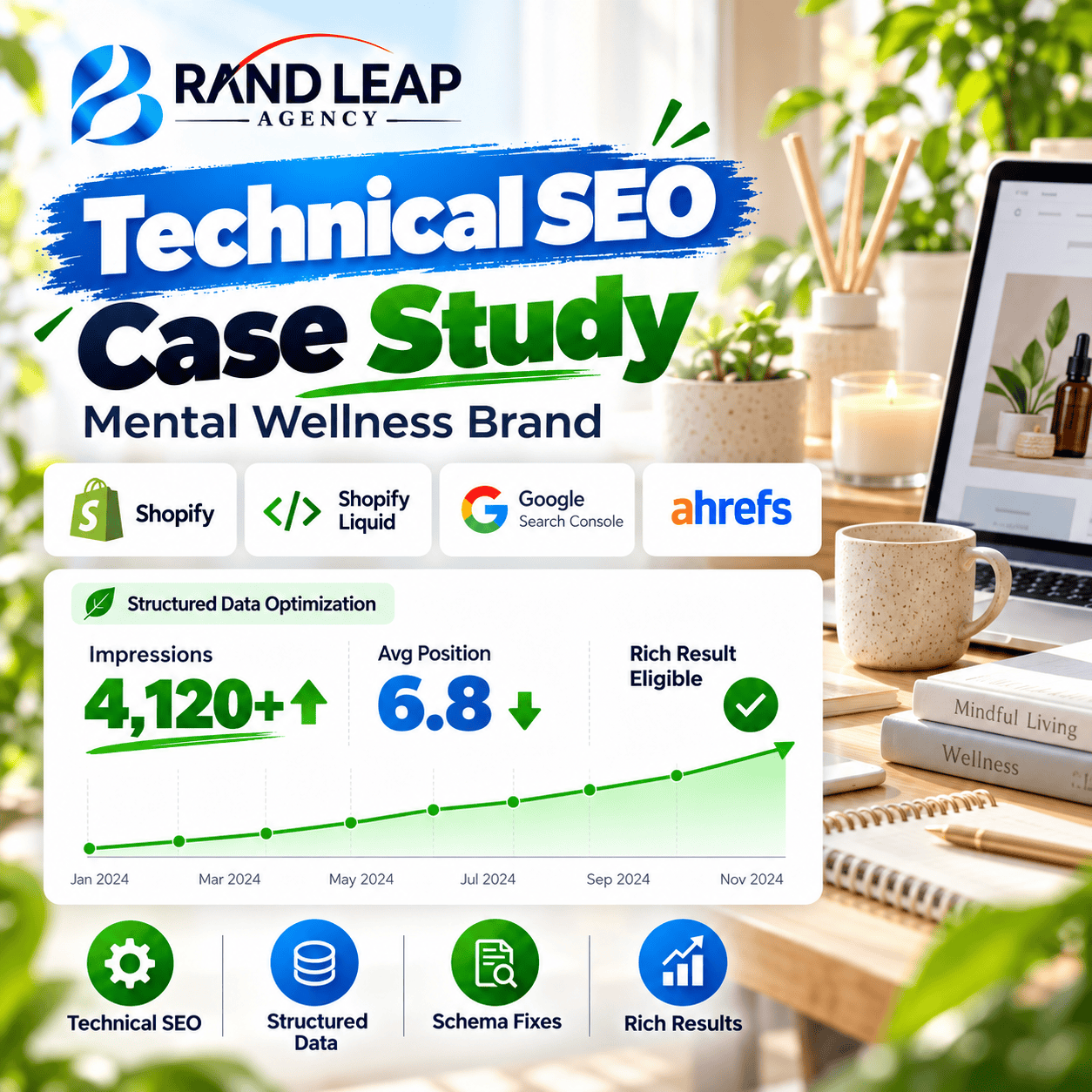
Brandleap Agency is built on exactly that model. The agency is founder-led, with SEO strategy set at the principal level rather than delegated to a junior account team. Clients work directly with the strategist who owns the engagement, backed by an in-house team covering technical SEO, content, web development, and PPC. That structure means you get execution breadth across every channel without the distance that a traditional account manager layer introduces, and without the single-freelancer risk that comes with depending on one specialist’s availability.
What working with a full-service partner actually looks like
Brandleap operates as one accountable partner for the entire digital marketing program. SEO strategy connects directly to content production, technical execution, and paid search performance because the same team owns all of it, no handoffs between siloed vendors, no gaps in coordination. If you’re weighing your options right now, the right first step isn’t signing a contract. It’s a conversation about your actual scope, your goals, and whether the model fits before any work begins.
Making the right call for your business
Freelancer SEO services make sense for well-scoped, budget-conscious projects with a single SEO priority. A full-service agency makes sense when you need coordinated execution across multiple channels and the team capacity to grow with your program. The real mistake is choosing based on cost alone without matching the model to your actual needs. A cheap freelancer who handles tasks outside their depth costs more in wasted months than a properly scoped agency retainer would have.
Use the vetting checklist from this article as your next practical step regardless of which direction you go. Ask for references. Request real work samples. Test before you commit. The businesses that win in search treat SEO as an ongoing investment with a clear partner, not a one-time purchase from whoever quoted the lowest price. If you want both strategic depth and personal accountability in the same engagement, Brandleap Agency is worth a conversation before you decide.