Most online stores approach SEO like a maintenance task: update a few meta tags, publish some blog posts, and wait. That approach works well enough to plateau. It rarely produces compounding organic growth, and it almost never addresses the structural problems that hold ecommerce sites back from page one. Mithun Baroi, founder of Brandleap Agency, built his ecommerce SEO practice around a different premise: that ranking an online store is an architecture problem before it is a content problem, and that fixing the architecture is what separates a brief traffic spike from sustained, scalable growth. This article explains the Mithun Baroi ecommerce SEO framework in full, the methodology, the real case results, and what you need to assess whether it is the right fit for your store.
Across 100+ campaigns working with Shopify and WordPress-based stores throughout the US and internationally, Mithun’s methodology has produced results that include a 550% organic visibility lift for a US retailer and a technical turnaround for an ecommerce brand that improved indexing rates and category keyword rankings within weeks of implementation. (Both outcomes are drawn from publicly shared LinkedIn case posts by Mithun Baroi.) The sections below walk through the exact framework he applies at Brandleap Agency, the verified case data behind it, and the practical information you need to make an informed decision.
Why ecommerce SEO is a different discipline entirely
The majority of SEO content on the internet was written with lead-generation websites in mind, service businesses, SaaS products, local firms. Online retailers face a structurally different set of problems: thousands of SKUs to manage, duplicate content risks baked into the platform itself, seasonal demand swings that shift priority pages overnight, and crawl budgets swallowed by poorly handled faceted navigation.
Generic SEO advice does not account for these constraints. A blog post about on-page optimisation will not tell you how to handle URL parameter bloat from size and colour filters, or how to prevent faceted navigation from generating hundreds of near-duplicate category pages. It will not explain why your highest-authority pages, the category pages, are often the thinnest pages on the site, or how poor internal linking between category and product pages flattens page authority distribution across your entire catalogue.
How Mithun Baroi frames the ecommerce SEO problem
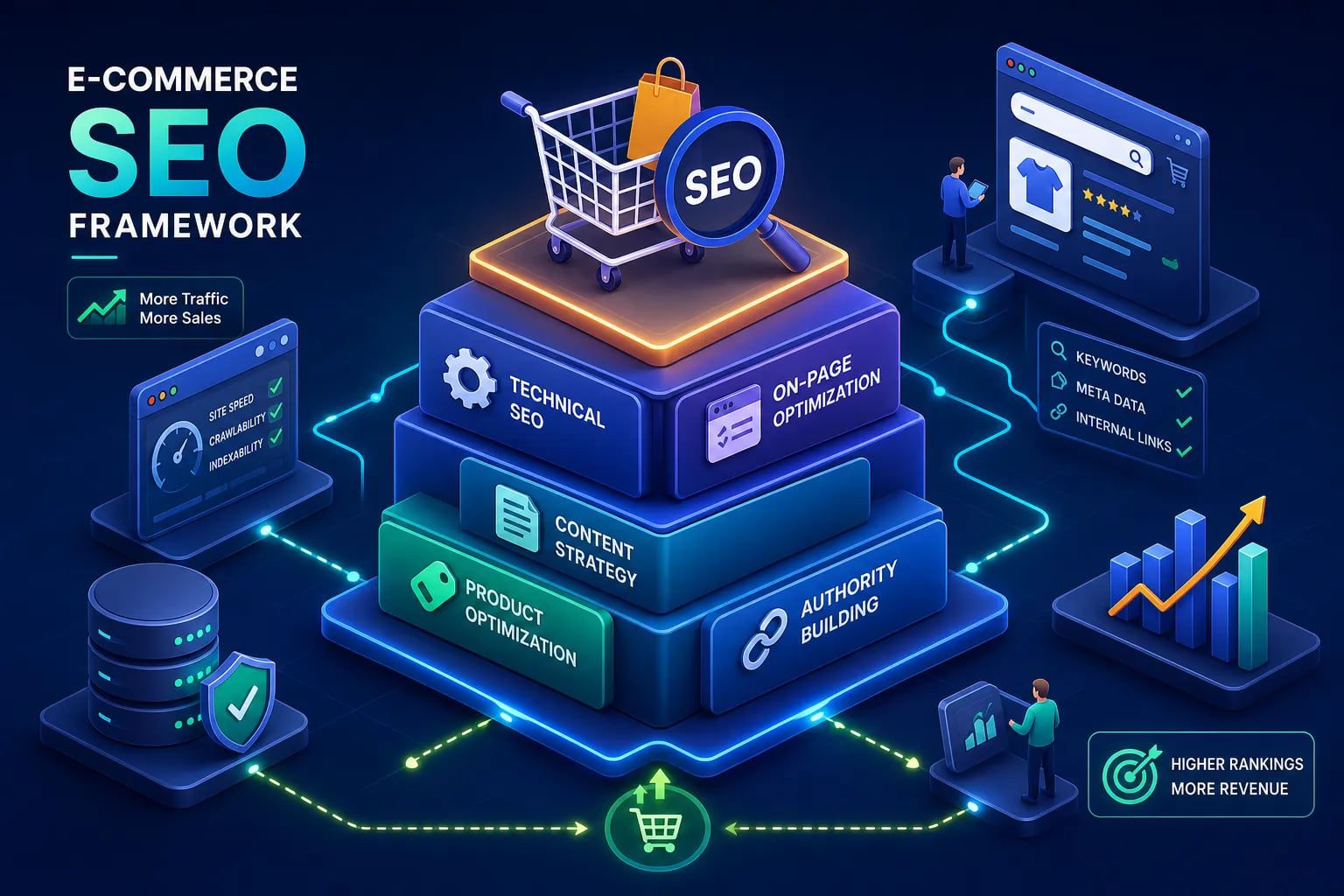
The core insight shaping every Brandleap Agency engagement with a retail client is this: ecommerce SEO is an architecture problem first. You cannot content-market your way out of a crawlability problem, and you cannot build links to pages that Google cannot efficiently find, render, and understand. The job starts with site structure, moves to page-level optimisation, and then scales through authority building and content strategy. Each layer depends on the one beneath it. Fixing one without addressing the others produces results that do not hold.
The Mithun Baroi ecommerce SEO framework: four pillars
1. Product page optimisation
Product pages are treated as standalone landing pages, not catalogue entries. Each page requires a unique title tag mapped to transactional search intent, a benefit-led meta description that improves click-through rate from the SERP, and an H1 structure that aligns with what a buyer actually searches. Image alt text, structured around descriptive and keyword-relevant language, contributes to both accessibility and image search visibility. The on-page content goes beyond the spec sheet: it answers the buyer questions that typically live in forums or review sections and keeps that intent satisfied entirely on the page.
Internal linking from category pages and relevant blog content feeds ranking signals into product pages, particularly important for newer products that have not yet accumulated external authority. A product page that sits in structural isolation rarely ranks competitively, regardless of how well the copy is written.
2. Category architecture and hierarchy
Category pages often function as the highest-authority pages on an ecommerce site, yet they are also the most frequently neglected. Foundational work here means logical URL structures, keyword-mapped category names, and breadcrumb navigation that supports both user experience and crawlability. Even a short, well-written paragraph that contextualises the category makes a measurable difference to how Google evaluates page quality. The ElectronicsBangladesh.com engagement, covered in detail below, saw category-level keyword rankings improve within weeks of restructuring, a notably fast response relative to content-led strategies.
3. Schema markup and structured data
Structured data is not optional for competitive ecommerce SEO. Product schema, Offer markup, AggregateRating, Review schema, and BreadcrumbList are all recommended as part of Brandleap Agency’s technical ecommerce optimisation work, included where scoped rather than treated as afterthoughts. Rich results, including price, availability, and review stars, have been shown to improve click-through rates from the SERP, which means schema implementation can have a measurable impact on traffic even before ranking position changes. For ecommerce stores competing against established retailers, every SERP feature counts.
4. Conversion rate optimisation as part of SEO
Traffic growth without conversion improvement produces weak return on investment. Page speed, mobile usability, clear calls to action, and well-structured product information are not merely UX considerations, they are signals that feed Google’s quality assessments and influence how pages are evaluated over time. Brandleap Agency treats CRO as integrated into the SEO engagement rather than a separate workstream, because the same on-page factors that improve user satisfaction tend to support organic ranking stability.
Scaling organic traffic: the long-term growth engine
Keyword mapping and content clusters for retailers
Once the technical foundation is sound, scaling traffic requires a deliberate content strategy. Ecommerce stores benefit from a hub-and-spoke model: category pages function as hubs, supported by informational blog content that captures top-of-funnel queries and funnels visitors toward products. The keyword research approach for ecommerce differs from other sectors. Commercial and transactional intent terms are prioritised for core product and category pages; informational terms are used strategically in supporting content to broaden the site’s topical authority and attract buyers earlier in their decision process.
Off-page authority and digital PR for product-led brands
Domain authority directly affects how competitive an online store can be against established retailers. Off-page SEO is listed among Brandleap Agency’s services, with relevant link-building approaches applied where scoped into the engagement. White-hat strategies suited to ecommerce include product-led PR, supplier and brand partnerships, resource page outreach, and category-specific acquisition. A store with a clean technical foundation and solid on-page work will still underperform in competitive categories if its domain authority is significantly below that of its ranking competitors. Off-page and on-page work are run in parallel, not sequentially.
Real results: ecommerce SEO case studies with verifiable KPIs
Freedom Fun USA: 1,700 to 18,000 monthly visitors
This engagement represents one of the clearest documented results attributable to Mithun Baroi’s ecommerce SEO work. Between January and June 2025, a six-month period, the US retailer’s organic traffic grew from approximately 1,700 to 18,000 monthly visitors, a 550% increase in organic visibility, with monthly impressions reaching 90,700. The growth profile is consistent with a store that had clear foundational gaps: product page restructuring, category optimisation, and content development working together on a site where baseline technical architecture had previously been limiting visibility. (Results sourced from a publicly shared LinkedIn case post by Mithun Baroi.)
In Mithun’s experience across 100+ campaigns, ecommerce SEO timelines typically run six to twelve months for stores in competitive categories building from a weak domain authority baseline. When structural issues are the primary constraint and the domain already carries some existing authority, meaningful movement can appear within three to four months, which is consistent with what the Freedom Fun USA data shows.
ElectronicsBangladesh.com: technical ecommerce SEO turnaround
This engagement demonstrates what focused technical ecommerce SEO changes can achieve in a shorter window. Directional outcomes, drawn from a publicly shared LinkedIn case post, included higher indexing rates, improved crawl efficiency, faster load times, and stronger organic impressions and clicks. Category-level keyword rankings improved within weeks of the optimisation work being implemented, without hard KPI figures publicly shared.
When the primary constraint is structural rather than competitive, fixing it produces faster measurable movement than content-led strategies. You do not need to wait for new content to age if the problem is that Google cannot crawl and index your site efficiently in the first place.
Platform specialisms and the stores that fit this approach
Shopify SEO specialist work and WordPress ecommerce
Shopify is the primary confirmed platform specialism within Mithun Baroi’s ecommerce SEO work. Shopify-specific considerations include canonical tag behaviour, the platform’s rigid URL structure, app-based schema implementation options, and the performance constraints that come with a managed hosting environment. WordPress-based ecommerce, including WooCommerce stores, is also within scope. WordPress offers considerably more flexibility for technical customisation and content architecture, but that flexibility requires deliberate management to avoid URL inconsistency problems, unmanaged filter pages, and performance issues that arise from plugin overhead.
Custom CMS environments are handled on a case-by-case basis through Brandleap Agency’s technical SEO audit process. If you are running a headless or bespoke platform, the audit phase will determine what is achievable within the constraints of your stack before any longer-term engagement is scoped.
Which online retailers get the best outcomes
The store profiles that tend to benefit most from this approach share a few common characteristics. Retailers with 50 to 10,000+ SKUs who are generating some organic traffic but not ranking competitively for category-level terms are a strong fit, as are stores heavily dependent on paid advertising that want to build a sustainable organic channel alongside it. The framework is designed to reduce that paid dependence over time, not simply complement it. A third profile worth noting is the established brand with a solid product range and existing domain authority that is held back purely by poor site structure. In these cases, fixing the architecture often produces faster results than would be possible for a newer domain building authority from scratch.
How to work with Mithun Baroi and what engagement looks like
Typical engagement models and realistic pricing
Brandleap Agency structures ecommerce SEO engagements around three primary models. Monthly retainers are the most common structure for ongoing work, with industry benchmarks for this type of specialist engagement typically ranging from around $2,500 to $10,000+ per month depending on catalogue size, competitive intensity, and scope, contact Brandleap directly for confirmed pricing relevant to your project. Project-based engagements cover one-off work such as technical audits and platform migrations. Hourly consulting is available for advisory work or out-of-scope questions that arise during an engagement. Every new client engagement begins with a discovery and audit phase, which defines the scope, identifies the priority issues, and sets the deliverables before any longer-term commitment is made. That structure protects both sides and ensures the work is scoped accurately rather than estimated generically.
Getting started: next steps to contact Brandleap Agency
The path to starting is direct. Visit the Brandleap Agency website, request an initial consultation or SEO audit, and come prepared with your current organic traffic data, your platform, and a clear picture of your primary competitor set. That information shapes a far more useful first conversation than a blank-slate discovery call. If your store is serious about reducing its dependence on paid advertising and building an organic channel that compounds over time, request your audit now and find out exactly where your growth is being held back.
The case for a structured approach over a generic one
The Mithun Baroi ecommerce SEO framework works because it treats organic search as a structural and strategic challenge, not a checklist exercise. Product page optimisation, category architecture, technical ecommerce optimisation, and traffic scaling are designed to compound over time, each layer reinforcing the others so that results continue to improve after the initial work is done, rather than plateauing once the quick wins are exhausted.
For online retailers looking to hire an ecommerce SEO consultant with a documented methodology and the full-service execution capability of Brandleap Agency behind them, this is a credible, well-evidenced option, with case results drawn from publicly documented engagements. To find out whether the Mithun Baroi ecommerce SEO approach is the right fit for your store, visit Brandleap Agency and request your audit.