
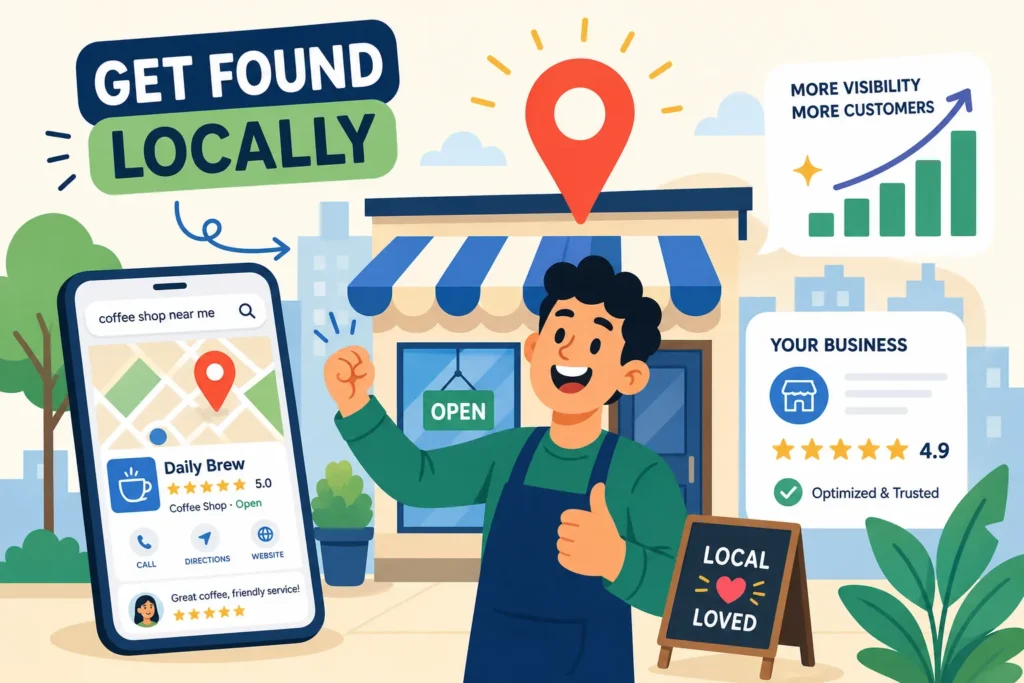
When someone in your neighborhood searches “best [your service] near me,” and a competitor two blocks away shows up first, that gap isn’t luck. These local SEO tips exist precisely to help you close it. The technical term is local search optimization, and most small business owners don’t realize how few targeted changes it actually takes to move up in the Local Pack.
Local search queries consistently rank among the highest-intent traffic channels available to any small business. Someone searching “plumber near me” at 9 PM on a Wednesday isn’t browsing; they have an immediate problem and strong purchase intent. Ranking in the Local Pack means you capture that moment before anyone else does.
The practical local SEO tips in this article come directly from the playbook the team at Brandleap Agency uses with local clients across competitive U.S. markets. We’ll cover five core areas: Google Business Profile optimization, citation cleanup, review strategy, local landing pages with schema, and behavioral signals. By the end, you’ll have a clear, prioritized action plan you can start this week, not a 50-item local SEO checklist you’ll abandon by Friday.
Local SEO tips: Start with your Google Business Profile
According to the 2026 Whitespark Local Search Ranking Factors survey, Google Business Profile signals account for 32% of your Local Pack visibility. That’s the single largest ranking factor by a wide margin, and it’s entirely within your control. Most small businesses set up their GBP once, call it done, and wonder why they’re stuck on page two of Maps. See BrightLocal’s guide to the Google local algorithm and ranking factors for deeper context on how these signals interact.
Google evaluates your profile through three lenses: relevance, distance, and prominence. Your GBP touches all three simultaneously, which is why optimizing it isn’t optional. It’s the foundation that every other tactic in this article builds on.
Pick the most precise primary category available
Your primary category is the strongest relevance signal Google has for your business. It acts as a filter that determines which searches you’re even eligible to appear in. A restaurant choosing “Restaurant” as its primary category instead of “Japanese Restaurant” is invisible to everyone specifically searching for Japanese food nearby.
Browse every available category option before settling. If you serve multiple verticals, your primary category should reflect your core revenue driver. Use secondary categories for everything else, and revisit this decision any time Google adds new, more specific options to the list.
Complete every field Google gives you, especially services and attributes
Most GBP profiles have blank fields where ranking signals should be. The services section is one of the highest-impact on-profile features to optimize: list each service individually with a short description, not just a label. Google’s AI pulls from these descriptions to match conversational search queries, so a plumber listing “Water Heater Installation” with a two-sentence description captures far more searches than a bare label does.
Attributes matter more than most business owners realize. Accessibility, sustainability, and service-related attributes appear as filters in Google Maps. If you don’t have an attribute enabled, you’re invisible to searches that use that filter. Accurate business hours are equally critical because being listed as “open” at the time of search is among the most influential local pack factors.
Post weekly updates and upload fresh photos regularly
Profiles that go 30 days without new activity see measurable visibility drops. Posting weekly and uploading fresh photos are engagement signals that tell Google your business is active and worth surfacing. According to Google’s own published data, profiles with photos receive 42% more direction requests and 35% more website clicks than those without.
What to post: promotions, new services, seasonal offers, and answers to common customer questions. Photos should be real images of your storefront, your team, or your completed work. Stock photos don’t build trust with Google or with the customers deciding whether to call you.
Fix your local citations before you build more of them
Citations are structured mentions of your business name, address, and phone number across directories and websites. They carry about 4, 6% of local ranking weight on their own, which sounds modest until you realize that inconsistent NAP data actively undermines your GBP authority. Google cross-references your information across the web, and conflicting data creates ambiguity. Google resolves ambiguity by ranking you lower.
Before you add new listings, fix the ones you already have.
Local SEO tips for citations: Start with the major data aggregators
Four key data aggregators distribute business information to hundreds of smaller directories automatically: Data Axle (formerly Infogroup), Foursquare (which acquired Factual), Acxiom (Localeze), and Neustar Localeze. Many small businesses have never submitted to any of them. A single correction at the aggregator level cascades across far more directories than you could manually update in weeks, which makes this the highest-leverage starting point in any citation cleanup effort.
Start here before touching individual directory listings. The leverage is substantially better. One accurate aggregator submission reaches directories that would otherwise require separate, repetitive manual updates, and the effect keeps compounding as new directories pull from those sources.
For prioritized lists of citation sources and how to approach them for U.S. businesses, consult a curated citation building list for the USA to guide which directories to prioritize.
Layer in industry-specific directories that high-intent searchers actually use
Once the aggregators are handled, allocate your remaining citation effort strategically. A proven split: 70% of effort on the top 20 directories (Google, Apple Maps, Bing Places, Facebook, BBB, Yelp), 20% on secondary industry-specific directories (Angi for home services, Healthgrades for healthcare, Avvo for legal, TripAdvisor for hospitality), and 10% on local community directories like Chamber of Commerce listings.
Top local competitors typically maintain 15, 30 solid citations. You don’t need thousands. You need the right ones with perfectly consistent information across all of them.
Build a review strategy that compounds over time
Reviews account for 17, 20% of local pack ranking signals, making them the second most important factor after your GBP. Most guides treat reviews as a one-time push to hit a round number. That framing will keep you stuck.
Review velocity outperforms total count once you cross 50 reviews. A business with 60 reviews that earned 12 last month routinely outranks a competitor with 300 reviews that earned 2 in the same period. The goal isn’t a big number. The goal is a steady, ongoing system. See this deep dive on the role of review velocity in local search performance for practical benchmarks and examples.
Why review velocity matters more than your total count
Google’s algorithm has placed increasing weight on review freshness, a trend that accelerated with the March 2025 core update. Below 50 reviews, total count builds the credibility baseline you need to compete at all. Above 50, velocity becomes the decisive ranking signal in nearly every competitive market.
The benchmarks to know: a minimum of one new review every two weeks, strong performance at two to three per week, and a healthy signal at four to six per month. Steady matters more than fast. A burst campaign that spikes and dies sends a worse algorithmic signal than a slow, consistent flow of genuine reviews from real customers.
How to respond to reviews in a way that actually helps your rankings
Research from BrightLocal indicates that responding to a meaningful share of your reviews improves conversion rates, and response speed is an engagement signal Google actively measures. Skip the copy-paste templates. Acknowledge something specific from the review, whether it’s the service mentioned or the team member named by the customer.
For negative reviews, show resolution intent without being defensive. A calm, specific response signals credibility to both Google and prospective customers reading through your profile. Also worth knowing: reviews from Google Local Guides that include photos carry stronger algorithmic weight than anonymous five-star ratings, so encouraging those detailed responses is worth extra attention.
Build local landing pages and add schema markup to your site
On-page signals account for 15, 16% of local ranking weight, yet most small business websites have a single generic contact page with a city name in the footer. That’s not a local landing page. A real local landing page is built around a specific service in a specific location and gives Google everything it needs to confirm your relevance for that search. This is also where near me SEO gains traction; learn how to create content for local landing pages that converts and ranks.
What every effective local landing page needs to include
The non-negotiables for a location-specific page:
- A location-specific H1 that includes your service and city or neighborhood
- NAP on the page that matches your GBP exactly
- An embedded Google Map with your location pinned
- Locally relevant content, not just a swapped city name in a template
- Mobile optimization and a load speed under two seconds
A concrete example: a plumber in Austin building a dedicated page for “emergency plumber in South Austin” will consistently outperform a generic “plumber in Texas” page. The specificity signals relevance for the exact search being made. Generic pages try to rank for everything and end up ranking for nothing. If you’re in the real estate industry and need tailored examples, see our guide Local SEO for Real Estate: Rank Higher in Your Market, 2026 for location-specific page templates and schema recommendations.
How to implement LocalBusiness JSON-LD schema correctly
Schema markup is a confirmation signal, not a shortcut. It works best when the same information already appears in visible page text. The essential fields to include in your LocalBusiness JSON-LD are: @type, name, address (with streetAddress, addressLocality, postalCode, and addressCountry), telephone, url, image, openingHoursSpecification, and geo coordinates.
Schema reinforces what Google can already read on your page; it doesn’t substitute for it. Once implemented, validate your markup using Google’s Rich Results Test before the page goes live. Errors in schema can actively confuse Google’s understanding of your location data, so validation isn’t optional.
Pay attention to behavioral signals, Google watches how people interact with your listing
Behavioral signals account for 7, 9% of local ranking factors, and almost no local SEO guides cover them practically. Google watches what users do after seeing your listing in search results. Clicks, calls, and direction requests confirm relevance. Scrolling past your listing without engaging signals the opposite.
Your listing’s appearance directly influences its own rankings over time. A weak profile photo or an outdated business description doesn’t just cost you that one customer, it costs you ranking position with every impression it makes.
GBP Insights metrics worth checking every week
GBP Insights gives you a direct window into behavioral performance. The metrics worth tracking weekly are photo views, direction requests, website clicks, and call volume. A healthy profile shows upward trends across all four. A stagnant or declining profile, especially on photo views, is a clear signal to upload new content and increase post frequency.
Each action users take on your listing feeds back into how Google ranks it. More engagement generates more ranking lift, which generates more impressions, which generates more engagement. That compounding loop starts with optimizing the profile and maintaining it consistently week over week.
Simple ways to improve your listing’s click-through rate
Your primary photo is the first impression anyone gets of your business in the Local Pack. Use a real storefront or team photo, not a logo. Write a business description that includes your service category and one clear differentiating detail, not a block of marketing copy that tells customers nothing specific.
The Q&A section is one of the most ignored features in GBP and one of the most useful. Seed it with common customer questions and accurate answers before anyone else does. This gives you control over the information that appears on your profile and provides Google with additional relevance signals tied directly to the searches your customers are making.
Pick one area and start this week
Given their relative ranking weight, the recommended order is: GBP optimization first, then reviews, then local landing pages and schema, then citation cleanup. Tackling all five simultaneously is exactly how business owners start, and abandon, their local SEO efforts before seeing any results. The ones who actually move rankings pick one area, execute it fully, and build from there.
Local search optimization is not a one-time task. It’s a compounding system where each improvement reinforces the next. A complete GBP strengthens your review signals. Consistent reviews drive behavioral engagement. Behavioral engagement feeds back into GBP authority. Tight local landing pages and schema give every other layer more surface area to work with. Get one layer right, then stack the next.
If you want a clear roadmap built for your specific market rather than a generic checklist, Brandleap Agency’s local SEO consulting services turn these local SEO tips into a fully executed strategy. Our team maps your competitive gaps, pinpoints the highest-leverage moves for your area, and delivers a plan with measurable milestones. If you’re evaluating providers, read Why Local SEO Agency Selection Matters for Small Business, 2026 to understand how agency choice impacts results. Reach out to find out what that looks like for your business.

BrandLeap Agency & BrandLeap Fashion | Founder & CEO
Mithun is an experienced SEO consultant recognized for helping businesses improve their digital presence through technical SEO, content optimization, and sustainable organic growth strategies. Working in the digital marketing industry since 2019, he has developed expertise in increasing search visibility, driving targeted traffic, and building long-term growth through data-driven SEO solutions. He has worked with businesses across multiple industries, helping brands strengthen their online authority and achieve measurable growth results.