
If you’re trying to figure out what small business SEO cost should realistically look like in 2026, you’ve probably already experienced the confusion firsthand. You asked three different agencies for a quote and got back numbers like $500, $2,200, and $4,500 per month, with zero explanation of what makes them different. That’s a frustrating and all-too-common experience for small business owners trying to make a smart investment decision. The “it depends” answer isn’t wrong, but it’s not helpful either.
At Brandleap Agency, we hear this question from small business owners constantly, and the honest truth is that the confusion isn’t accidental. SEO pricing can be genuinely opaque, and some providers prefer it that way. This article fixes that. You’ll walk away knowing the real price ranges for 2026, what each budget tier actually delivers, how to choose between DIY, freelancer, and agency options, and what a realistic timeline to ROI looks like.
What Small Businesses Actually Pay for SEO in 2026
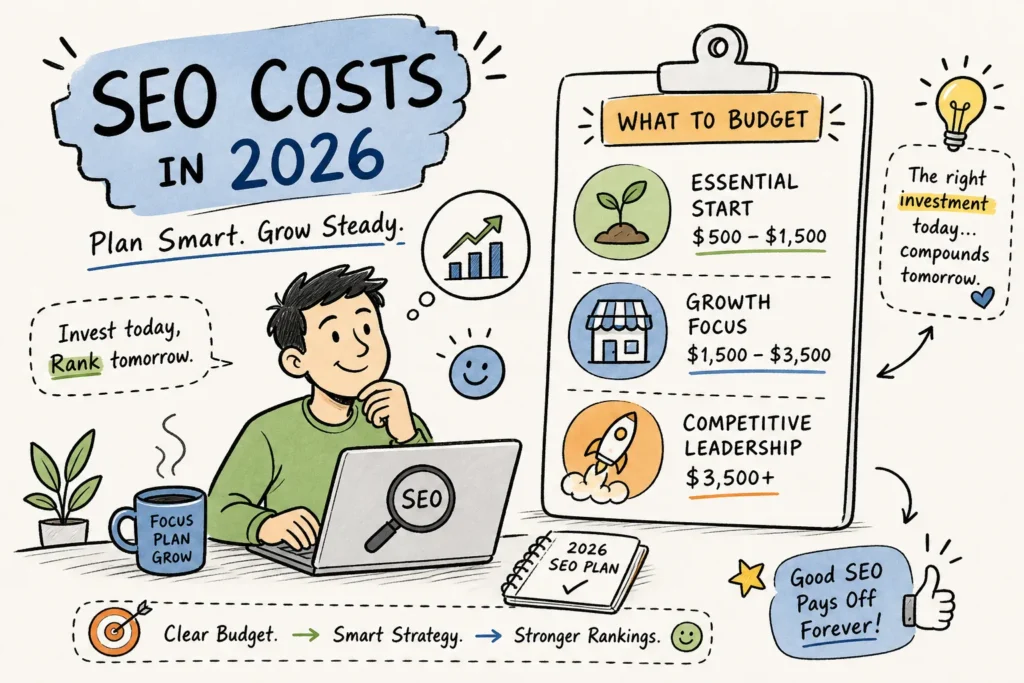
The median spend for a single-location small business running an ongoing SEO campaign lands between $1,000 and $1,500 per month, according to 2026 industry pricing surveys. Most small businesses fall somewhere in the $500 to $3,000 range depending on market competition and scope. The $2,900+ “average” you’ll see cited in those surveys skews high because it folds in enterprise brands and national campaigns that have nothing to do with a local plumber or boutique retailer.
If you’re in a moderately competitive market, a realistic small business SEO cost estimate for a legitimate agency is $800 to $1,500 per month. Highly competitive industries, legal services, finance, or home services in a major metro, will push that number to $2,500 or more. Understanding why that range exists starts with knowing the three ways agencies charge for their work.
The Three Pricing Models You’ll Encounter
Monthly retainers are the dominant model, used by roughly 78% of agencies according to recent industry surveys. You pay a fixed fee each month for an agreed set of services, and the value compounds over time as rankings improve and organic traffic builds. This is the model that fits most small businesses pursuing sustainable growth. For additional context on current market benchmarks for SEO pricing, see this overview of modern SEO pricing benchmarks and models.
Hourly consulting rates for experienced U.S.-based SEO professionals run from $75 to $200 per hour for mid-level and senior consultants, with technical SEO specialists reaching $250 or more. This model works well for specific, one-time needs, getting a second opinion on your strategy or troubleshooting a traffic drop, for example. For typical market hourly ranges and what to expect from contractors, this breakdown of SEO expert hourly rates is a useful reference.
Fixed project fees cover one-time deliverables. Site audits typically run $2,000 to $15,000, while larger engagements like site migrations can reach $30,000 or more. If you need a clear diagnosis before committing to ongoing work, a project-based audit is often the right starting point.
What Drives Your Cost Up or Down
Four variables move your number more than anything else. First is market competition: ranking for “plumber Denver” requires more sustained effort than “custom furniture maker Bozeman.” Second is geographic scope: a single-location business targeting one city costs less than a regional chain covering five metro areas.
Third is your domain’s existing authority and age. An established site with years of inbound links and content needs less foundational work than a brand-new domain. Fourth is your current SEO infrastructure: if your site has serious technical problems or has never had optimization work done, expect higher initial costs while those fundamentals get fixed.
Small Business SEO Cost Breakdown: What Each Budget Tier Delivers
Knowing your budget is only half the picture. The other half is knowing whether that budget is enough to move the needle in your specific market, and what you’re actually getting for your money at each level.
$300, $700/month: Tools, Templates, and Trade-offs
At this level, you’re assembling a DIY tool stack or working with a very basic freelancer on a narrow task. A typical setup includes Google Business Profile management, a citation tool for local directory listings, and basic keyword rank tracking. You can maintain existing rankings and clean up citations, but you can’t build from scratch.
What this tier cannot deliver is original strategy, consistent link building, or technical fixes that require a developer’s understanding of your site. If your competition is investing more, this budget will not close the gap. It’s a maintenance budget, not a growth budget.
$1,000, $3,500/month: The Sweet Spot for Most Small Businesses
This is where coordinated SEO campaigns become possible. At $1,000 to $1,500 per month, a quality provider will handle Google Business Profile optimization, local citation management across 50-plus directories, on-page fixes for your core service pages, two content pieces per month, and monthly reporting tied to Google Search Console data. That’s legitimate foundational work, and it compounds.
Stepping up to the $2,000 to $3,500 range adds more content output, proactive link acquisition, review management strategy, and a more hands-on account manager. This is the tier where boutique agencies deliver measurable local and regional growth without enterprise-level overhead. Brandleap Agency’s service tiers are built specifically for this range because it’s where the majority of small businesses actually live, learn more about our affordable SEO services designed for small budgets and big results.
$5,000+/month: Full-Service and Competitive National Campaigns
At this level, you’re getting dedicated strategists, robust monthly content programs, aggressive link building, and analytics reporting tied directly to revenue metrics rather than just rankings. This is appropriate for businesses competing nationally, operating in high-stakes industries like insurance or legal, or managing multiple locations simultaneously.
Most small businesses don’t need this level of investment, and spending here before your fundamentals are solid wastes money. But if you’re in a saturated national market or have aggressive growth targets, this budget buys you the resources to compete seriously.
DIY, Freelancer, or Agency: How to Choose the Right Fit
Budget isn’t the only factor in this decision. Your time, your existing knowledge, and your growth timeline all shape which option makes the most sense for your situation. If you’re unsure where to start, our guide on how to find affordable SEO services for small business walks through practical steps and evaluation criteria.
When Doing It Yourself Is a Legitimate Option
DIY SEO makes sense when you’re in a low-competition local niche, you have the time to learn and execute consistently, or your business is pre-revenue and cash is the hard constraint. Tools like Google Search Console, Google Business Profile, and a basic keyword tracking platform give you enough to make progress in forgiving markets.
The realistic ceiling on DIY is that it’s time-intensive, and the learning curve is real. Technical issues often go undiagnosed, and content without a strategy rarely compounds the way agency-managed content does. Use DIY as a starting point, not a long-term plan.
What a Freelancer Can and Can’t Do for You
Freelancers excel at specific, defined scopes: a technical audit, a batch of optimized service pages, or a Google Business Profile setup. Mid-level U.S. freelancers charge $75 to $150 per hour, and for a focused project, that’s often good value. The problem is that hourly costs add up fast without a structured plan guiding the work.
What freelancers typically can’t provide is ongoing strategic accountability. If your rankings drop in month three, a freelancer you hired for a one-time project isn’t there to diagnose and respond. Strategy, consistency, and accountability are where the freelancer model has real limits.
What a Results-Driven Agency Brings to the Table
A results-driven agency in the $1,000 to $3,500 range gives you what neither DIY nor a freelancer can: a coordinated strategy, consistent monthly execution, technical expertise, and someone accountable for reporting real results. You’re not paying for the most expensive option, you’re paying for the most complete one at a price point built for small business realities.
At Brandleap Agency, we built our service tiers specifically around this middle ground because that’s where the majority of small businesses actually live. Affordable doesn’t have to mean incomplete, and results-driven doesn’t have to mean enterprise-priced. If you’re evaluating providers, remember why local SEO agency selection matters and what to look for in a partner who understands small business constraints.
Red Flags That Tell You a Provider Is Too Cheap to Trust
Cheap SEO is one of the few marketing investments where paying less often costs you more. Recovering from a Google penalty or a polluted link profile takes longer and costs more than doing it right the first time. Here’s what to watch for.
Promises That No Legitimate Agency Will Make
A few warning signs show up consistently across low-quality providers. Guaranteed #1 rankings top the list. No agency can guarantee a specific position, Google’s algorithm is theirs, not ours, and any provider making that promise is either misleading you or planning to use tactics that will eventually harm your site.
Immediate results measured in weeks is another red flag. Legitimate SEO takes months to show meaningful movement. Watch out, too, for “proprietary methods” that can’t be explained. Real SEO strategy is explainable. If a provider won’t tell you what they’re doing and why, that secrecy protects them, not you.
What Suspiciously Low Local SEO Pricing Usually Signals
A $99 or $200 per month SEO package typically signals one of a few things: automated link spam pointing at your site from low-quality directories, keyword-stuffed content generated without any strategy or original research, or a monthly report with no real work behind it. These approaches aren’t harmless. According to Google’s spam policies and documented penalty recoveries, these tactics can trigger algorithmic filters and result in ranking drops that take 12 months or more to reverse, sometimes longer in competitive markets.
The math is simple: if an experienced SEO professional charges $75 to $150 per hour, a $99 per month package buys less than 90 minutes of actual work. That’s not a campaign. That’s a checkbox.
How Long Before SEO Starts Paying Off
This is the question that determines whether a business stays the course or pulls the plug too early. Setting realistic expectations from the start is what separates businesses that win with SEO from those that quit right before results arrive.
Realistic Timelines by Competition Level
In low-competition local niches, businesses typically see early keyword movement within two to four months and consistent lead generation by month four to six. In moderately competitive markets, meaningful traffic growth usually begins around month five or six, with steady lead flow by month nine. High-competition industries, legal services, insurance, financial products, often require 12 to 24 months before SEO delivers a real return on investment, and in the most saturated markets that window can stretch further. For a deeper look at industry timelines, see this analysis of how long SEO typically takes to show measurable results.
Industry data consistently shows that the biggest SEO gains typically arrive in year two, when the compounding effect of consistent content and links fully kicks in. In average-competition markets, Brandleap Agency’s client data shows organic traffic growth routinely in the range of 40 to 60 percent year over year once a campaign reaches maturity, this aligns with broader research into average SEO traffic growth over time. That kind of return doesn’t happen overnight, but it does happen, and it lasts.
The KPIs That Matter Before You See Page-One Rankings
Most businesses abandon SEO because they’re watching the wrong metrics in the early months. Rankings take time, but there are signals that show the campaign is working well before position one appears. In Google Search Console, watch for impressions growing month over month: that means your pages are being indexed and surfaced, even if clicks aren’t flowing yet.
Other early indicators include local pack appearances increasing, time-on-page improving as optimized content resonates better with visitors, and branded search volume rising as your visibility builds. These signals tell you the investment is working before the revenue directly follows. An agency worth keeping will show you these metrics and explain what they mean, not just hand you a PDF of keyword rankings.
The Right Small Business SEO Cost Makes the Decision Easier
Most single-location small businesses should plan for $1,000 to $1,500 per month as a baseline for SEO that actually moves the needle. Expect results to compound meaningfully over a six to twelve month window, and choose a provider whose pricing and deliverables match what you’ve read here, rather than what sounds cheapest or most impressive on the surface.
The right agency doesn’t just execute a strategy on your behalf. They help you understand what’s being done and why, so you’re never flying blind on your investment. That transparency is the difference between a vendor relationship and a real growth partnership. At Brandleap Agency, that’s exactly how we work with every client we take on.
If you’re ready to get a clear picture of what the cost of SEO for your specific business and market should look like, schedule a free 30-minute estimate with Brandleap Agency. We’ll give you an honest plan you can act on, real numbers, realistic timelines, and a clear path forward.

BrandLeap Agency & BrandLeap Fashion | Founder & CEO
Mithun is an experienced SEO consultant recognized for helping businesses improve their digital presence through technical SEO, content optimization, and sustainable organic growth strategies. Working in the digital marketing industry since 2019, he has developed expertise in increasing search visibility, driving targeted traffic, and building long-term growth through data-driven SEO solutions. He has worked with businesses across multiple industries, helping brands strengthen their online authority and achieve measurable growth results.