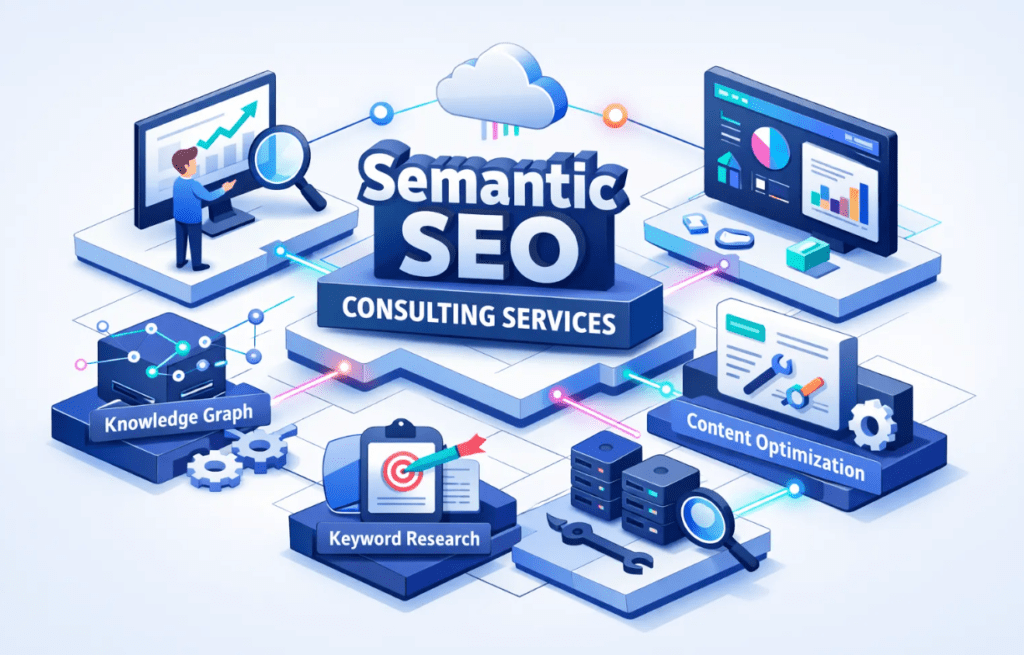
Ben Stace’s semantic SEO consultancy services focus on mapping meaning across your site instead of chasing isolated keyword positions. Ben turns topic maps, entity signals, and content networks into practical playbooks your team can follow. The article outlines what a semantic SEO consultancy delivers and how to identify the most valuable outputs.
Expect strategic and tactical outputs: prioritized topical maps, entity graphs, content briefs, schema templates, and a content roadmap tied to a semantic SEO tool. Ben’s engagements combine advisory work with hands-on delivery, where fixed-scope audits deliver maps and templates and retainers add iterative content builds and technical fixes. The end result is a repeatable semantic content strategy your writers and engineers can implement.
A semantic SEO consultant addresses intent gaps, prevents keyword cannibalization, and builds topical authority that keyword-focused approaches often miss. Consolidating thin product or service pages into a single topic-cluster structure can capture related queries and improve internal relevance. Typical clients include e-commerce category owners, complex B2B niches, local multi-service businesses, and startups; projects often start small but require a minimum content cadence and light engineering, which an initial audit will assess.
Quick summary
Quick summary for decision-makers: the key approach, core deliverables, and how to measure impact. Use this as a checklist to evaluate consultants and internal plans.
- Core approach: focus on semantic systems rather than individual keywords. The work maps topics, extracts entities, and builds topical clusters that align search intent with site structure.
- Deliverable stack: prioritized topical maps, entity graphs, semantic content briefs, schema templates, and a content roadmap tied to the semantic tool. These outputs create clear work tickets for writers and engineers.
- Implementation phases: audit, entity scaffolding, content remediation, schema and internal linking. Each phase includes tools, QA checks, and named owners to keep progress visible.
- Measure success: track topical authority signals and grouped content KPIs alongside conversion outcomes. That helps you separate long-term gains from short-term rank shifts.
- Hiring guidance: use a consultant for diagnosis and playbooks, build an in-house function for continuous cadence, or hire an agency for managed execution. Base the choice on capacity and the outcome you need, not just hourly rates.
What semantic SEO consultancy actually does
A semantic SEO consultancy turns scattered pages into a coherent knowledge system that both people and search engines can follow. The work maps topics, extracts entities, structures content networks, and produces content briefs written for semantic coverage. That combination helps your site answer more queries with fewer, higher-quality pages.
Typical deliverables are tangible and repeatable. Expect a package that includes the items below and clear handoff notes for writers and engineers.
- Topical maps and content clusters for priority subjects. The map defines pillar pages, supporting articles, and the internal links needed to cover intent comprehensively.
- Entity graphs that show relationships between concepts. These graphs guide schema choices and help writers use canonical terms consistently.
- Semantic content briefs and outlines ready for writers. Briefs include intent tags, entity prompts, headings, and example FAQs to reduce revision cycles.
- Schema and template recommendations for CMS implementation. Guidance includes Schema.org types, sample markup, and integration notes for your CMS.
- Prioritized content roadmaps and competitive semantic gap analysis. Roadmaps sequence work by impact and effort so you can capture quick wins.
Technical steps to build semantic relevance
Treat semantic relevance as a buildable system, not a one-off edit. Break the work into three clear stages: topical mapping, entity scaffolding, and site plumbing. Each stage has tools, deliverables, and quality checks so you can audit gaps and hand off clean tasks to engineers or writers.
Topic cluster mapping and content networks
Seed topics from your highest-intent pages, then extract subtopics using SERP gap tools like Ahrefs, SEMrush, or a semantic SEO tool. Produce a prioritized content matrix in CSV that lists pillar pages, supporting articles, intent tags, and internal linking targets. Use quality checks such as a cluster coverage score (aim for 80% or higher of identified subtopics), an orphan page audit, and a rule that each pillar receives 3 to 5 internal links from supporting pages. For background on structured approaches to grouping content, review a practical guide to topic clusters.
Entity extraction, schema and knowledge scaffolding
Run NLP entity extraction with Google NLP API, spaCy, or DBpedia Spotlight against top competitors to surface canonical entities and relationships. Output an entity graph in CSV or JSON and map nodes to Schema.org types, prioritizing Organization, Person, BreadcrumbList, Product, Article, and FAQPage where relevant. Validate structured data with Google’s Rich Results Test and ensure entity anchors appear in headings, metadata, and the first 150 words of pillar pages. If you need a practical walkthrough on how to identify and map entities, see this piece on how to find entities for SEO optimization.
On-page work, internal linking and site plumbing
Define a canonical strategy, keep URL depth shallow, and plan crawl budget using log-file analysis and Screaming Frog. Run speed and mobile audits with Lighthouse, confirm mobile-first rendering, and fix rel=canonical and hreflang issues when necessary. Maintain consistent internal parent/child linking patterns and provide engineers with clear templates to prevent accidental regressions.
How to measure success and interpret signals
Turn semantic work into dashboards that show real progress rather than short-term rank moves. Track metrics that reflect topical authority and group them so stakeholders see the narrative behind the numbers. The list below shows core indicators to include.
- Impressions and query growth for topic sets. Measure impressions and the number of distinct queries within each topic cluster to show expanding visibility over time.
- Unique query coverage. Track how many new queries your cluster pages capture, not just position changes for individual keywords.
- SERP feature movement. Note wins in featured snippets, knowledge panels, and people-also-ask as evidence of semantic relevance.
- CTR improvements and conversions. Tie CTR lifts on cluster pages to downstream goal completions to prove business impact.
Benchmarks set realistic expectations: small sites often show measurable lifts in 3 to 6 months, mid-size topical builds take 6 to 12 months, and enterprise networks need longer due to scale and governance. Timelines depend on content cadence, engineering capacity, and how quickly you deploy schema and linking changes.
When evaluating ben stace semantic seo consultancy services, request baseline exports and dated Search Console snapshots before and after work. Verify any public case study with timestamped data, third-party exports (for example, Ahrefs or Semrush), and conversion or traffic event proofs rather than single-point percentage claims.
Use Search Console to pull queries grouped by topic, impressions, average position, and SERP feature flags. In GA4, track content paths, engagement events, session-quality signals, and conversions attributed to cluster pages, and create segments for topic-based landing pages. A semantic content platform can surface missing entities and topic gaps so you know where to expand. For leadership, provide a concise dashboard showing topic impression growth, unique queries gained, SERP feature wins, CTR lift, and conversion rate per cluster. For a deeper look at practical steps to build topical authority, this resource on how to build topical authority in SEO is helpful.
Use these signals to prioritise the implementation playbook and content sequencing. Start with pages that combine intent fit, traffic opportunity, and engineering readiness.
When to hire a consultant versus building in-house or hiring an agency
Choosing between coaching, project work, or managed services depends on capacity, timeline, and the outcomes you need. Consultants are efficient at diagnosis and producing strategic playbooks; in-house teams are best for continuous iteration, while agencies handle predictable, full-stack delivery. Look at cost-to-outcome rather than hourly rates, since lower hourly cost can underperform if execution stalls. If you need a local option, consider engaging an SEO Consultant in Chicago for hands-on support.
Watch for measurable signals that indicate you need outside help instead of relying on impressions alone. The list below shows common blockers that require at least one internal resource or an external partner to resolve.
- Stagnant topical coverage despite high content volume. If many pages exist but coverage still lacks breadth, hire an editorial lead to implement a topic-cluster plan and enforce content quality.
- Poor query diversity with repeated keywords across pages. Bring in an analyst to map queries to pages and manage rewrites to avoid cannibalization.
- Inconsistent internal linking and orphan pages. Assign a developer or CMS editor to fix templates and apply consistent parent/child linking so authority flows correctly.
- Lack of schema or structured data know-how. Engage a front-end developer to add and test markup and document the implementation for future editors.
Match engagement type to the job: use a project for audits and one-off builds with deliverables such as a prioritized roadmap and implementation-ready tickets. Choose monthly retainers for sustained topical authority programs, where deliverables include iterative content production, technical sprints, and monthly KPIs measured by topical depth and organic conversions. Coaching fits when you have execution capacity but need strategy and training; deliverables include playbooks, templates, and office hours, and success is tracked by internal team velocity.
When execution capacity is the bottleneck, an agency provides predictable delivery by combining technical SEO, content production, and conversion optimization into a single workflow. If you want a named expert for strategy, ben stace semantic seo consultancy services is an option; if you need full-stack execution that scales, Brandleap can run the program. The next section covers pricing models and how to forecast ROI for each engagement type.
Common pitfalls that derail semantic projects
Over-reliance on tools or chasing optimization scores
Tools speed up research and surface topical gaps, but they don’t build a readable information architecture for your audience. When teams chase a score, they produce checklist-driven copy that ranks for fragments but fails to satisfy intent. Add an editorial QA before publish to check the clarity of the lead, the logic of subheadings, and the presence of at least one real-world example or case.
Thin clusters, cannibalization and fractured topic flows
Poor mapping creates pages that compete with each other, dilute link equity, and confuse users and search engines. Decide whether to merge, canonicalize, or reposition overlapping pages so each URL has a single, clear intent tied back to the pillar. Remedies include consolidating duplicates, tightening the pillar-to-cluster hierarchy, and mapping internal links to reinforce topic relationships rather than create circular navigation.
Technical mistakes that kill semantic gains
Even strong topical work collapses when schema is misapplied, content is hidden by poor templates, or canonical tags are misused. Run an engineering sprint that confirms schema types match page intent, ensures important sections are crawlable, and validates canonical tags and server-side redirects. These checks prevent regressions and protect the relevance you built with content. For a perspective on entity-led strategies and topical authority, consider reading about entity-based SEO and topical authority.
A practical 90-day playbook and tool walkthrough
Day 1 to 30 is an audit and prioritization sprint where you run a competitive semantic audit, extract core entities, and build a priority topical map highlighting quick wins. Pick the first 5 to 10 pages to rework based on traffic opportunity, intent fit, and technical health. Deliverables at the end of this sprint include an audit report, mapped topics, and a 30-day content schedule that assigns owners and publishing dates.
Day 31 to 60 focuses on production and editorial handoff. A semantic writing tool speeds competitive analysis, creates data-backed outlines, and flags missing concepts so writers cover full topic depth. Export to WordPress or Google Docs for a clean handoff and pair the tool with a senior editor to maintain brand voice and accuracy.
Day 61 to 90 is measure, refine, and decide: validate gains against your KPIs, refine the topical map using performance data, then decide whether to scale in-house or bring in an agency. Use a simple go/no-go checklist: increased organic sessions, improved SERP feature presence, content engagement uplift, and a repeatable production cadence. When you’re ready to discuss options, you can book a meeting with the team to review timelines and pricing.
Semantic SEO consultancy is systems work combining topical mapping, entity relationships, technical fixes, and disciplined editorial execution. Ben Stace’s semantic SEO consultancy services and semantic writing tools show one way to compress research into productive content weeks, but verify case data and timelines before signing a contract.
How Ben Stace’s semantic SEO consultancy services deliver measurable relevance
Ben Stace’s semantic SEO consultancy services convert scattered pages into a coherent knowledge system that both search engines and users understand. The consultancy builds semantic relevance as a repeatable system by mapping core topics, creating content clusters, implementing schema, and tightening internal linking and site architecture. Deliverables include an ontology, prioritized content fixes, and measurable signals you can test against ranking and conversion outcomes.
What is semantic SEO and why does it matter?
Semantic SEO helps search engines understand the meaning behind your content, not just the keywords. It improves topical relevance, builds stronger content clusters, and can help your site rank for a wider range of related searches.
What does Ben Stace’s semantic SEO consultancy include?
The consultancy typically focuses on topic research, content strategy, entity optimization, internal linking, content structure, and improving how search engines interpret your website. The goal is to make your content clearer, deeper, and more relevant.
Who should use semantic SEO consultancy services?
Semantic SEO consultancy is useful for SaaS brands, eCommerce stores, publishers, local businesses, and service-based companies that want stronger organic visibility. It is especially helpful for websites with existing content that needs better structure and topical depth.
How is semantic SEO different from traditional keyword SEO?
Traditional SEO often focuses on individual keywords. Semantic SEO goes further by covering search intent, related topics, entities, and contextual relevance. This helps content perform better across broader and more natural search queries.
How long does it take to see results from semantic SEO?
Results depend on your website’s current authority, content quality, competition, and how fast recommendations are implemented. In many cases, improvements in relevance, crawling, and visibility start building over a few weeks to a few months.