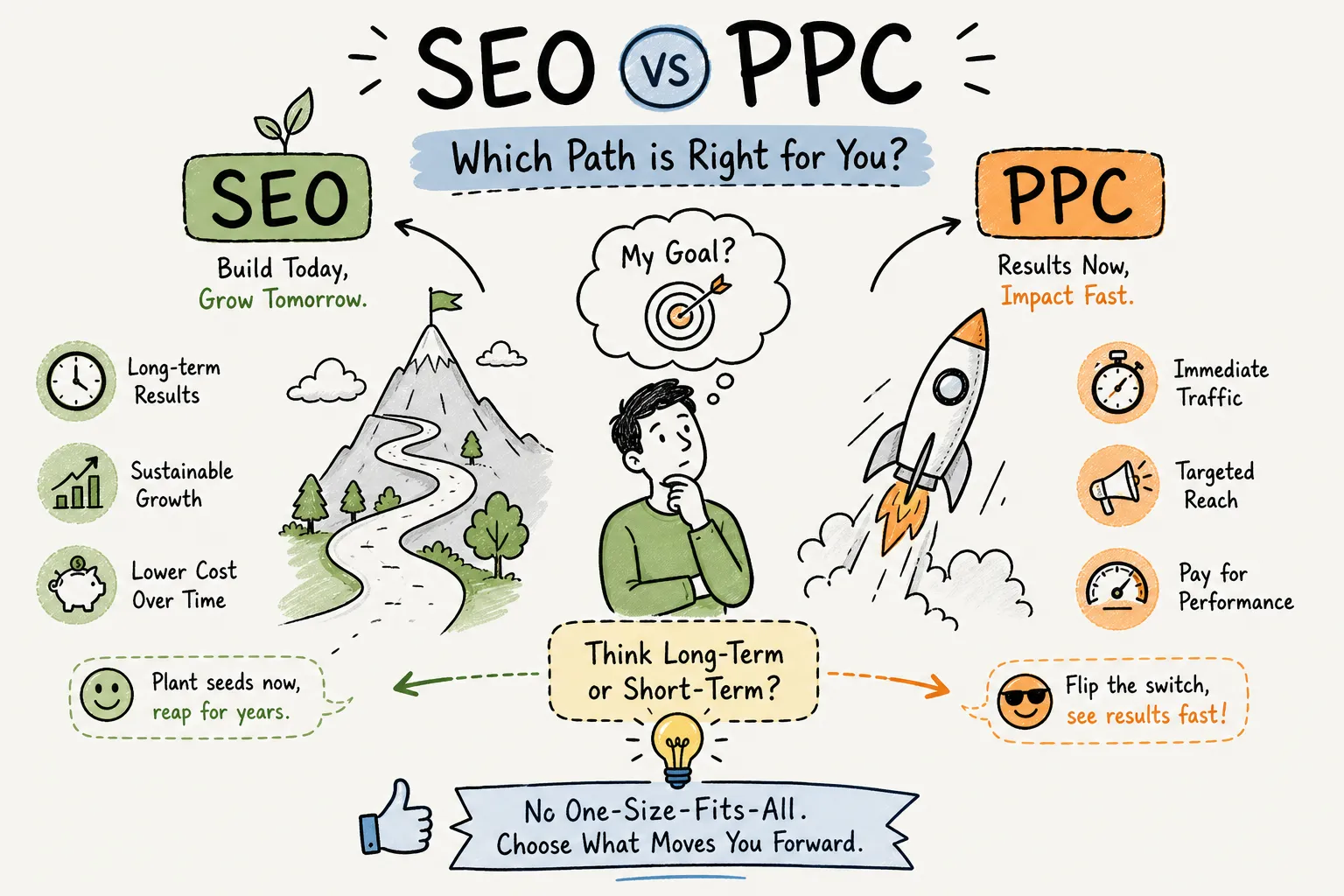
Every business owner has faced this exact moment: a marketing budget that feels smaller than the ambition behind it, and two channels each making a convincing case for your dollars. The SEO vs. PPC debate isn’t new, but the stakes are higher in 2026 because costs have climbed, competition has intensified, and choosing the wrong starting point doesn’t just waste money, it wastes months. Research indicates SEO delivers roughly $12.20 for every $1 spent over time (Search Engine Journal, 2025 industry benchmark), while PPC averages approximately $2.00 for every $1 spent. Those aren’t close numbers.
At Brandleap Agency, we work through this decision with clients every week. A local service business needs leads by next month. A funded startup wants to build authority before the market gets crowded. A B2B firm is watching its Google Ads bill grow while its organic presence flatlines. Each scenario calls for a different answer, and the right one depends on your budget, timeline, and how your business actually makes money.
By the end of this article, you’ll have a clear framework for deciding whether organic search, paid search, or an integrated approach fits your current stage. No vague advice, real numbers and a decision structure you can act on today.
What SEO and PPC Are (And Why the Distinction Matters)
How Organic Search Builds Long-Term Visibility
SEO is the process of earning search rankings through content quality, technical site performance, and authority signals like backlinks. Every click from organic search is free at the point of delivery, but the investment happens upstream through content production, technical audits, and link acquisition. Rankings build on themselves over time. Content published in month 3 can still generate leads in month 18, and your rankings don’t vanish the moment you stop spending. They do, however, take 3 to 12 months to build meaningfully, a real constraint for businesses with urgent revenue needs.
How Paid Search Buys Immediate Placement
PPC, primarily through Google Ads, places your business at the top of search results for targeted keywords in exchange for a cost-per-click. You set the budget, choose the keywords, and your ads appear within hours of campaign launch. The tradeoff is straightforward: traffic is instant and fully controllable, but it stops the moment your budget does. A business with no organic rankings that pauses its PPC campaigns loses all search visibility overnight. There is no residual effect, no compounding return, and no fallback position. If you need a rapid, well-managed short-term acquisition program, consider running purpose-built targeted PPC campaigns while your organic foundation is being built.
SEO vs. PPC: Speed, Cost, and ROI
How Long Before Each Channel Delivers Results
SEO produces initial traction in 3 to 6 months and meaningful, competitive growth in 6 to 12 months. The ROI break-even point typically lands around month 9, and SEO cost-per-acquisition drops below PPC’s between months 12 and 18. PPC campaigns go live within hours and generate usable optimization data within 30 days. For most businesses, that speed gap is what determines which channel makes sense right now, and understanding PPC vs. SEO ROI over time is essential before committing to either.
What It Actually Costs to Run Each Channel
A typical small-to-mid-size SEO retainer runs $1,500 to $5,000 per month, covering technical audits, content creation, and link-building. PPC requires ad spend of $1,000 to $10,000 or more per month, plus agency management fees of $500 to $2,500. Critically, PPC costs are tied directly to your industry’s cost-per-click benchmarks. Legal services average $8 to $15 per click, while e-commerce keywords often run under $1.20. An insurance firm spending $10,000 per month on Google Ads to maintain visibility could instead invest in our Organic SEO services and, within 18 months, own those rankings outright.
Long-Term ROI Comparison by Business Type
The numbers favor organic search over time, but not equally across every business type. SEO delivers approximately 25% higher ROI than PPC on a long-term basis, and organic traffic converts at 14.6% compared to PPC’s 3.75% (HubSpot, 2025). For local businesses, SEO leads cost 68% less than PPC leads, and organic search drives 53% of traffic in competitive local markets versus 27% from paid. For e-commerce, Google Ads vs. search engine optimization is a nuanced comparison: PPC can generate immediate return on ad spend while SEO builds the catalog and category rankings that sustain growth without continuous ad spend. In 2026, organic results account for roughly 85% of total search clicks, making the case for a paid vs. organic search strategy difficult to ignore over any multi-year planning horizon.
When SEO vs. PPC Favors Paid Search for Your Business
You Need Traffic Now, Not in Six Months
New product launches, seasonal campaigns, and businesses with zero organic presence are natural PPC use cases. If your cash flow depends on leads this month, SEO’s 6-month runway is not a viable option. PPC fills that gap with precision, letting you target high-intent keywords immediately while your organic foundation gets built in the background. For early-stage businesses, allocating 70 to 80% of the marketing budget to PPC while SEO ramps up is a common and effective approach.
Your Margins Can Absorb the Cost-Per-Click
The math on PPC only works when your average order value or client lifetime value supports it. B2B services, legal practices, and financial advisors often see CPCs of $3.30 to $5.50, but their deal sizes are large enough to make those clicks worthwhile. Run a simple margin test: if a converted lead at a $10 CPC generates $5,000 in revenue, paid search makes economic sense. If you’re selling $30 products at a 2.81% conversion rate, you need e-commerce CPCs under $1.20 to make the numbers work, achievable in less competitive categories.
You Want to Test a Market Before Committing to Content
PPC keyword data reveals which search terms convert before you invest months into content production. Running a 60 to 90-day paid campaign on a new product line or service category tells you exactly which queries drive real buyers, not just browsers. Once you’ve identified the top performers, you build your SEO content strategy around proven commercial intent rather than assumptions. This approach reduces wasted content spend and gives your organic strategy a head start built on real data.
When Organic Search Delivers Better Long-Term Returns
Your Industry CPCs Make PPC Economically Unsustainable
In competitive verticals like legal, insurance, and SaaS, cost-per-click rates run $5 to $15 or more. Sustaining those costs month after month makes an SEO retainer look like a bargain within 12 to 18 months. Consider a SaaS company spending $12,000 per month on paid search versus a $3,000 monthly SEO retainer: by month 18, the SEO investment has built permanent rankings while the PPC spend has generated nothing lasting. The fixed cost of SEO versus the perpetual spend of PPC changes the economics fundamentally over any 24-month planning window.
You’re Building a Brand That Needs Authority, Not Just Clicks
Organic rankings carry trust signals that paid ads don’t. Users click organic results at significantly higher rates for research and comparison queries, and B2B buyers, high-ticket service shoppers, and anyone in the evaluation phase of a purchase are actively skeptical of ads. Organic content meets those users at the right moment with the right intent signal. When your SEO content answers the exact question a prospective client is asking before they’re ready to buy, you build brand recall and authority that converts later, on your own terms.
You Need a Channel That Works While You Sleep
Once SEO rankings are established, traffic flows consistently without ongoing spend. That’s a fundamentally different economic model than PPC. A single well-optimized blog post or service page can generate qualified leads for years. For resource-constrained businesses that can’t sustain a five-figure monthly ad budget indefinitely, this compounding return changes the unit economics entirely. The investment concentrates upfront; the returns distribute over time.
Why the Strongest Strategies Run Both Channels Together
PPC and SEO Inform Each Other in Ways Neither Channel Can Alone
PPC data reveals converting keywords faster than organic testing ever could. At the same time, SEO content improves ad landing page relevance, which directly raises Google Ads Quality Scores. A higher Quality Score lowers your cost-per-click because Google rewards relevance with cheaper auction prices. These two channels create a feedback loop that amplifies performance in both directions, but only when managed by a team that understands both. Running them in silos through separate vendors breaks that loop and leaves significant efficiency gains on the table.
The Budget Allocation Rule Most Marketers Use
Early-stage businesses typically allocate 70 to 80% of their search marketing budget to PPC to generate immediate cash flow while SEO builds in the background. As domain authority grows and organic rankings take hold, the budget split gradually shifts toward 70 to 80% SEO. Integrated campaigns, where PPC keyword data directly informs content strategy and organic landing pages improve ad Quality Scores, can outperform single-channel strategies by up to 300% in competitive categories like SaaS.
How a Full-Service Agency Executes Both Without the Silos
Most agencies specialize in one channel or the other. An SEO shop won’t manage your Google Ads effectively. A PPC agency won’t build your content architecture. Brandleap Agency operates differently: technical SEO, on-page optimization, Google Ads management, and landing page development all run under one roof. The data from paid campaigns feeds directly into the organic content strategy, and organic rankings inform which paid keywords to scale or cut. No handoff gaps, no conflicting reports, and no channel cannibalization eating into returns. For businesses that want both strategy and execution from a single accountable partner, that integration is the difference between incremental gains and a compounding growth engine.
A Clear Decision Framework for Choosing Where to Start
When SEO vs. PPC Makes Sense for Your Business: Four Questions
Use these four questions to cut through the noise and arrive at a practical starting point:
- How soon do you need results? If you need leads within 30 days, start with PPC. If a 6-month runway is acceptable, SEO is viable from day one.
- What is your monthly budget? Under $2,000 per month limits your PPC options significantly. Over $5,000 per month opens up integrated campaigns.
- Is your website new or established? New sites with no domain authority will wait longer for organic results. PPC bridges that gap while SEO builds the foundation.
- Are you in a high-CPC vertical? If your industry keywords cost $8 or more per click, SEO’s long-term economics are almost always superior once you pass the 12-month mark.
The Budget Scenarios That Make the Choice Obvious
Your monthly budget is often the clearest signal of where to begin. Under $2,000 per month, start with SEO and delay PPC until you can fund ad spend at a meaningful scale, spreading a small budget across both channels produces weak results in both.
Between $2,000 and $5,000 per month, a split approach makes sense: use PPC for high-intent, bottom-of-funnel keywords while building SEO content around longer-tail, educational queries. At $5,000 per month and above, run fully integrated campaigns where shared keyword data flows between channels and landing pages are optimized for both Quality Score and organic ranking simultaneously.
The Real Answer to the SEO vs. PPC Question
Framing organic search and paid search as competitors misses the point. They’re different stages of the same growth engine. PPC generates immediate cash flow and market intelligence. SEO converts that intelligence into permanent, compounding visibility. The businesses winning search in 2026 aren’t picking one or the other at scale, they’re using PPC data to sharpen their content strategy and using organic authority to reduce what they pay per click over time.
When weighing SEO vs. PPC, your starting point depends on where your business sits today, not where you want to be in three years. A new business with urgent revenue needs starts with paid search. An established business with thin margins and a 12-month horizon leans into SEO. A business with the budget and patience to run both simultaneously builds a durable competitive advantage that neither channel alone can create.
If you’d rather not manage two channels through two separate vendors while trying to run a business, that’s exactly the problem Brandleap Agency was built to solve. Reach out to the Brandleap team for a growth audit and a clear channel strategy mapped to your specific budget, timeline, and revenue goals, one partner, one accountable outcome.