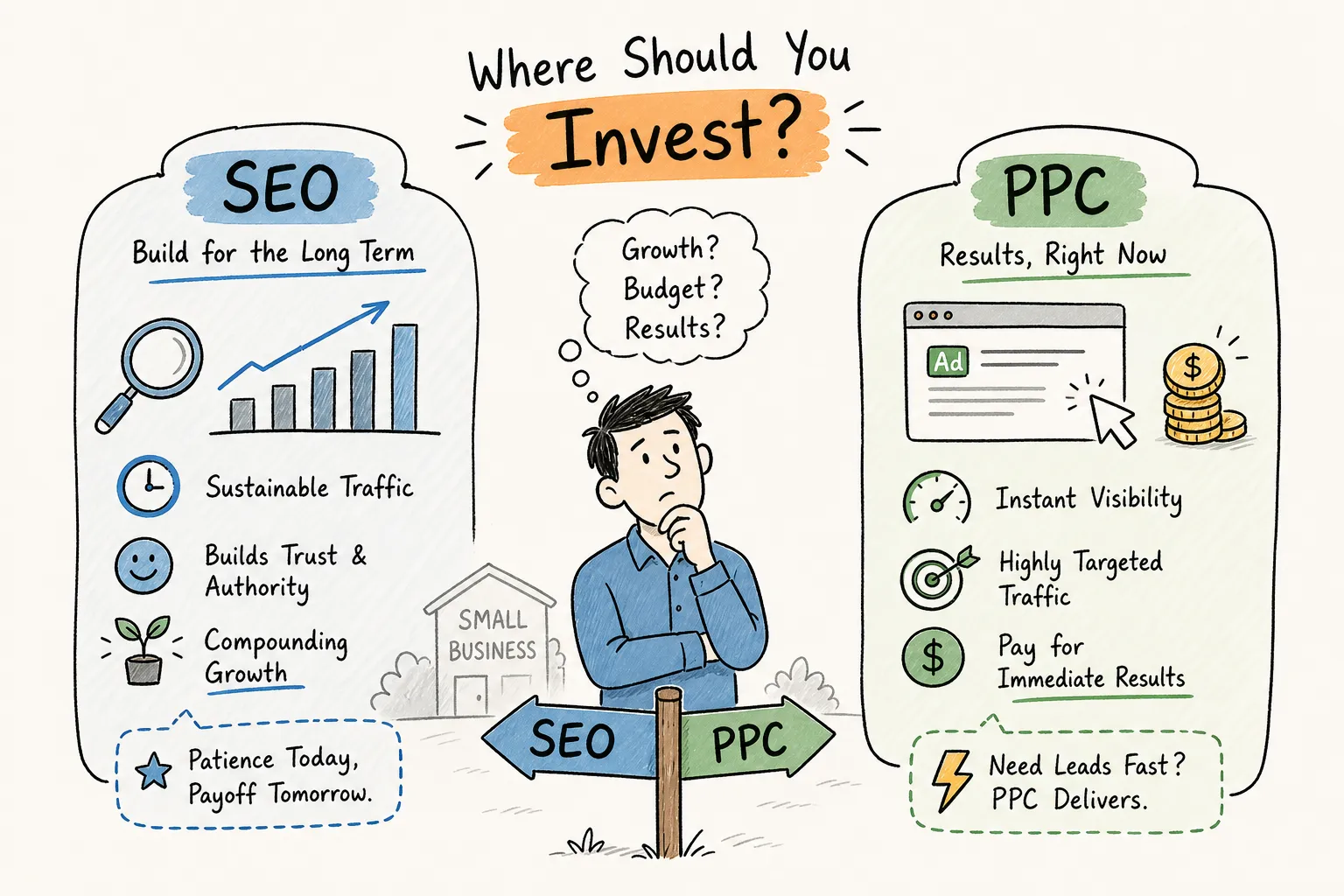
Should I invest in SEO or PPC for my small business? It’s a question with real financial consequences, and it deserves a straight answer, not a sales pitch. You have a fixed marketing budget, two channels that both promise results, and no clear framework for choosing between them. Every marketing agency you talk to has an opinion, and somehow that opinion always favors whatever they happen to sell. At Brandleap Agency, it’s one of the first questions we work through before building any growth strategy.
Choosing the wrong channel doesn’t just drain budget. It delays real growth by months, or sets expectations so far off-base that you abandon a strategy before it has a chance to work. Consider the business owner who expects SEO to generate leads in week three and quits at month two, right before the compounding returns kick in. Or the one who pours money into Google Ads without a converting landing page and burns through budget with nothing to show for it.
This guide breaks down the real numbers on cost, timelines, and long-term ROI for both organic and paid search. It also gives you a practical framework for making the call based on your business type, current budget, and how urgently you need results.
What Each Channel Actually Costs a Small Business
Before you weigh timelines or ROI, ground yourself in realistic cost expectations. Many agencies see clients come in with SEO budgets that simply can’t fund the work required to move the needle, leading to under-investment and disappointment when results don’t appear.
The Minimum Viable SEO Investment
In a competitive US market, meaningful SEO results require a monthly budget of $1,500 to $3,000 at minimum. Below that threshold, the work required to build rankings outpaces what the budget can fund: content creation, link building, technical fixes, and ongoing optimization all have to happen simultaneously. There’s also a one-time foundation cost, a technical audit and on-page groundwork typically runs $1,500 to $5,000 before monthly retainer work even begins. Skipping that foundation means your ongoing investment builds on a cracked base. If you need clarity on what those services look like in practice, our organic SEO services page outlines the core deliverables and expected timelines.
Investing in SEO vs. PPC: Cost, Timeline, and ROI by Industry
Paid search costs vary dramatically by industry, and the numbers matter before you set a budget. Local service businesses face an average cost per click of $6.40 in consumer services, meaning an HVAC company or plumber needs a meaningful daily ad spend just to stay competitive in their local market. B2B advertisers pay an average of $3.33 per click, while ecommerce brands see the lowest CPC at $1.16. That $1.16 sounds affordable until you factor in ecommerce’s average conversion rate of roughly 0.45%, which means you need a high volume of clicks to generate a single sale. Understanding your industry’s specific economics determines whether paid search advertising is a smart short-term lever or an expensive treadmill. For current benchmarks on Google Ads costs by industry, see the 2026 Google Ads benchmarks, and for historical industry averages consult WordStream’s Google Ads industry benchmarks.
How Long Before You Actually See Results
Timeline expectations are where most small businesses get burned. Expecting SEO to behave like PPC, or expecting PPC returns to compound like SEO, sets you up for frustration in both directions.
PPC: Days to First Conversion
Paid search campaigns generate traffic and conversions within hours to days of launch. ROI is measurable almost immediately, and you can adjust messaging, bids, and targeting in real time. The trade-off is that long-term returns stay relatively flat: the average PPC return runs around 200%, or roughly $2 in value for every $1 spent. That number doesn’t compound over time the way organic rankings do, and the moment you stop spending, traffic disappears entirely. If you want help setting up high-performing ads, our team builds and optimizes targeted PPC campaigns that focus on converting visitors from day one.
SEO: The 3-to-12-Month Reality
SEO requires 3 to 6 months to gain real momentum in most markets, and 6 to 12 months or more in competitive niches. That timeline frustrates business owners accustomed to the immediacy of paid advertising. But the long-term economics justify the patience: SEO ROI can compound significantly over 12 to 24 months, and organic traffic generally converts at a higher rate than paid search. The break-even point typically lands around month six, after which cost-per-acquisition trends downward as rankings hold and traffic scales without a corresponding increase in spend. For data comparing conversion rates and longer-term performance between SEO and paid channels, see this SEO vs PPC statistics report.
Should I Invest in SEO or PPC for My Small Business? A Decision Framework by Business Type
The most important variable in this decision isn’t your budget. It’s your business model. The economics of SEO versus paid search shift significantly depending on whether you serve a local area, run an ecommerce store, or sell to other businesses.
Brick-and-Mortar and Local Service Businesses
For businesses that depend on local foot traffic or service area leads, local SEO changes the math entirely. A customer searching “plumber near me” is not comparing national brands, they’re choosing the closest, most credible option. That proximity-driven intent makes local search optimization, specifically Google Business Profile optimization and local citation building, one of the highest-ROI investments a brick-and-mortar business can make. According to Google’s own data, optimized profiles receive 70% more direction requests and generate twice as many customer actions as incomplete listings. Local SEO competes on a hyper-local scale, which means rankings are achievable faster and at lower cost than national campaigns. PPC still captures high-intent searches immediately, but local SEO is the sustainable growth engine for businesses tied to a geographic area.
Ecommerce Brands
Ecommerce faces the most challenging paid search economics. A $1.16 CPC sounds manageable, but a 0.45% conversion rate means you need significant click volume to drive consistent sales. PPC works well for product launches, seasonal promotions, and testing new SKUs where you need fast data. For the long term, organic search optimization of product pages, category content, and backlink building offers superior economics because the cost-per-acquisition falls as rankings mature rather than staying flat or rising.
B2B Service Companies
B2B buying decisions have longer sales cycles, and that cycle length matters when evaluating paid search marketing. A $3.33 CPC with a 3.04% conversion rate is workable for capturing high-intent prospects, but the real value in B2B comes from content-led SEO: thought leadership articles, case studies, and service pages that build authority and generate inbound leads organically over time. A prospect who finds your firm through a well-ranked article on a problem they’re actively researching arrives with more built-in trust than one who clicked an ad.
The Long-Term ROI Case: Why Compounding Matters
Looking at the first 90 days of either channel gives you an incomplete picture. The financial trajectory over 12 to 24 months is where the real difference between SEO and paid search becomes clear.
Why PPC ROI Stays Flat
PPC is a rented asset. The $2 return per $1 spent holds relatively constant as campaigns mature beyond basic optimization. There’s no compounding effect, you don’t build equity in paid search the way you build equity in organic rankings. Stop the budget and traffic stops the same day. For businesses that need predictable, controllable lead flow, that’s a feature. For businesses building toward lower customer acquisition costs over time, it’s a ceiling.
How SEO ROI Compounds Over Time
SEO cost-per-lead averages $20 to $40 by month six and continues to improve as traffic scales without proportional increases in spend. By month 12, that cost is often 30 to 50% of what paid search costs for the same lead volume. A Decorating Den franchisee case study illustrates a secondary benefit worth noting: businesses that built SEO authority alongside their PPC campaigns saw a 128% increase in PPC form lead conversion rates compared to franchisees running paid ads alone. SEO doesn’t just compound on its own; it makes every other channel work more efficiently.
How to Split Your Budget If You Want to Run Both
A vague “do both” recommendation helps no one. The right budget split depends on where you are right now and what your business needs over the next six to twelve months.
Under $2,000 per month: This budget is too thin to run both channels effectively. If you need leads within 30 days, put the full budget into PPC. If you can wait three to six months for results, go SEO-first with everything you have. Splitting a budget this size leaves both channels underfunded and neither performing.
$2,000 to $5,000 per month: When your business reaches this range, a hybrid approach starts to make financial sense. A 60/40 PPC-to-SEO split tends to work well, PPC captures immediate demand and funds the business while SEO builds the foundation. Stay disciplined about not shifting everything to paid when organic results feel slow.
$5,000 per month and above: Start with a 70/30 PPC-to-SEO split at launch to generate immediate pipeline, then shift gradually toward 40/60 as organic rankings mature and organic traffic begins delivering consistent lead volume. The rebalancing typically makes sense around months six to nine, once organic conversion data is available to justify the shift.
How to Know When to Rebalance
Once organic traffic is delivering consistent lead volume, shifting spend from paid search advertising toward SEO and content reduces overall customer acquisition cost without sacrificing lead flow. This analysis requires actual conversion data, not assumptions. At Brandleap Agency, we run this rebalancing continuously against live performance metrics, so budget always follows what’s actually working rather than what looked good in a spreadsheet six months ago.
A Short Decision Checklist Before You Commit to a Channel
Run through these five questions before you allocate a dollar. Each one steers the answer toward the right channel for your situation.
- Do you need leads within 30 days, or can you invest for 6 to 12 months? If the business needs revenue now, start with PPC. If you have runway, SEO delivers better long-term economics.
- What is your monthly marketing budget? Under $2,000 means you pick one channel. Above $2,000 opens up a hybrid approach combining paid search advertising and organic growth.
- Are you serving a local area or a national/ecommerce audience? Local businesses should prioritize Google Business Profile and local SEO. Ecommerce and national brands have different content and link-building levers to pull.
- Have you built any domain authority or organic rankings yet? A site with zero organic presence needs more runway for SEO to pay off. A site with existing authority can see rankings move faster and at lower cost.
- Do you have a landing page or website that converts traffic? PPC without a converting landing page is a guaranteed way to waste budget. Fix conversion before driving paid traffic, regardless of channel.
If the answers point clearly to one channel, you have your direction. If they point to both, that’s exactly where a full-service partner earns its keep, helping you structure the split, execute both channels, and adjust as the data comes in. For guidance on choosing vendors and structuring an SEO engagement, review our checklist on how to choose the right SEO services for small businesses.
The Right Answer Depends on Your Situation, Not a Trend
Neither SEO nor paid search is universally better. PPC wins when speed matters, when you’re launching something new, or when you need to validate demand before committing to a content strategy. SEO wins when you’re building for the long game, want decreasing acquisition costs over time, and are willing to invest through the ramp-up period. For most small businesses with the budget to run both, the combination outperforms either channel running alone, as the Decorating Den data makes clear. For additional perspective on the broader SEO vs PPC debate, see this SEO vs PPC comparison.
Consistent growth comes from treating SEO and PPC as complementary engines, not competing line items. If you’re still asking yourself “should I invest in SEO or PPC for my small business,” the honest answer is that the right channel mix depends on your specific market, timeline, and budget, and it should be revisited as your rankings and revenue evolve. Brandleap Agency offers a free growth strategy conversation where we map out that channel split for your situation. Start there.