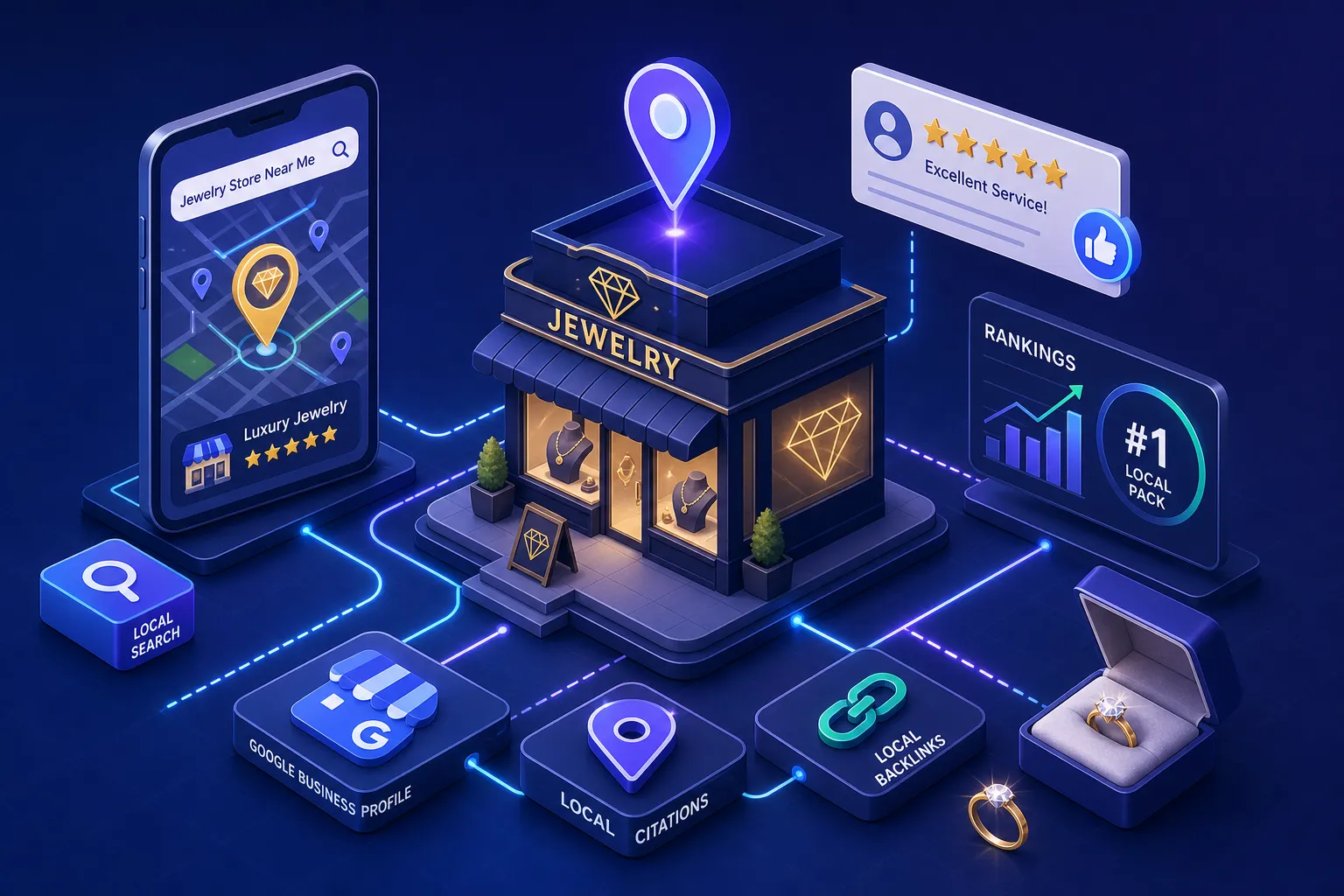
Someone searching “engagement rings near me” or “jewelry store open now” is not browsing. They are ready to walk in the door, often within 24 hours. A dedicated jewelry store local SEO service helps you capture exactly that kind of purchase-ready intent, and it is rare in any industry. For jewelers, it represents an enormous local search opportunity that most stores are not capturing. The reason is almost always the same: an incomplete or inconsistently managed online presence.
At Brandleap Agency, our team works with high-end retail businesses on hyper-local campaigns, and jewelry stores consistently rank among the highest-opportunity niches for local search growth. The gap between what most stores currently rank for and what they could rank for is wide, and it is closeable with the right execution.
This guide gives you a clear priority order: which services move the needle most for local search visibility, what results to realistically expect, and what to look for when evaluating an agency to handle the work. No theory. Just the tactics that drive direction requests, phone calls, and showroom visits.
1. Why your Google Business Profile is the most valuable local SEO asset you own
If you have one hour to invest in local search optimization for your jewelry store, spend it on your Google Business Profile. No other single asset drives as many direction requests, calls, and storefront visits. Profiles with 30 or more photos, 50 or more reviews, and GBP Products enabled receive 4.8 times more direction requests than incomplete profiles. That is not a marginal difference. It is the difference between appearing in the local map pack and being invisible to shoppers a mile away.
The most common mistake jewelers make is treating GBP as a setup task they completed once. It is not a one-time checkbox. It is an active local marketing channel that rewards consistency, freshness, and precision.
Google Business Profile optimization for jewelry stores: the exact setup that drives direction requests
Start with category selection, because this is where most jewelry stores get it wrong. Your primary category should be “Jewelry store.” Secondary categories should only include options that reflect real services you offer: “Jeweler,” “Jewelry repair service,” and “Jewelry designer” are all legitimate choices. Resist the urge to pile on categories you do not truly deliver. Category precision carries more weight than category volume, and irrelevant secondary categories dilute your relevance signal for the searches that matter most. For an updated reference on Google Business Profile categories, consult this list of GBP categories.
For attributes, enable “in-store shopping” and “curbside pickup” if those apply to your location. These help shoppers make fast decisions before they ever leave the search results. For photos, think like a shopper: exterior shots help them find you; interior shots build trust before they walk in; product shots answer the question “do they carry what I’m looking for?”; and service photos showing custom design consultations or repair work reinforce your expertise. Each photo type serves a different stage of shopper intent, so include all of them.
Reviews and GBP posts: the ongoing signals that sustain rankings
Reviews are a live ranking factor, not a historical asset. A store with 60 reviews that stopped collecting feedback 18 months ago is already at a disadvantage against a competitor with 35 reviews that arrived in the last 90 days. Build a systematic process for requesting reviews at the moment of highest satisfaction: when a customer picks up a custom piece, when a repair is completed on time, or when a sale closes. Respond to every review within 48 hours, including the negative ones. That response pattern signals to Google that the profile is actively managed.
GBP posts are equally underused by jewelry stores. New arrivals, limited-time promotions, holiday events, and custom design showcases all make legitimate post content. Posting consistently, even twice a month, keeps the profile active and reinforces your relevance for recurring Maps searches in your area.
2. Local citations and NAP consistency: the foundation most jewelers overlook
A citation is any online mention of your store’s name, address, and phone number. When those details match perfectly across every platform, search engines build confidence that your business is legitimate and accurately located. When they do not match, whether because of an old phone number still live on a directory, a suite number that appears on some listings but not others, or a duplicate entry from a previous address, that inconsistency suppresses your map rankings without you ever knowing why.
Citation work is not exciting, but it is foundational. Every other local SEO service you invest in sits on top of this layer. If the foundation is cracked, the results above it will underperform.
Where to list your jewelry store for maximum local authority
Prioritize your listings across three tiers:
- High-authority general platforms: Google Business Profile, Apple Business Connect, Bing Places, Yelp, Facebook, and the Better Business Bureau. These carry the most weight for local discovery and map visibility.
- Supporting general directories: Yellow Pages, Manta, Superpages, MerchantCircle, and your local Chamber of Commerce.
- Jewelry-specific directories: Jewelers.org and curated jewelry trade directories that reinforce your topical relevance.
Wedding-focused platforms deserve a special mention. Listings on directories like The Knot and WeddingWire connect your store directly to couples actively planning, the highest-intent buyer segment in your market. These platforms drive referral traffic that general directories never will, and they add a trust signal that tells search engines your store is a legitimate player in the bridal category.
How citation errors silently suppress your map rankings
The most common citation problems jewelry stores face are mismatched phone numbers from a number change, duplicate listings created when someone claimed the profile a second time without removing the original, and stale addresses after a store relocation. Each of these creates a conflicting signal that makes search engines less confident about your location, which translates directly to lower map pack placement.
A citation audit should be the first diagnostic step in any local SEO engagement for a jewelry store. It involves pulling all existing mentions of the business across directories, identifying inconsistencies, correcting errors at the source, and suppressing or merging duplicates. If you need a curated list of citation sources tailored for jewelers, see this citation building list for jewelers. Without this step, every tactic built on top of it has to work harder than it should.
3. Geo-targeted content that captures high-value, ready-to-buy shoppers
A jewelry store competing for “engagement rings in [city]” or “custom jewelry designer [neighborhood]” needs more than a homepage with a city name dropped into the footer. Those searches carry strong purchase intent, and they reward stores that have dedicated content built specifically to answer the geo-modified query. Your website is the third pillar of local search authority, and it needs to carry real SEO weight.
Local landing pages that convert “near me” searches into showroom visits
A well-built local landing page is not a thin keyword page. It includes a geo-specific headline, a clear focus on one or two product categories, engagement rings, custom design, jewelry repair, an embedded Google Map, locally sourced reviews, and a direct call to action that gets someone into your store. The page should answer the implicit question behind the search: “Is this the right jeweler for what I need, and is it near me?” When a page answers that clearly, it ranks and it converts.
If your store serves multiple neighborhoods, suburbs, or nearby towns, separate location pages for each area are worth building. The same logic applies across product lines: a page targeting “engagement ring stores in [city]” and a separate page for “jewelry repair [city]” will each rank for distinct intent clusters rather than competing with each other.
Schema markup that makes your jewelry store eligible for rich search results
Three schema types matter most for jewelry stores. Use the JewelryStore type, a LocalBusiness subtype, on your location pages, embedding your name, address, phone, hours, and price range in JSON-LD format. Use Product schema on individual product pages to provide name, price, availability, and material details. Add AggregateRating only on pages where genuine, visible review data exists. These schema types make your listings eligible for rich results showing star ratings, prices, and availability directly in search. Eligible does not mean guaranteed, but without the markup, you are categorically excluded from those features. For a reference to the JewelryStore schema fields, consult this JewelryStore schema list, and for practical JSON-LD examples for ecommerce, see this guide to schema markup for ecommerce (JSON-LD).
4. What a full-service local SEO campaign actually delivers for jewelry stores
A professionally managed jewelry store local SEO service is not a single tactic. It is a coordinated set of services working together: GBP management, citation audit and build, on-page local optimization, review strategy, local content creation, schema implementation, and monthly performance reporting against metrics that matter, specifically direction requests, calls, and website visits from local search.
One-off or piecemeal services that address only one of these layers will produce short-term fluctuations, not compounding growth. The stores that win “engagement rings near me” searches are not necessarily the biggest jewelers in town. They are the ones whose complete local presence is managed consistently over time. For additional strategy and industry-specific tactics, see this SEO for jewelry stores guide.
How Brandleap builds hyper-local campaigns for high-end jewelers
At Brandleap Agency, every jewelry store engagement starts with a local visibility growth audit: a full diagnostic of the store’s current GBP completeness, citation health, on-page local signals, and competitor gap analysis. From there, we build a prioritized campaign that matches budget to impact, starting with the highest-leverage work first rather than spreading resources across everything at once.
Our founder-led model means strategy and execution stay connected. There is no handoff from a strategist to a separate team that loses context along the way. For luxury and high-consideration retail like fine jewelry, where trust and local relevance are everything, that continuity matters. Since SEO, content, and web development sit under one roof at Brandleap, we eliminate the coordination gap that jewelry stores typically face when managing three separate vendors who never talk to each other. Read more about why local SEO agency selection matters and how our approach keeps strategy and execution aligned.
5. How to evaluate and hire the right local SEO agency for your jewelry store
Most agency proposals look similar on the surface. The difference between a strong partner and a wasted budget usually comes down to whether the agency understands what local search marketing for jewelers specifically requires, not just local SEO in general. Here is how to vet any agency before you sign.
Questions to ask any agency before signing a contract
Ask for examples of GBP-specific results, not just organic ranking improvements. GBP management requires a different skill set than broad SEO, and many agencies are stronger on one than the other. Ask whether they conduct a citation audit before starting any campaign. If the answer is no, they are building on an unstable foundation. Ask exactly how they report on local performance: direction requests, phone calls from GBP, and local pack impressions are the metrics that reflect real foot-traffic potential, not keyword position reports alone.
Watch for these red flags: guaranteed ranking promises, proposals that skip the audit phase entirely, and packages that exclude ongoing GBP management. Also be cautious of agencies that cannot explain their local content process in specific terms. Creating thin, keyword-stuffed location pages is not a strategy. It is a liability. If you want region-specific programs or examples of localized service packages, review our Local SEO Services Philippines offering to see a model for market-specific execution and reporting.
Realistic timelines and ROI benchmarks from real jewelry store campaigns
Set your expectations based on what the data shows. GBP improvements can produce movement in direction requests and call volume within 60 to 90 days when the work is done correctly. Broader organic traffic growth from local content and citation building typically becomes measurable at the 3-to-6-month mark.
Stronger, more stable gains in competitive markets tend to take closer to 6 to 12 months. Campaign data from jewelry store SEO engagements shows organic traffic lifts in the 250% to 280% range within that window when a complete local strategy is executed. Integrated campaigns combining local SEO with paid media have shown sales increases of 52% and ROI improvements of 70% or more, though those figures reflect multi-channel work rather than local SEO in isolation.
Local SEO is a compounding investment. The citation authority, review volume, and content you build in month three are still working for you in month eighteen. That compounding return is what separates it from paid advertising, where visibility stops the moment you stop spending. If you want to see examples of how map-focused local work can dominate search visibility, check this resource on Google Map domination for jewelers.
Build the local presence your store deserves
The priority order is clear. Start with GBP optimization: get the categories right, load the photos, enable products, and build a review generation system. Then audit and clean up your citations so your NAP data is consistent everywhere it appears. Then build out geo-targeted landing pages and implement schema markup to capture high-intent organic searches. Finally, put ongoing management in place so those gains compound rather than erode.
The jewelry stores showing up at the top of “engagement rings near me” searches are not there by accident. They have a complete, consistently managed local presence, and they built it with the right partner. If you want a jewelry store local SEO service that identifies exactly where your store stands, which gaps are costing you visibility, and what a prioritized campaign would look like for your market, request a local visibility audit from Brandleap Agency. We will show you the specific opportunities your competitors are missing, and the ones they are already exploiting against you.