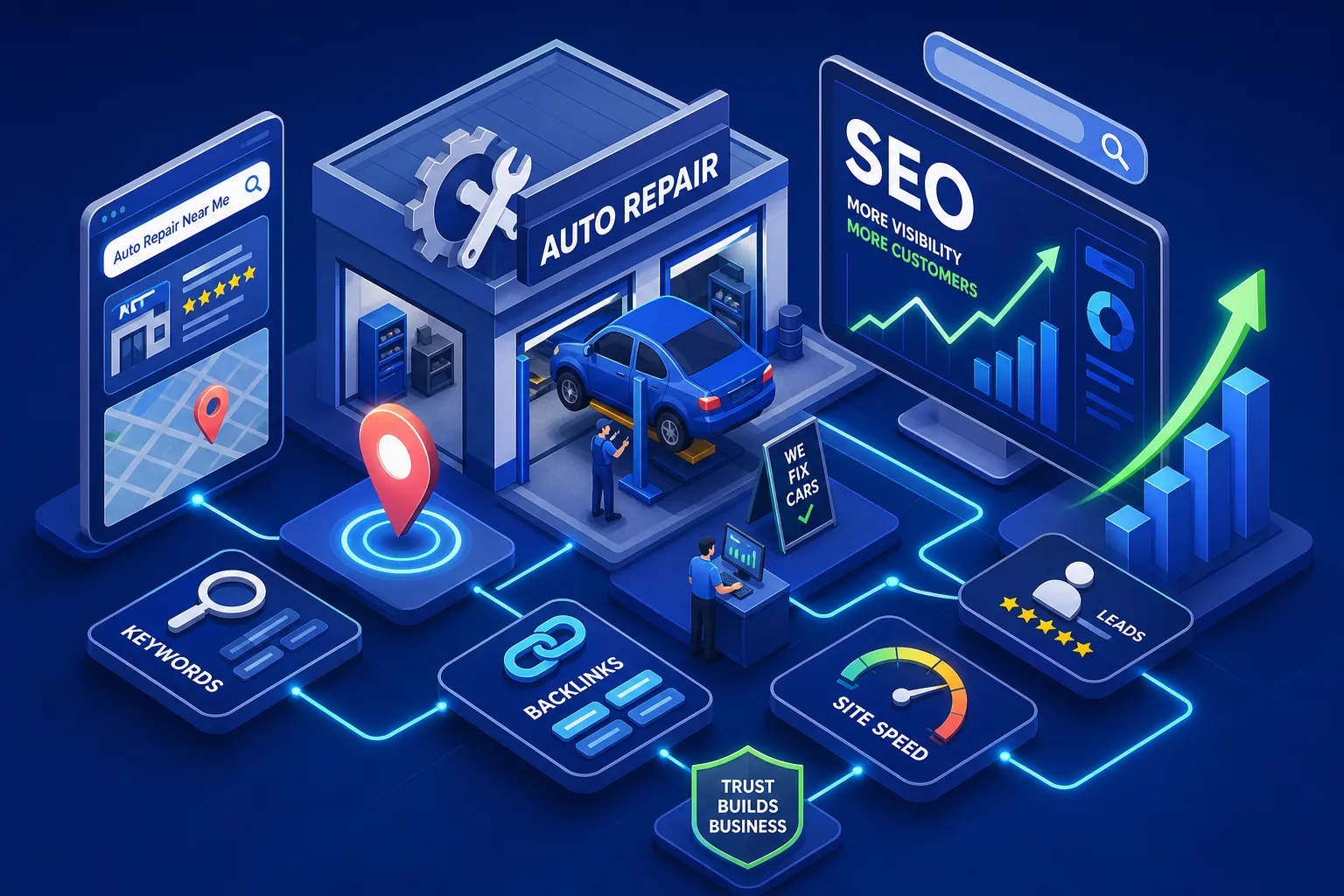
Your shop does great work. Your techs are skilled, your turnaround is fast, and your existing customers keep coming back. But down the street, a competitor with mediocre reviews is booked out three days ahead while you’re watching bays sit empty on a Tuesday. That’s a common scenario in local markets where visibility, not quality, determines who gets the call. The difference isn’t quality. It’s visibility.
Local search has become the primary channel where car owners decide which shop gets the call. A driver hears a grinding noise, pulls out their phone, and types “brake repair near me.” The shops that appear in those first three Google results claim the lion’s share of clicks and calls, shops that don’t appear simply don’t exist for that customer. Auto repair SEO services built specifically for local repair businesses have closed that visibility gap for hundreds of independent shops. Brandleap Agency structures its auto repair digital marketing programs around exactly this problem: getting independent shops into the Map Pack and keeping them there.
This guide covers the exact tactics that drive calls for auto repair shops: optimizing your Google Business Profile, building a review system that runs on autopilot, cleaning up your citations, and evaluating SEO providers based on pricing, deliverables, and measurable outcomes.
Why local search decides which shops fill their bays
The phone book is gone and Facebook recommendations are slow. When a driver hears something wrong with their car, the first move is a Google search. High-intent queries like “oil change near me” or “check engine light [city]” trigger the Google Map Pack instantly, and those three listings capture the bulk of clicks and calls. Everything below the Map Pack is a distant second.
How customers search before they call a shop
The typical search journey starts with a symptom: “grinding noise when braking” or “car won’t start in the morning.” Those symptom queries lead to service-specific searches, which lead to proximity queries like “brake shop near me.” Each step narrows intent and increases the likelihood of a call. Shops that have service pages and a strong Map Pack presence capture customers at every stage of that journey. Shops that don’t appear for service-specific terms lose those potential customers before the searcher ever considers picking up the phone.
What the Google Map Pack controls and why it matters
The Map Pack is the three-listing block that appears above organic results for local service queries. It has its own ranking algorithm, its own trust signals, and its own conversion behavior. According to BrightLocal‘s local consumer review research, 28% of local searches convert to direct purchases or calls, and the top Map Pack listings claim the lion’s share of that traffic. Shops that land in the top three tend to see compounding call volume month after month. Shops outside it effectively compete for the remaining clicks on page two.
The competitive gap most shop owners don’t see
Most shop owners check their own Google rankings by searching their business name and assume everything looks fine. That’s branded search, and it tells you almost nothing about competitive visibility. Non-branded searches like “auto repair [city]” or “transmission shop near me” are where new customers are won and lost. A competitor across town with a fully optimized Google Business Profile may be capturing dozens of those clicks every day while your shop, with better reviews and a cleaner facility, sits invisible for every query that doesn’t include your name.
Auto Repair SEO Services: GBP Optimization and Review Strategy
Before investing in content or backlinks, the Google Business Profile needs to be fully built out. GBP is the core input Google uses to match your shop to local repair queries, and profile completeness directly determines whether you enter the Map Pack at all. Shops with 100% field completion and 20 or more photos consistently outperform neglected profiles in both impressions and call volume.
The GBP fields that directly influence Map Pack rankings
Category selection carries the most ranking weight of any single GBP field. Set your primary category to “Auto repair shop,” not “Mechanic”; the latter has lower search volume and weaker matching for general repair queries. Add secondary categories only for services you actually offer: Brake shop, Oil change service, Transmission shop, and Tire shop are the highest-impact additions. Fill out the services section with every individual service and a short description for each, embed local keywords naturally in the business description, and keep hours accurate including holiday closures. A single unclaimed or incorrect field creates friction between your profile and the queries you should be ranking for.
Photos, posts, and your service list as conversion tools
Twenty photos is the threshold that meaningfully increases profile interaction rates. Use exterior shots, interior views, technicians working on vehicles, branded signage, and before-and-after jobs. Weekly GBP posts covering seasonal services, promotions, and brief educational content signal to Google that the business is active and trustworthy. A complete service list with descriptions doesn’t just help rankings, it helps customers confirm your shop does what they need before they ever click through to your website.
GBP setup mistakes that quietly suppress your profile
The most common GBP errors are also the easiest to fix. Mismatched address formats between your GBP and your website confuse Google’s verification process. Selecting the wrong primary category limits which queries trigger your profile. Leaving the services section empty is a missed opportunity for query matching. Ignoring the Q&A section means potential customers see unanswered questions, which can hurt conversion before the call even happens, local SEO practitioners consistently flag this as a low-effort, high-impact fix. These corrections take less than two hours and deliver lasting results that no amount of backlink building can compensate for if the profile is broken.
Review generation: the trust signal that converts searchers into callers
Reviews are a direct ranking factor and the primary conversion lever between a searcher and a call. Google prioritizes shops with high volumes of recent, specific reviews because they signal both trust and service relevance. The goal isn’t a one-time review drive. You need a repeatable system that generates five to ten new reviews every month without relying on staff memory or customer initiative.
Building a post-job review cadence that runs on autopilot
Timing matters significantly. Send an automated SMS immediately after vehicle pickup, or at minimum within 24 hours, while customer satisfaction is highest and the experience is still fresh. Include a direct link to the GBP review form, never make customers search for it. Front-desk staff can verbally prime the request at checkout by saying something simple: “If everything looks good, a quick Google review really helps us out.” That verbal setup increases follow-through on the text significantly. The longer you wait to send the request, the lower the response rate.
How your response strategy signals reliability to Google
Responding to every review tells Google the business is active, engaged, and trustworthy. Strong responses are personalized, reference the specific service mentioned, and avoid templated language that makes the business feel automated. For negative reviews, acknowledge the concern directly and invite the customer to resolve it offline. Never be defensive or dismissive. Prospective customers read how you handle negative feedback as much as they read the review itself, and response rate is a visible trust signal that influences calls before anyone dials.
Why the language inside reviews carries ranking weight
When customers naturally write “fixed my transmission here in [City]” or “best brake shop in [neighborhood],” Google uses that language to strengthen your shop’s relevance for those exact queries. You can ethically encourage this without violating Google’s review policies by asking an open-ended question during checkout: “What did we help you with today?” That frames the experience in the customer’s mind before the review request arrives, making specific, service-rich language far more likely, without prompting a specific rating or outcome.
Local citation building: the consistency layer that anchors your rankings
Citations are your business name, address, and phone number listed across directories, review platforms, and local sites. Google cross-references these listings to verify your shop’s identity and location. When those listings conflict (a different phone number on Yelp than on Bing, an old address still live on Facebook), Google treats the inconsistency as a reliability problem and pulls back on local rankings. Citation consistency is unglamorous work, but it’s the structural foundation everything else sits on.
The directories that actually move the needle for auto repair shops
Claim and verify the universal Tier 1 directories first: Google Business Profile, Yelp, Apple Maps, Bing Places, Facebook, and BBB. These account for roughly 80% of local citation authority. Then prioritize the automotive-specific directories that carry category relevance: RepairPal, AutoMD, AAA Approved Auto Repair, and Mechanic Advisor. Per Whitespark’s citation database, RepairPal and AutoMD are prioritized over general directories specifically because they are trusted sources in the automotive service vertical, which strengthens your shop’s topical relevance for repair queries.
How NAP inconsistencies quietly erode your local authority
The most common inconsistency sources are address abbreviations (Street vs. St.), suite numbers formatted differently across platforms, outdated phone numbers from a previous location, and duplicate listings created accidentally during a platform update. A single conflicting listing on a mid-tier directory can send a confusing signal that suppresses an otherwise well-optimized profile. Google doesn’t assume the inconsistency is a typo; it reads it as unreliable data and adjusts rankings accordingly.
A practical citation audit process to start this week
Run your existing mentions through BrightLocal or Whitespark to pull a full citation report. Identify every inconsistency, then submit manual corrections to each directory. Don’t rely on automated submission tools for accuracy when cleaning up errors, since those tools often replicate the same mistakes. Once the foundation is clean, citations require only a monthly check rather than ongoing heavy lifting. The cleanup is a one-time investment; the maintenance is minimal.
How to evaluate and price auto repair SEO services
Shop owners who are ready to hire an SEO partner need a realistic framework for what to pay, what to expect in deliverables, and how to identify agencies that take retainers without producing calls. The pricing data below reflects what specialized local SEO agencies and mechanic SEO agencies charge in 2026 for single-location shops in competitive U.S. markets.
Pricing for auto repair SEO services: what each tier covers
Entry-level car repair SEO packages in the $500 to $1,500 range typically cover GBP setup and light content, but lack the technical depth or link outreach needed to compete in established markets. Growth packages from $1,500 to $3,500 per month add monthly technical audits, on-page optimization for 10 to 20 pages, schema markup, citation management, review response handling, and four to eight content pieces per month. This is where single-location shops in mid-size markets tend to see the strongest results. Comprehensive garage SEO services and multi-location programs from $3,500 to $10,000 or more suit competitive metro areas or operators who need programmatic location expansion and digital PR.
The deliverables every auto repair SEO contract must include
Before signing any agreement, the scope of work should explicitly list the following items. First, monthly GBP management and a weekly posting schedule. Second, dedicated service pages for brakes, oil changes, engine diagnostics, AC, and transmission. Third, symptom-based content pages targeting diagnostic queries. Fourth, local citation management and review response handling. Fifth, schema markup deployment for AutoRepair and LocalBusiness entities. Sixth, a monthly report tied to actual KPIs. Any agency that can’t provide this in writing before the retainer starts is a red flag.
Red flags that reveal an agency isn’t worth your budget
Guaranteed first-page rankings are impossible to promise. Any agency making that claim is either overstating its capabilities or guaranteeing rankings for keywords no one searches. Reports that show only traffic without calls or booked appointments tell you nothing about revenue impact. Templated content that never mentions your city, your specific services, or your market is generic filler that won’t rank for anything useful. Auto shop SEO services worth their retainer structure deliverables around measurable outcomes: calls, booked appointments, and Map Pack visibility for revenue-driving keywords. That’s the difference between a real growth partner and a retainer collector. Brandleap Agency’s local SEO programs for auto repair shops are built on exactly that framework, with reporting tied to calls and Map Pack rankings rather than vanity metrics.
What to track: KPIs and realistic timelines for shop owners
The most common reason shop owners lose confidence in SEO after three months is that they’re watching the wrong metrics. Traffic graphs going up means very little if the phone isn’t ringing. Connecting your reporting to revenue-linked data from the start eliminates that ambiguity and gives you the tools to hold an agency accountable for real results.
The four metrics that tie directly to booked appointments
Track these in order of revenue impact: booked appointments from organic search (using CallRail or WhatConverts tied to GA4), calls from GBP Insights, local pack visibility for five to ten service-specific keywords, and organic traffic by landing page in GA4. Generic metrics like total session count and bounce rate don’t tell you whether SEO is working. Only conversion-linked data does. If your agency’s monthly report doesn’t include call data and Map Pack rankings, ask for a revised reporting structure immediately.
What to realistically expect in months one through twelve
Months one through three are the foundation phase: GBP optimization, citation cleanup, service page creation, and review system launch. You won’t see significant call increases yet, but impressions and average position in Search Console will begin to move. Months three through six bring Map Pack entry for shops in moderate competition markets, and phone calls from GBP start increasing noticeably. By months seven through twelve, content authority builds, citations stabilize, and lead flow compounds. Shops in dense metro areas typically need six or more months before Map Pack entry; suburban shops often see movement faster.
How to use your monthly report to hold an agency accountable
A trustworthy report includes Map Pack ranking movement for your target keywords, GBP impressions and click-to-call data, new reviews acquired that month, content published, citation work completed, and a brief forward-looking action plan for the next 30 days. If a report is missing conversion data or only shows traffic graphs without tying them to calls or appointments, push back. You’re paying for leads, not sessions.
Start now or keep watching competitors win
The priority order for local search dominance is clear: optimize your GBP first, build a review cadence second, clean up your citations third, create dedicated service and symptom pages fourth, then evaluate an agency partner using the pricing and deliverables framework in this guide. Each of those actions compounds over time. The work done in month one pays dividends in month eight.
The shops consistently booked out three days in advance aren’t necessarily better mechanics. They started their auto repair SEO work earlier, and now they’re collecting calls that used to go to competitors. Every month without a foundation in place is a month of leads going somewhere else. Working with a partner who understands the local service business model, not just SEO theory, is what separates shops that see real results from shops that see invoices without answers.
If you’re ready to close the visibility gap, start with a focused auto repair SEO services strategy: audit your GBP, clean your citations, and build a review system before evaluating any paid retainer. When you’re ready for a partner who structures results around calls and Map Pack rankings, Brandleap Agency offers auto repair digital marketing programs built specifically for independent shops. See their packages and decide whether the approach fits your market.