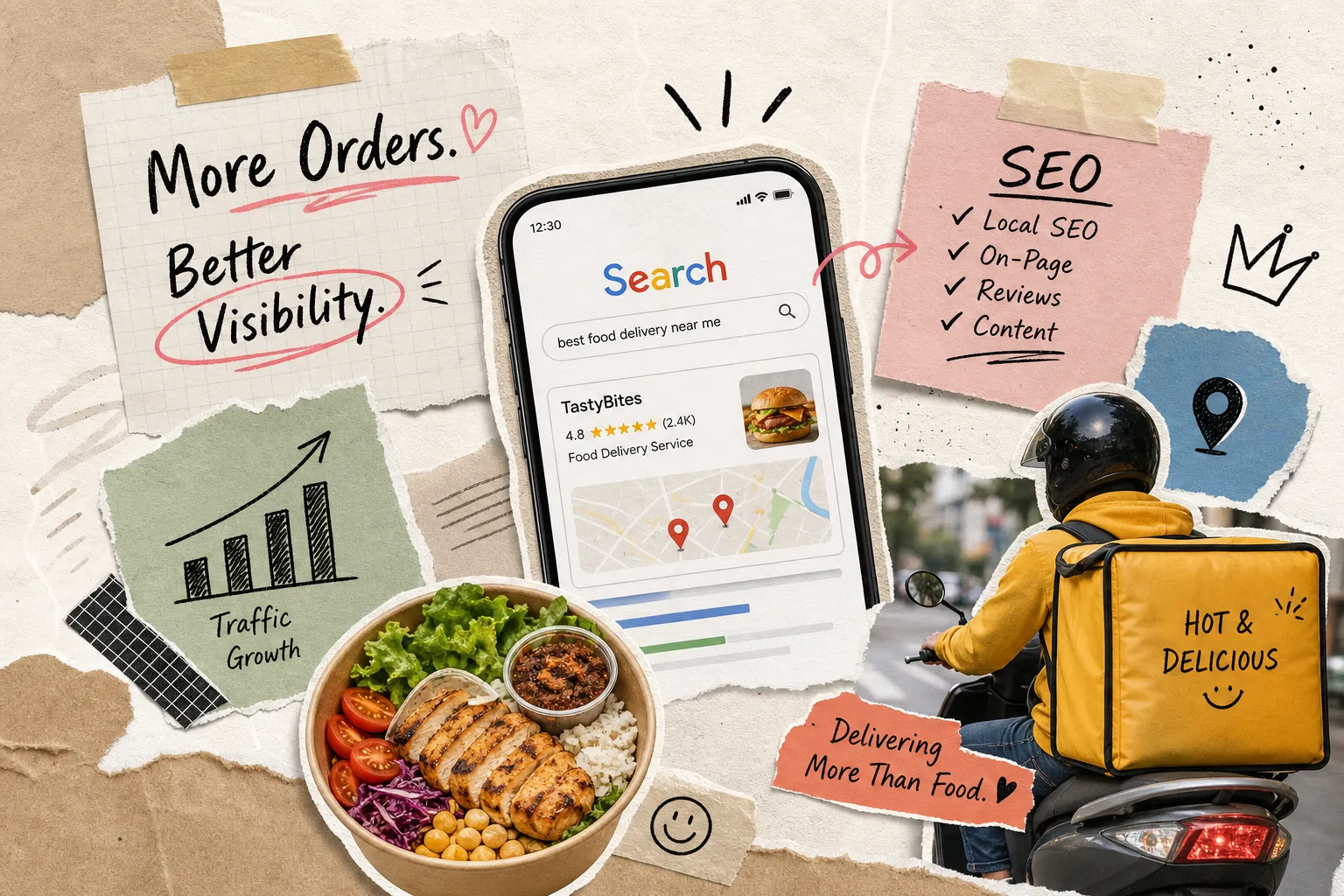
Food delivery is one of the most search-competitive local markets on the internet. Before a single dollar gets spent on SEO, most delivery businesses are already losing organic ground to aggregators that dominate the first page with paid placements, strong domain authority, and years of review volume behind them. That dynamic may discourage some operators from investing in search at all, which is exactly the wrong conclusion to draw. Working with a qualified food delivery service SEO company changes the math entirely, because the right agency targets delivery intent directly rather than trying to out-muscle aggregators on their own turf.
Organic search, when built around delivery-specific intent, drives direct orders at zero per-order commission. Every customer who finds your service through a neighborhood search query and orders straight from your site is a customer the aggregators never got a cut from. Operators who run this model consistently for 12 months often report meaningful reductions in commission spend alongside growth in direct order volume, which is why the brands winning in local food delivery treat SEO as a core revenue channel, not a marketing afterthought.
The agencies making a real difference in this space approach local SEO for food delivery differently from standard restaurant marketing. They treat the service as a zone-based, delivery-intent business, not a static storefront with a menu. What follows covers five areas where that distinction matters: neighborhood keyword strategy, menu structured data, Google Business Profile optimization, technical performance, and how to evaluate and hire the right partner.
Why targeting generic restaurant keywords is costing you orders
The delivery intent gap most businesses miss
A customer searching “best pizza near me” and one searching “pizza delivery Lincoln Park” are not in the same place in their decision process. The delivery query carries immediate transactional intent, that person is placing an order within the next few minutes, not browsing options for a dinner out later in the week. Keyword strategy for a delivery service has to reflect that urgency, which means prioritizing location-modified, transactional phrases over the broader restaurant content that most SEO templates default to.
Generic restaurant keywords are also significantly more competitive, typically dominated by review aggregators and editorial content that a delivery-focused business has little chance of displacing. A phrase like “best restaurants Chicago” sits at a Keyword Difficulty of 70-plus, with the SERP occupied almost entirely by Yelp, TripAdvisor, and editorial lists, none of which a delivery operator can realistically compete against. Narrowing focus to delivery-specific phrases reduces that competition while increasing the likelihood of converting the traffic you do capture.
Building a keyword map around neighborhoods, not just city names
Instead of building content to rank for “burger delivery Chicago,” the smarter play is creating pages that rank for “burger delivery Lincoln Park” or “meal delivery Wicker Park.” Neighborhood-level targeting works because locals search at that granularity, and because Google’s local algorithm rewards geographic specificity when the content, schema, and profile data all align. Each delivery zone gets its own optimized landing page with unique local content, a clear ordering CTA, and location-specific signals that tell Google exactly where the business operates.
The most effective formulas stack dish or cuisine type with a recognized neighborhood name and a clear intent signal: “vegan delivery in SoHo,” “late-night taco delivery downtown Austin,” “contactless meal delivery Wicker Park.” Agencies specializing in delivery SEO typically build out 10 to 20 of these neighborhood queries per market before broadening the strategy, because those pages convert at a higher rate than anything targeting a full metro area.
Menu schema markup: the structured data advantage most competitors skip
What restaurant and menu schema actually does for your visibility
Structured data for food businesses includes Restaurant schema, MenuItem markup, and aggregate rating data. Together, these make a listing eligible for rich results in Google Search and voice search responses. Schema tells Google what dishes are available, what they cost, where the business delivers, and how customers rate the food. That information gets surfaced directly in search results, increasing click-through rates before users even visit the site. According to Google’s own documentation on rich results, schema-enhanced listings consistently outperform plain blue-link entries in engagement, with industry analysis frequently citing CTR improvements in the 20 to 35% range for eligible rich result formats.
For delivery-focused SEO specifically, this matters because customers scanning search results will click the listing that shows dish names, star ratings, and a price range over a bare blue link every time. Schema doesn’t move rankings on its own, but the CTR improvement it generates creates the engagement signals that support rankings over time.
The JavaScript crawlability problem hiding your menu from Google
A common technical failure across food delivery sites is rendering menu content dynamically through JavaScript or loading it from PDFs. JavaScript-rendered content and PDFs can be missed or inconsistently indexed by crawlers unless server-side rendering or machine-readable formats are used, a limitation Google’s own technical documentation addresses directly. That means the dishes, prices, and dietary tags that should be driving keyword matches are effectively invisible in the worst cases. Agencies fix this by replacing PDF menus with individual HTML pages per menu category, using server-side rendering for all menu content, and implementing machine-readable schema so Google can index every relevant item as actual content. Each dish description becomes a ranking opportunity when it’s treated as structured, crawlable text rather than a design element.
Google Maps and Business Profile optimization for the local pack
Why your Google Business Profile controls local order visibility
For any food delivery business, ranking in the local map pack is where the highest-intent visibility lives. A fully optimized Google Business Profile includes complete service area settings, accurate business categories, up-to-date ordering links, and a consistent stream of customer reviews. NAP consistency across Yelp, TripAdvisor, and food directories reinforces the local authority signals that push rankings into the top three map results. Inconsistent name, address, or phone data across platforms undermines those signals and directly affects where you appear in local pack results.
Weekly Google Posts featuring delivery promotions, new menu items, or seasonal offers signal active management to Google and keep the profile relevant. Actively generating and responding to reviews within 24 to 48 hours has a measurable impact on local ranking, and agencies managing GBP for delivery clients treat review velocity as a core ongoing task, not a one-time setup step.
Managing third-party aggregator interference on your profile
Aggregators often push their own ordering links into a restaurant’s Google Business Profile, redirecting customers away from direct ordering channels. Many business owners don’t realize this is happening because the change occurs at the platform level, not on their own site. A knowledgeable delivery service marketing agency audits for this by ensuring the business’s own menu data is the primary source in GBP and by setting up direct ordering CTAs that appear before third-party links. Reclaiming that ordering path is one of the higher-impact technical fixes available to a food delivery business, directly reducing the commission leakage that makes aggregator dependency so costly.
The technical performance issues quietly killing your organic rankings
Core Web Vitals and why mobile speed is non-negotiable
Industry data consistently places mobile’s share of food delivery searches above 80%, making page performance a revenue issue as much as a ranking one. Google’s Core Web Vitals, specifically Largest Contentful Paint and Cumulative Layout Shift, directly affect both rankings and conversion rates. Hungry users abandon slow pages in under three seconds, and given that food delivery intent is among the most time-sensitive in local search, every second of load delay costs real orders. The fixes are concrete: compress images to WebP or AVIF formats, preload above-the-fold resources, defer non-critical JavaScript, and use a CDN to serve content quickly across all regions.
Delivery zone duplicate content and how agencies solve it
Delivery services building multiple neighborhood pages often trigger duplicate content issues when those pages share identical menu descriptions and boilerplate text. When Google identifies near-duplicate pages, as commonly happens with programmatic neighborhood page builds, it will typically index only one version, meaning a bank of similar pages may generate far less ranking benefit than the effort invested in building them. Agencies solve this with unique introductory copy per page that references local landmarks or specific delivery windows, canonical tags to handle filtered menu views, and robots.txt exclusions for low-value parameter pages. Each delivery zone page needs to earn its ranking through unique local content, not copy-pasted text with a neighborhood name swapped in.
What a food delivery service SEO company should actually deliver
Pricing benchmarks and what you get in return
Pricing for this type of work in 2026 breaks down roughly by scope:
- Single-location services: $1,500, $3,000/month for focused local SEO work
- Multi-location or regional services: $2,500, $5,000/month
- National platforms in high-density metros: $5,000+/month, scaling with market complexity
Retainers below roughly $800 per month for “full SEO” typically indicate a software-driven, report-heavy offering rather than hands-on strategy. Real human work on a competitive local market has a cost floor, and pricing below it usually reflects that reality.
Deliverables at any tier should include delivery zone page builds, schema implementation, GBP management, local citation cleanup, and monthly reporting tied to order-relevant metrics. If the deliverables list stops at keyword rankings and monthly traffic summaries without connecting to direct order data, the agency is optimizing for optics rather than revenue.
KPIs that tell you whether SEO is actually working
The metrics that matter for food delivery are specific: top 3 local pack rankings within a 3-mile service radius, a 2 to 4% organic conversion rate from website visitors to direct orders, and measurable growth in non-branded organic traffic from delivery-specific queries. Review growth and GBP engagement are secondary indicators that support those primary metrics. A legitimate food and beverage SEO agency sets these benchmarks before work begins and reports against them monthly, not just against keyword positions that don’t tie back to orders placed.
How to evaluate and shortlist a food delivery service SEO company
The deliverables and red flags that separate real agencies from the rest
A legitimate agency should offer verifiable case studies with specific traffic or conversion metrics, demonstrate working knowledge of menu schema and delivery zone page architecture, and be transparent about timelines. Real SEO work in a competitive local market takes four to six months to show measurable results. Any agency promising page-one rankings in 30 days is selling a guarantee no one can deliver. The same applies to vague deliverable lists, no defined KPIs at the start of the engagement, and reporting that leads with vanity metrics instead of order-related data.
Ask directly: have they worked with service-area businesses before? Do they understand how delivery zone pages differ from standard location pages? Can they show a client in a comparable market with traffic and conversion data attached? If the answers are vague or the case studies don’t name specific results, treat that as a signal about how future reporting will go.
Why industry experience in service-area businesses matters more than a generic track record
The strongest results in this space come from agencies that understand how service-area businesses differ from standard e-commerce or brick-and-mortar retailers. The keyword strategy, the technical architecture, the GBP setup, and the content approach all require delivery-specific thinking. Brandleap Agency works with service-based businesses in competitive local markets, building organic growth strategies grounded in delivery intent, technical SEO that prioritizes what Google can actually crawl, and content that converts searchers into customers rather than just adding sessions to a dashboard.
The next move that actually closes the revenue gap
The five areas covered here, hyper-local keyword targeting, menu schema markup, Google Business Profile optimization, mobile technical performance, and agency selection, are what separate delivery brands that dominate local search from those that stay buried beneath aggregator listings. None of it requires waiting on a platform or splitting revenue with a middleman. It requires consistent, delivery-specific execution.
The most valuable audit you can run right now costs nothing: open Google Search Console and check whether your neighborhood delivery pages are indexed. Then pull up your Google Business Profile and verify that your ordering link points to your own site, not a third-party aggregator. If either of those checks reveals a gap, that’s where orders are being lost today.
For businesses ready to close that gap, Brandleap Agency offers a straightforward starting point: a technical audit scoped specifically for food delivery sites, followed by a growth strategy built around direct orders, not commission-dependent traffic. If you want a food delivery service SEO company that focuses on delivery intent and measurable order growth, reach out to start the conversation.