
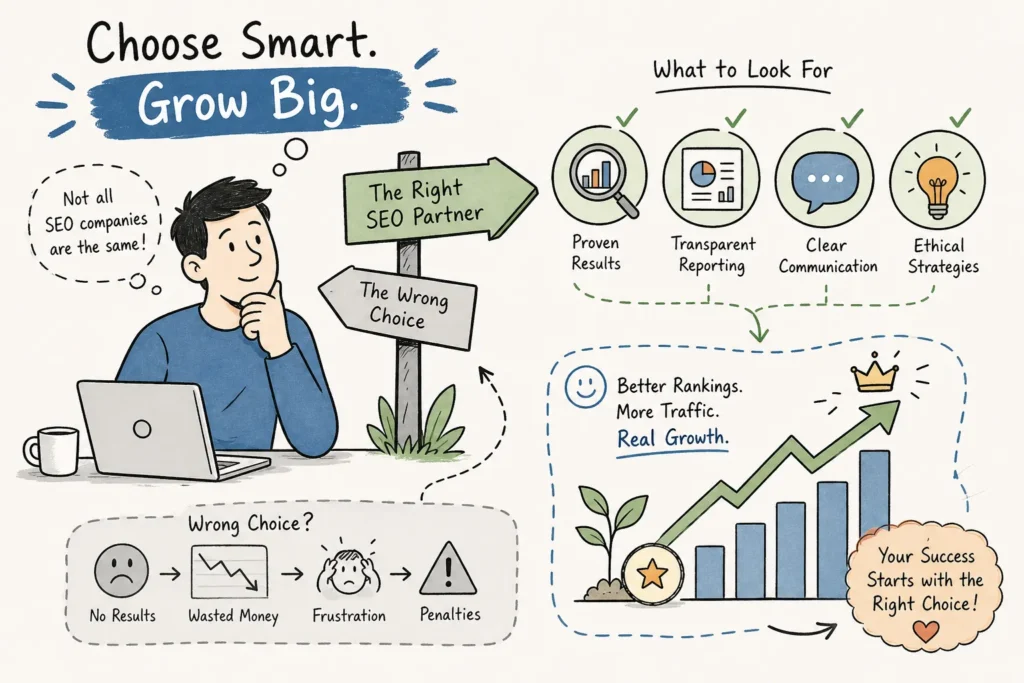
Knowing how to choose an SEO company before you write the first check can save you months of wasted budget and real business damage. Hiring the wrong firm can cost more than the retainer itself, it can mean months of compounding delay, budget diverted from real growth, and in serious cases, Google penalties that take significant time to recover from. Many business owners end up burned not because they were careless, but because nobody handed them a reliable framework for evaluating agencies before they signed. This guide fixes that. Whether you’re vetting your first agency or replacing one that underdelivered, the sections below give you a practical checklist, the right interview questions, and the red flags that should end any conversation on the spot. Learning how to choose an SEO company is itself a competitive skill, and one that too many companies underinvest in.
What a legitimate SEO company commits to before month one
A trustworthy agency defines the work in writing before money changes hands. The scope should name specific deliverables: how many content pieces per month, what a technical audit covers in terms of checkpoints and output, and when link building begins. If an agency hands you a proposal that says “we’ll improve your rankings,” that’s not a scope of work. It’s a placeholder designed to protect them, not you.
Contract terms matter just as much as the work itself. Look for a 3-month minimum retainer rather than a 12-month lock-in with no exit clause. The agreement should include a 14-day cancellation window after the initial term, clear language confirming that all deliverables belong to you (your content, your data, your access), and an explicit disclaimer that no specific ranking positions are guaranteed. Any agency that guarantees rankings is either misinformed about how search engines work or planning to use tactics that will eventually hurt you.
The onboarding timeline is something you should see committed to in writing as well. Week one should cover access setup, a discovery call, and audit kickoff. By week two, you should have the audit in hand alongside a strategy roadmap. Priority technical fixes and on-page work typically begin in weeks three and four, with link building and a content cadence launching in month two. If an agency can’t outline a clear structure like this, ask for examples of how they’ve onboarded past clients before drawing conclusions, but treat vague answers as a signal worth probing.
How to choose an SEO company: vetting the track record
Strong case studies name the industry, describe the starting conditions, and outline specific tactics used. They show measurable outcomes over a defined time period. That means organic traffic growth percentages, keyword visibility changes, and documented conversion improvements, not vague charts with no context. Weak case studies reference “a client in the retail space” with nothing to back it up. Always ask whether the referenced websites are still live, and if the agency offers access as proof, verify the data in Google Search Console yourself.
Interview questions that reveal real competence
The questions you ask during a sales conversation reveal far more than any deck. Ask the agency to walk you through a specific technical SEO problem they recently solved: what the issue was, how they found it, and exactly what they did to fix it. Ask how they distinguish their work’s impact from seasonal traffic shifts in their reporting. Request a quick live triage of your own website during the call, a competent agency can often surface obvious, critical issues on the spot, though a thorough audit will follow. Vague answers to specific questions are data, not minor concerns.
References versus testimonials
References matter more than testimonials, and the distinction is important. Testimonials on a website are curated by the agency. References are not. Ask for two or three current or past clients you can contact directly, and ask those clients specifically whether the agency communicated proactively when something wasn’t working. An agency’s behavior when a campaign underperforms tells you far more than its behavior when everything is trending up.
How to choose an SEO company: red flags to avoid
No ethical SEO professional guarantees a specific ranking position. Google’s algorithm involves hundreds of variables that no agency controls, and any firm claiming otherwise is either misinformed or deliberately misleading you. The same applies to agencies that are vague or secretive about their methods. If they won’t explain how they build links, create content, or handle technical fixes in plain language, treat that secrecy as a red flag, it may indicate non-transparent or risky tactics. Ask for examples and general descriptions of their processes before moving forward.
Watch for specific black-hat tactics during any agency conversation. Be cautious of firms that promise a fixed number of backlinks per month without discussing quality or relevance. Link buying, private blog networks, keyword stuffing, doorway pages, and AI-generated content at scale are all tactics Google actively penalizes. If an agency mentions any of these as part of their process, or if they’re unwilling to discuss their link sources at all, the conversation should end there.
A one-size package structure is also a signal worth taking seriously. An agency offering the same service tier to a local dentist and a national e-commerce brand doesn’t understand SEO strategy. It understands sales volume. Pair that with thin reporting that highlights wins while glossing over traffic drops or missed milestones, and you’re not getting a partner. You’re getting a highlight reel on a monthly invoice. Always request a sample report before signing. If it’s full of vanity metrics with no business context, that tells you everything you need to know about how this agency operates.
SEO pricing in 2026: what’s realistic and what’s suspicious
Most legitimate agencies operate on monthly retainers, which is the right structure for an ongoing SEO engagement. For local or single-location small businesses, retainers often start in the $1,000 to $3,500 range per month; small businesses targeting regional or national scale typically spend $2,500 to $5,000. Mid-market brands generally budget $5,000 to $10,000 monthly, and enterprise campaigns routinely exceed that figure. Hourly consulting runs $100 to $300 per hour and works well for audits or one-time technical fixes. Project-based pricing, typically $1,000 to $5,000, suits site migrations or foundational strategy builds when you’re not ready for a full retainer.
Any agency offering comprehensive SEO for $200 a month is cutting corners somewhere, usually in content quality, link sourcing, or both. For meaningful traction in a competitive market, most small businesses should budget at least $1,500 to $2,500 per month. That funds enough content production, technical attention, and link building to move the needle over a 6-to-12-month window. Severely underfunding SEO limits your ability to produce content, implement technical fixes, and build quality links; in competitive markets, it will likely prevent measurable traction altogether. If your current budget sits well below that threshold, consider starting with a focused project-based engagement to build a technical foundation, then moving to a retainer once you’re ready to scale.
The reporting standards worth demanding before you sign
Good agencies don’t bury the lead in Domain Rating improvements or impressions charts. The three metrics that tie SEO directly to business outcomes are organic traffic (reach and visibility growth), conversion rate from organic sessions (traffic quality), and organic revenue or leads generated (direct business impact). Everything else supports the story those three metrics tell. In a healthy campaign after the initial ramp-up period, 5 to 10 percent month-over-month organic traffic growth is a commonly cited benchmark, though actual results vary by industry, competition level, and starting baseline.
Monthly reports are the industry standard for a reason: SEO is a compounding, long-term channel, and week-to-week data is usually noise. A monthly report should open with an executive summary covering the top business metrics, followed by a performance overview with month-over-month and year-over-year comparisons. It should break down the work completed that month, explain ranking changes for target keywords in context, and close with specific recommendations for the next 30 days. Quarterly reviews should zoom out to assess overall strategy and set goals for the following period.
If your agency only reaches out when things are going well, that’s not a partnership. A high-quality report explains traffic trends in context, including algorithm updates, seasonality, and competitor activity. If you receive a PDF screenshot of a rank tracker with no explanation or narrative, ask for a proper reporting template before the next billing cycle. The format of the report signals how seriously an agency takes your business outcomes, not just their own deliverable checklist.
Making the final call: your shortlisting process
After running two or three agencies through this framework, the decision often becomes clear. You’re looking for the firm that gave you specific, verifiable answers to tough questions, provided a written scope before asking for any commitment, and offered references willing to speak candidly about the full arc of their engagement, including the difficult moments. Pricing should align with your market and your goals without promising results that no one can ethically guarantee.
At Brandleap Agency, the criteria in this guide reflect our stated commitments to every client, every month. Our approach covers documented scopes, transparent reporting tied to business outcomes, and communication that doesn’t disappear when a campaign hits a rough patch. If you want to see what a rigorous, accountable SEO engagement looks like in practice, our services page walks through exactly how we structure strategy, reporting, and client communication from day one.
Use this guide to drive how you choose an SEO company that’s built for real growth. Demand a written scope with defined deliverables. Ask for verifiable proof of past results. Walk away from any conversation where rankings are guaranteed or methods are hidden. Anchor your expectations to realistic pricing for your market. When you find the right agency to hire, it will meet every standard on this list without hesitation, because those standards reflect how serious professionals actually work.

BrandLeap Agency & BrandLeap Fashion | Founder & CEO
Mithun is an experienced SEO consultant recognized for helping businesses improve their digital presence through technical SEO, content optimization, and sustainable organic growth strategies. Working in the digital marketing industry since 2019, he has developed expertise in increasing search visibility, driving targeted traffic, and building long-term growth through data-driven SEO solutions. He has worked with businesses across multiple industries, helping brands strengthen their online authority and achieve measurable growth results.