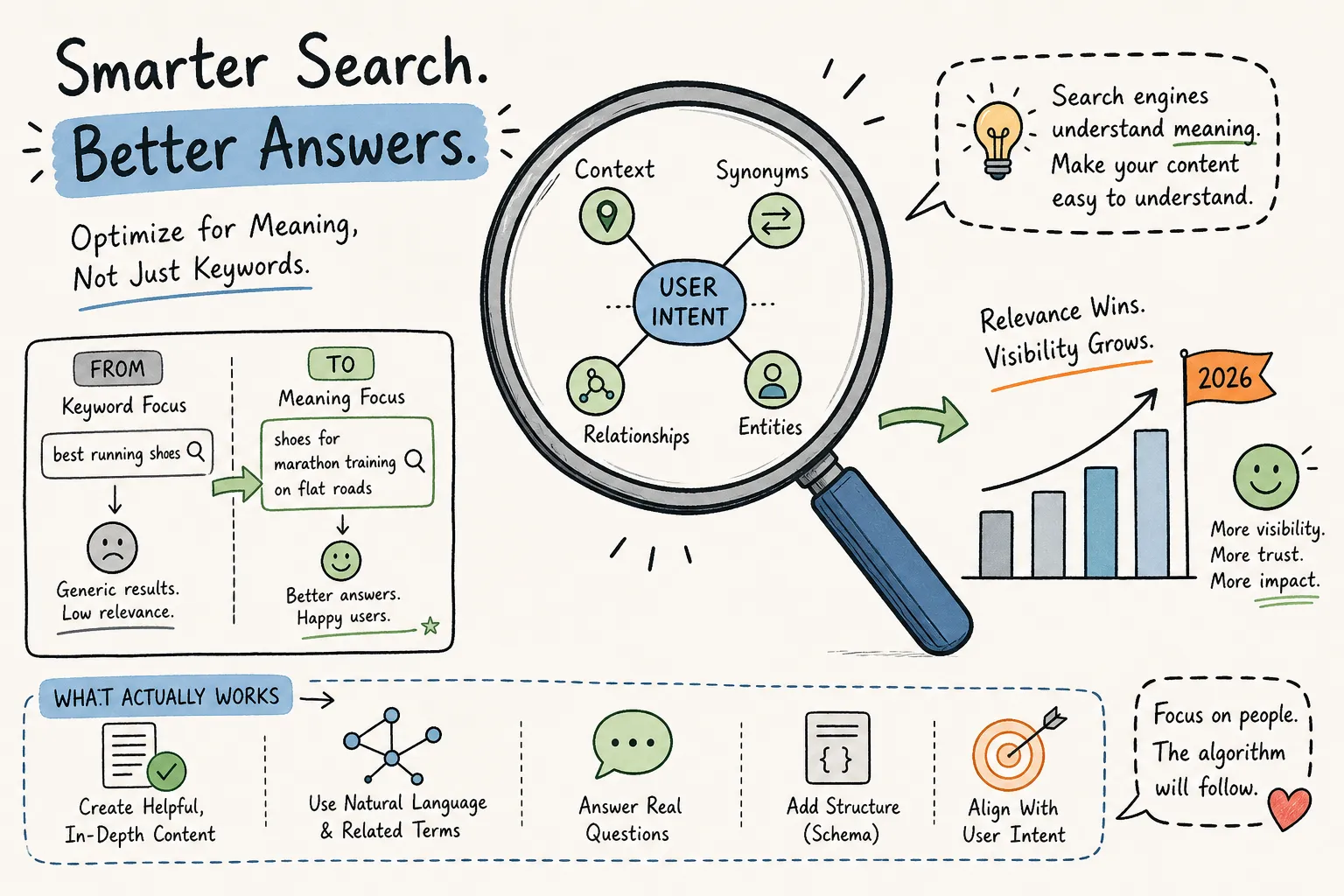
Keyword-first content strategies built for 2010s-era search engines are still surprisingly common, even as Google has moved well past that model. Many businesses chase exact-match keywords, repeat phrases until they feel forced, and wonder why pages with genuinely useful information can’t crack the first page. Semantic search optimization, the practice of structuring content so Google understands what your page is about, who it’s for, and how it fits into a broader network of related knowledge, is what separates pages Google confidently recommends from ones it skips over, even when the information is solid. The answer isn’t more keywords. It’s a fundamentally different understanding of how Google reads content.
Google no longer asks “does this page contain the keyword?” It asks “does this page genuinely answer the question, and does it belong in a larger context?” That shift has real consequences for how content needs to be planned, written, and structured.
That shift has played out in practice. At Brandleap Agency, moving small business clients away from keyword-first content toward a topic-and-entity model has produced measurable organic visibility gains within months, not years. This guide walks through exactly how that approach works, from core concepts to the specific tactics you can apply this week.
What semantic search optimization actually means
The foundation of semantic search is Google’s ability to interpret the meaning behind a query rather than just match words on a page. Through a sequence of algorithm updates starting with Hummingbird in 2013, then RankBrain, BERT, and MUM, Google progressively learned to process natural language and understand conceptual relationships. By 2026, neural matching isn’t experimental. It’s the core of how Google evaluates every piece of content on every query.
This means Google now converts text into high-dimensional vectors using transformer-based models, comparing your content against a query based on meaning, not literal word presence. Two pages can use completely different vocabulary and still match the same query if they carry the same conceptual meaning. Conversely, a page stuffed with a keyword phrase can rank poorly because it doesn’t demonstrate genuine understanding of the topic.
What entities and relationships have to do with it
Entities are the named things Google tracks: people, places, brands, concepts, and topics. Google’s Knowledge Graph maps relationships between these entities, and when you write content, Google tries to position that content within that map. A page about “content marketing for dentists” isn’t just combining two keywords. It’s about the relationship between a business category, a marketing discipline, and a specific audience.
Semantic SEO means making those relationships explicit rather than assuming Google will infer them from keyword proximity. The clearer you define what your content is about and how it connects to related entities, the more confidently Google can index, categorize, and surface it for relevant queries.
How Google uses user intent to decide what ranks
Google categorizes every search query by intent: informational, navigational, commercial, or transactional. Aligning your content’s format and depth with the right intent type strongly correlates with ranking outcomes, it influences which documents Google considers relevant in the first place. A blog post competing against product pages for a transactional query won’t win. A homepage pitch competing against comparison guides for a research query won’t win either.
Consider two pages targeting “best CRM for small business.” One is a detailed comparison guide with a scoring table and use-case breakdowns. The other is a service page pitching a CRM product. For that query, the comparison guide is far more likely to outrank the service page, because the user’s intent is to research options, not to buy from the first result they see. Reading the intent before writing a word is what separates semantic SEO from traditional keyword targeting.
How user behavior reinforces semantic signals
Google doesn’t just evaluate content at index time. It validates relevance through clicks and other engagement signals. When users stay on your page, engage with the content, and don’t return to Google looking for a better answer, that’s a signal your page satisfied the query. Good intent alignment creates a feedback loop that stabilizes and improves rankings over time.
This is why copying a competitor’s keyword list and writing similar content rarely works. If your page format doesn’t match what the intent demands, users leave fast, and Google reads that as a relevance failure regardless of how well-written the content is.
Semantic search optimization for topical authority
Topical authority is earned when Google sees your site as a comprehensive, reliable source on a subject. It’s not built through one well-researched article. It’s built through a network of related content that signals deep, broad expertise on a topic. The numbers bear this out: Encazip.com applied a semantic approach and saw a 155% organic traffic increase in six months, while other implementations documented in published case studies have produced traffic growth exceeding 1,100% over five months, results achieved by sites that shifted away from isolated keyword targeting toward structured topical coverage.
More important than the traffic spikes is what topical authority does for ranking stability. Sites with deep topical coverage experience fewer drops during algorithm updates and recover faster when drops occur. Sites built around individual high-authority pages are more vulnerable, because each page stands alone without a reinforcing ecosystem around it.
How topic clusters replace keyword-by-keyword targeting
The hub-and-spoke content model is the practical implementation of topical authority. A hub page covers the broad topic at a high level, and spoke pages go deeper on each subtopic. For a local service business, the hub might be “local SEO for small businesses,” with spokes covering Google Business Profile optimization, citation building, local schema markup, and review management. Internal links connect the cluster, and together they communicate comprehensive coverage to Google. For practical examples and implementation guidance, see the Brandleap Agency Blog | Expert Digital Marketing Insights.
Practical steps to map your first topic cluster
Start by picking one core topic your business legitimately owns. Then list the 6 to 10 subtopics a thorough reader would need addressed to fully understand the subject. Check which ones you’ve already covered and which are gaps.
This content gap audit is the starting point before writing a single new page. You don’t need to publish everything at once. As a general guideline, a steady cadence of one to two cluster pages per week tends to build authority signals more reliably than publishing 10 pages at once followed by a long silence, though your pace will depend on resources and topic scope. The goal is consistent coverage, not a single burst.
Entity mapping and schema markup: the technical foundation
Writing great content isn’t enough if Google can’t confidently categorize it. Schema markup in JSON-LD format is how you communicate entity information directly to search engines, making your content machine-readable in addition to human-readable. Google explicitly recommends JSON-LD over other formats because it’s easier to implement, less error-prone, and cleanly separated from the visible HTML on your page. For a practical guide to the schema.org vocabulary, consult vendor and documentation resources that explain common types and properties.
For small business websites, the most impactful schema types are LocalBusiness (using the most specific subtype available, such as Restaurant, Dentist, or LegalService), Organization, Article, and FAQPage. Properties like mainEntityOfPage, isRelatedTo, and brand explicitly define relationships between entities on your page, giving Google a clear map of what your content is about and how it connects to other entities in the Knowledge Graph.
Here’s a minimal LocalBusiness JSON-LD example to illustrate the structure:
Adapt the type (e.g., MarketingAgency) and properties to match your specific business. The point is to make relationships explicit rather than leaving Google to infer them. For the definitive reference on available types and properties, consult the full schema.org documentation.
Identifying and closing entity gaps in your content
Entity gap analysis compares your page against top-ranking competitors to identify which named entities, concepts, tools, and terminology they reference that you don’t. Missing entities signal incomplete topical coverage, and that incompleteness is one reason pages fail to rank even when the writing quality is high.
You don’t need enterprise-level tools to run this analysis. InLinks offers a free-tier entity analysis tool, and Google’s Natural Language API provides a limited number of free monthly requests (paid tiers apply beyond that threshold). A simple Google Sheets comparison of entity coverage across pages can supplement both. Run the analysis on your page and three to five competitor pages, list every entity that appears in competitor content but not yours, and prioritize by relevance to your core topic. If you prefer ready-made utilities, an entity gap analyzer and other gap-analysis tools can speed the process. Add those entities into your content naturally, not as a list of mentions, but woven into explanations and examples. Then re-run the analysis to confirm the gap is closed.
Measuring semantic search optimization success
Semantic search optimization doesn’t produce overnight ranking jumps. It builds relevance signals over weeks, and knowing what to track keeps you from abandoning a strategy that’s actually working. The right measurement framework focuses on leading indicators, the signals that appear before final rankings shift.
In Google Search Console, watch for impressions growth across topically related queries, not just your primary target keyword. If a page is gaining visibility on 15 related queries it wasn’t appearing for before, topical authority is building even if the primary term hasn’t moved yet. Track average position improvements across your entire keyword cluster, and watch for new queries appearing that weren’t there when you started. Those new queries are often the clearest sign that Google is expanding its understanding of what your page covers. Pair that analysis with an on-page SEO checklist to ensure technical and content-level optimizations aren’t holding your pages back.
Real benchmarks from semantic SEO results
Published case studies set realistic expectations. Encazip.com applied a semantic SEO approach and achieved 400 new top-3 rankings and 5,000 new organic queries as part of that 155% traffic increase over six months. GetWordly.com grew from zero to 330,000 monthly organic clicks in six months. DreamBox documented a 733% organic traffic increase in three months. These aren’t outliers from massive domain authority sites; they’re the result of structured topical coverage and entity clarity applied consistently.
The typical timeline for a topic cluster strategy to produce measurable ranking improvements is three to six months, with compounding results continuing through the 12-month mark. Most implementations that fall short do so because the content cluster is incomplete or the internal linking is too thin. The structure has to be complete enough for Google to see comprehensive coverage, not just a few related posts loosely connected.
What to do next
Businesses that keep targeting isolated keywords are competing for a version of Google that no longer exists. The algorithm has moved on, and strategy has to move with it. Semantic search optimization works because it aligns content with how Google actually evaluates relevance today: through topic coverage, entity relationships, and intent matching rather than keyword frequency.
Brandleap Agency has applied these principles to help small businesses outperform competitors with far larger budgets and domain authority, not through shortcuts, but through structuring content the way Google actually reads it. Learn more about our approach in How Ben Stace’s Semantic SEO Consultancy Services Work, 2026.
If your current content strategy starts and ends with a keyword list, this is where that changes. Start with one core topic your business owns. From there, map the subtopics around it, then run a free entity gap analysis on your top-performing page. Once that’s done, add one schema markup type you’re currently missing. Semantic SEO compounds: each credible signal builds on the last, creating authority that holds through every algorithm update ahead. If you’d like a structured next step, explore our recommendations on how to Achieve Better Rankings With Proven SEO Solutions, 2026.