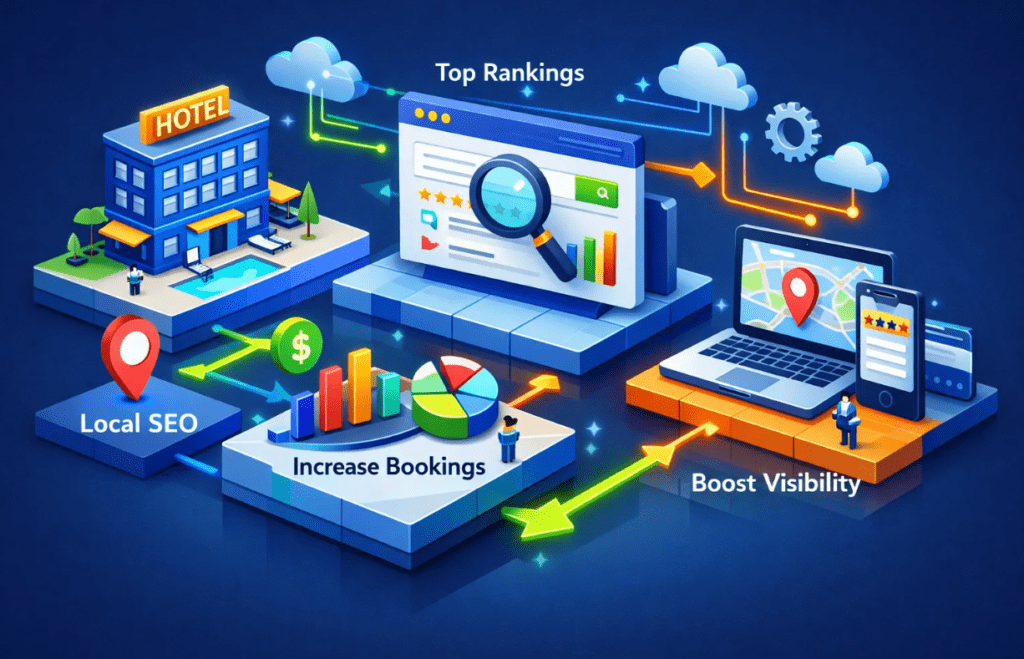
Managing a hotel means competing with OTAs that capture large shares of bookings and cut into margins. Seo services for hotels can shift demand back to your site, lower commission costs and increase average daily rate by capturing high-intent organic traffic. Because travel queries include transactional, local and inspiration intent, a clear page strategy: brand and property pages for awareness, room pages for booking intent and package or blog pages for inspiration, makes each visit more likely to convert.
Key takeaways
- Protect margins: Direct-booking SEO reclaims revenue from OTAs and can lift ADR by capturing high-intent organic traffic instead of relying on paid channels.
- Map search intent: Align brand, room, package and blog pages to transactional, local and inspiration queries so each visit has a clear conversion path.
- Local fundamentals: Claim and optimize your Google Business Profile, maintain consistent citations and drive review velocity to win nearby searches.
- Fix technical leaks: Prioritise mobile speed, crawlability, booking-engine integration, schema and CRO so visibility converts to reservations.
- Measure and act: Track booking-intent organic sessions and attributed revenue, set realistic timelines and run a 10-minute audit plus GBP updates this week.
1. Why hotels need specialized SEO
OTAs often occupy top search results and outspend individual properties on paid ads, steering bookings into high-commission channels. That dependency reduces margins and can suppress pricing power when operators rely mainly on OTA listings. Reducing OTA share through direct-booking SEO is a practical commercial step that puts more revenue on your books.
Professional seo services for hotels blend technical SEO, on-page optimization, content strategy, Google Business Profile management, link building and conversion-rate improvements focused on reservations. Technical work covers mobile speed, schema and sitemaps; on-page work improves titles, headers and internal links; content builds intent-mapped room and package pages.
2. What seo services for hotels include
Start with a full-site audit to locate where your property is leaking organic traffic and conversions. Seo services for hotels typically check crawlability, mobile user experience and booking-engine integration, and flag large images, render-blocking JavaScript and other bottlenecks that slow pages. Also look for canonicalization and hreflang issues so search engines serve the correct pages to each market.
- Crawlability and sitemap fixes
- Mobile UX and responsive checks
- Speed improvements, image and JS optimization
- Canonical, hreflang and booking-engine validations
On-page work focuses on revenue-driving elements at property and room level. Rewrite title tags, meta descriptions and header structure to match search intent, add descriptive image alt text, standardize internal linking and refine booking microcopy so guests see value before they click. Rate and offer pages should get transactional keyword optimization and visible CTAs instrumented with event tracking and UTMs to measure direct revenue from organic traffic.
Content turns search intent into bookings through targeted landing pages, local experience pages and curated package pages. Build semantic keyword clusters such as “city + book”, “hotel + landmark” and “packages + dates,” and support pages with guest reviews, FAQs and structured data like review, FAQ and offer schema to improve rich result eligibility. Those pages create clear conversion paths from inspiration to booking.
3. Local seo playbook: GBP, citations and reviews
Claim and fully complete your Google Business Profile: choose accurate categories, set attributes, add direct booking links and keep hours and contact details current. Upload photos and a virtual tour, publish regular posts and answer questions promptly; monthly hygiene checks help remove outdated offers and correct any inaccuracies. Use GBP insights to track profile clicks, direction requests and photo views so you can test offers and rate messages that appear in search.
Keep your name, address and phone consistent across directories, tourism listings and event sites, and monitor for duplicate OTA-created profiles that fragment visibility. Consider partnering with a specialist local SEO service to manage citations and GBP hygiene, and coordinate with local partners to secure contextual links and make sure OTA listings match your official information.
Design a repeatable review workflow to grow and surface guest feedback. Automate post-stay review requests via your PMS or SMS the day after checkout, keep messages short and avoid gating, and reply to reviews promptly to build trust. Mark aggregated review snippets with Review and AggregateRating schema to help earn rich results and improve click-through rates.
- Positive: thank the guest, mention a highlight and invite a return stay.
- Neutral: acknowledge feedback and outline planned improvements.
- Negative: apologise, offer a private contact and propose a tangible remedy.
Once GBP, citations and review velocity are in place, move to the technical priorities that most affect conversion and booking success. Addressing those issues next typically yields the fastest lift in reservations and revenue.
4. Technical priorities that harm or help bookings
Page speed and mobile checkout usability directly affect reservations, so start by fixing slow pages and the booking flow on mobile. Common culprits include large unoptimized images, render-blocking JavaScript, slow server responses and multi-step mobile forms that increase abandonment. Fix these by serving responsive, compressed images with lazy loading, deferring noncritical scripts, enabling server caching or a CDN and simplifying forms with fewer fields and one-tap payment options.
Canonical tags and index controls prevent your site from cannibalising its own visibility across room types, rate plans and tracking parameters. Use rel=canonical consistently, configure parameter handling in Search Console and avoid canonicalising to OTA pages or masked partners. For multilingual or multi-region setups, implement self-referencing hreflang tags with language-region codes and serve the correct currency and localized content so visitors land on appropriate pages.
Structured data helps search engines show rooms, offers and reviews in rich snippets and the knowledge panel. Implement Hotel, Room, Offer, AggregateRating and Review schemas via server-rendered JSON-LD so booking data matches on-page content. Accurate schema can increase click-through rates and reduce reliance on OTAs by making your inventory and deals more discoverable. For a practical hotel-focused reference on technical implementation, see this technical SEO for hotels.
Run a technical audit, prioritise fixes that move measurable KPIs and track improvements in impressions and conversions. Triage issues into quick wins and engineering projects, then align technical fixes with CRO tests so traffic gains translate into more bookings. Use phased sprints to deploy low-risk changes quickly while scheduling larger platform work and measure impact before scaling further. Also review common pitfalls in implementation via a guide on common hotel SEO mistakes and how to fix them.
5. Measuring success: realistic KPIs, timelines and pricing
Focus on metrics that link organic visibility directly to revenue and booking intent. The following KPIs show both traffic signals and commercial impact:
- Organic sessions, segmented by transactional versus branded queries
- Rankings for booking-intent keywords
- Organic booking conversion rate
- Revenue from organic search
- Average daily rate (ADR) change and OTA share shifts
These KPIs let you see whether SEO shifts real demand to your direct channel and which work drives bookings.
Use GA4 e-commerce or equivalent analytics with booking-engine integrations to capture reservation events and revenue. Enforce UTM discipline on campaigns and partners to prevent misattribution, and surface GBP and booking events in the same dashboards so on-site changes and local updates are measured against revenue rather than clicks. Dashboards should show both leading indicators (rankings, impressions) and lagging outcomes (bookings, revenue). An SEO strategy checklist for hotels outlines common deliverables and sequencing to align these dashboards with commercial goals.
Expect a multi-month timeline for material results. Months 1 to 3 typically cover technical fixes and early visibility improvements; months 3 to 6 bring content, GBP work and local traction; months 6 to 12 is when you should see material booking uplifts. Factor seasonality and competitor moves into targets and use benchmarked ranges for high and low seasons.
Pricing depends on scope and property size. Typical retainers run roughly $1,500 to $3,000 per month for independent or boutique hotels, $3,000 to $6,000 for mid-size properties and $6,000-plus for resorts or enterprise programs. Retainers usually cover an initial audit and roadmap, ongoing technical and on-page tasks, a content cadence, GBP management and monthly reporting, with optional CRO and link-building add-ons and one-time fees for migrations or major site projects.
6. Choose the right partner or brief your team: checklist and case study
We worked with a 45-room boutique property where an audit found slow pages, incomplete Google Business Profile fields and thin content on high-intent pages. Months 1 to 3 focused on technical fixes, mobile speed and schema plus GBP hygiene; months 3 to 9 delivered content clusters, citation pushes and CRO experiments on the booking path. Results included a 30% increase in occupancy, a 42% rise in direct booking sessions and an 18% reduction in OTA commission spend.
- Top KPIs: occupancy +30%, direct booking sessions +42%, OTA commission down 18%.
- Timeline snapshot: Month 0 audit; months 1 to 3 technical and GBP hygiene; months 3 to 9 content, citations and CRO.
- Channels: on-site content, GBP, local citations and targeted UX tests.
When vetting an agency or briefing your internal team, ask for specific deliverables and evidence. Request sample audits, case studies and a clear roadmap so you can compare scopes on shared KPIs. See Brandleap’s published example work for travel businesses in the SEO for Travel Agents overview, and use the checklist below before signing a scope of work.
- Hospitality case studies and references
- Sample technical audit and prioritised roadmap
- Expected KPIs and realistic timeline
- Reporting format and cadence
- Named team members and roles
- Link-building and citation approach
- GBP and review growth tactics
- CRO deliverables for the booking funnel
- Contract length, pricing bands and cancellation terms
Start an RFP with a clear goal such as “increase direct bookings by X% in 12 months.” Begin with a technical audit, GBP hygiene, content clusters for booking intent, local citations and CRO tests. Deliverables should include a prioritized roadmap, monthly reporting, a 6 to 9 month timeline and named team members. For immediate action, run a 10-minute site health check, audit your GBP data and map high-intent pages; Brandleap Agency provides a downloadable brief and timeline template you can hand to agencies or your internal team — or book a meeting to discuss customised options.
Boost bookings with the right hotel seo playbook
Hotels compete with deep-pocketed OTAs and broad search results, so SEO must reflect property-level revenue, availability windows and local demand. A full technical audit shows where your site leaks organic traffic and which pages fail to convert, and when combined with targeted content and conversion tests, seo services for hotels can convert visibility into direct bookings. Focus first on a technical baseline audit, a prioritized on-page and content fix list, and a local SEO push that includes GBP, consistent citations and higher review velocity.
Frequently Asked Questions About Hotel SEO Services
1. What are SEO services for hotels?
SEO services for hotels help your website rank higher on Google when people search for places to stay. This includes keyword targeting, local SEO, Google Business Profile optimization, content updates, technical fixes, and improving pages so more travelers find and book your hotel.
2. How does local SEO help hotels get more bookings?
Local SEO helps your hotel appear in local search results, Google Maps, and “near me” searches. When travelers search for hotels in your city or area, strong local SEO increases your visibility and brings in more direct booking opportunities without relying only on OTAs.
3. Why is Google Business Profile important for hotel SEO?
A well-optimized Google Business Profile helps your hotel show up in map results and local searches. It lets guests see your location, photos, reviews, contact details, and directions quickly, which builds trust and can increase calls, website visits, and direct bookings.
4. How long does hotel SEO take to show results?
Hotel SEO usually takes a few months to show clear results, depending on your competition, website condition, and location. Some improvements, like better local visibility and profile engagement, can happen sooner, but stronger rankings and booking growth need steady work over time.
5. What is included in hotel local SEO services?
Hotel local SEO services often include local keyword research, on-page optimization, Google Business Profile setup or updates, review strategy, technical SEO, local citations, content creation, and location-based landing pages. The goal is to improve visibility, attract nearby searchers, and increase direct bookings.
6. Why is Brandleap Agency the right choice for hotel SEO services?
Brandleap Agency helps hotels improve local visibility, attract more qualified traffic, and increase direct bookings through practical SEO strategies. From local keyword targeting to Google Business Profile optimization and hotel-focused content, the work is built to help your property rank better and convert more travelers.