
Introductions
An SEO agency in Philippines often delivers senior SEO talent at roughly 40–60% lower blended rates than comparable Western suppliers. Those savings can fund larger content sprints, more link outreach, or conversion-rate optimization tests that move revenue. Cost is only one practical benefit to weigh when you pick an offshore provider.
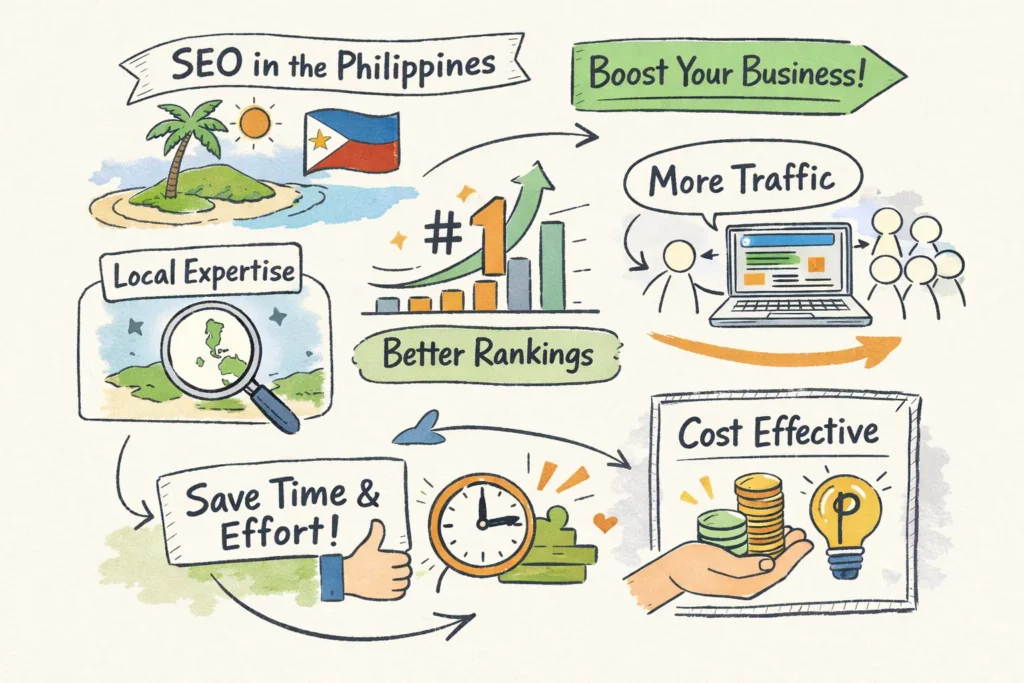
Philippine agencies combine experienced strategists with implementation teams, letting you run larger content sprints and monthly outreach sooner. Local SEO expertise—Tagalog and English phrasing, listing signals, and holiday cycles—improves conversions for B2C and local services. Bundled work across SEO, content, web development, and paid ads speeds experiments like landing-page builds and CRO tests.
Below are five benefits tied to decisions you can act on, with short proof points from Philippine firms to help you choose between an SEO company in the Philippines or a local partner. If your goals are lower CPA, faster scaling, and ongoing Maps and listings compliance, the partner you pick will affect how quickly those gains show up in revenue.
The top 5 benefits of hiring an SEO agency in Philippines
Hiring an SEO agency in Philippines gives you five measurable business outcomes: lower costs, faster execution, local insight, clearer reporting, and continuous improvement. Each benefit below links to actions you can take immediately.
- Cost-effective access to senior SEO talent. Philippine agencies typically provide experienced strategists and implementation teams at blended rates lower than many Western suppliers. Redirect those savings to content, link campaigns, or faster technical fixes to speed keyword coverage and time-to-impact.
- Local market knowledge and language nuance. Teams based in the Philippines understand Tagalog-English intent, regional phrasing, and holiday cycles that influence search volume and conversions. Properly localized pages and citation work improve query matching and trust signals for local searches.
- Faster scaling with integrated services. Many firms bundle SEO, content, web development, and paid channels to reduce handoffs and accelerate experiments. Coordinated teams can validate landing pages and CRO changes in parallel, shrinking test cycles and speeding decisions.
- Better ROI through process efficiency. Mature agencies bring repeatable playbooks and workflows that reduce trial-and-error costs and clarify unit economics. Template-driven work and predictable resourcing make CPA and forecasting easier to manage than ad-hoc internal efforts.
- Continuous optimization and local compliance. SEO needs ongoing attention to algorithm updates, schema, and Maps hygiene to prevent traffic loss. Local teams keep listings healthy, apply schema updates, and resolve citation issues faster than generalist vendors, often restoring steady traffic within weeks after cleanup.
How Philippine SEO pricing works and what to expect
You’ll commonly see four pricing models: monthly retainers, fixed projects, hourly consulting, and performance-based deals. Retainers suit ongoing growth work, fixed projects are appropriate for migrations or audits, hourly rates fit short advisory tests, and performance deals can align incentives when KPIs are precise. Freelance consultants typically charge ₱1,500–₱6,000 per hour depending on seniority, while agencies package those hours into scopes tied to outcomes.
Use these benchmark ranges to set a realistic budget: entry and small-business packages often start at ₱5,000–₱25,000 per month (roughly $90–$450), mid-market runs ₱25,000–₱150,000 (roughly $450–$2,700), and enterprise engagements commonly exceed ₱150,000 per month depending on scope. Variation comes from keyword competition, existing technical debt, website complexity, and link profile. Deliverables should scale predictably with price and include an SEO audit, prioritized technical fixes, a keyword cluster plan, a content calendar, link outreach, and regular reporting. Premium packages add custom landing pages, dedicated dev hours, and a named account strategist. See our Affordable SEO Services Guide for a breakdown of common deliverables and unit costs.
Translate deliverables into unit costs—per-page writing, per-link outreach, or per-dev-hour—so you can compare proposals side by side. Use those normalized figures to challenge vendors on scope and efficiency before you shortlist.
Shortlist 3–5 agencies that match your budget and industry
Trim a long vendor list to 3–5 finalists in a single session by using a timed checklist. Set a 30–60 minute timer, move through clear filters, and avoid procurement stalls so your team can compare offers quickly. This approach keeps the process efficient and decision-focused.
Apply five fast filters: industry experience, verified reviews, recent case studies, tech-stack compatibility, and communication hours. Source evidence from LinkedIn, company case pages, Clutch or Sortlist reviews, and a short discovery chat to confirm overlap. These filters surface agencies that match both technical and sector needs.
Match agency strengths to your brief. For example, SharpRocket often focuses on link building and local SaaS or e-commerce; Searchworks handles enterprise SEO and content marketing; Leapout and Wordlift specialize in conversion-focused e-commerce SEO; Optimind works on property and real estate listings; and ExaWeb shows consistent client-service metrics. If you want a local-first partner that runs SEO and paid channels together, Brandleap Agency can pilot an engagement with buyer insights, fast technical fixes, and transparent ROI reporting.
Next, use the vetting checklist and focused reference checks below to convert shortlisted vendors into a final decision. Run a small pilot before committing to a long contract so you can validate execution.
Vetting checklist, red flags and reference checks
Turn meetings into decision points by asking discovery questions that reveal competence and capacity. Treat answers as measurable checkpoints rather than marketing claims and insist on proof where relevant.
- What is your company history and core results for businesses like ours?
- Can you share relevant case studies with contactable outcomes?
- What is your 30‑60‑90 day roadmap for our site?
- What specific deliverables do you provide and on what cadence?
- How often do you report and what does the report include?
- Will we have direct access to analytics and dashboards?
- What is your link‑building approach and where do links come from?
- Can you provide references and client contacts we can call?
- How is pricing structured and what are termination terms?
- How much time and resources do you expect from our team?
High-quality answers are specific: URLs to case studies, a written 30‑60‑90 plan, sample reports or GA4 exports, and a clear scope with timelines. Ask for follow-up proof on the spot and insist on contactable references before you proceed. For any outstanding claims, request raw exports so you can verify before signing.
Watch for rank guarantees, vague deliverables, hidden subcontracting, lack of reporting access, unverified case studies, and pressure for long lock-in contracts. Ask direct questions like “Who will do the work?” and “Can we see the contract clause on deliverables?” to expose issues quickly. If doubts remain, run a small paid pilot to test execution and responsiveness.
Use the vetting output to score finalists side by side and prepare an objective RFP for your preferred vendors. Translate those scores into negotiation points and a clear SOW.
How to request and evaluate winning proposals
Turn your shortlist into action with a focused RFP that makes proposals comparable and decisions objective. When you brief a potential SEO agency in Philippines, include business goals and KPIs, baseline analytics access, target keywords and markets, a budget band, a timeline, decision criteria, and preferred contract terms. That forces vendors to scope to your priorities and makes evaluation straightforward.
Use a simple scoring matrix to remove guesswork. Weight experience and case studies (30%), scope and deliverables (30%), price (20%), reporting and transparency (10%), and communication and fit (10%). Ask each vendor for one comparable deliverable set and convert those deliverables into unit costs so you can compare apples to apples.
Run a 20–30 minute reference call to verify timelines, responsiveness, and measurable outcomes. For outreach, send a short email explaining why you shortlisted them and link to the RFP document. Paste an RFP skeleton into a shared doc with placeholders for budget, expected KPIs, and a proposal deadline, and set a one-week turnaround as your default.
Next, prepare negotiation points and milestone-based contracting to finalize the engagement. Tie payments to delivery milestones and clear acceptance criteria to reduce disputes.
Measuring success: KPIs, timelines and realistic expectations
Measure metrics that link directly to commercial outcomes, not just sessions. Track qualified organic leads, conversion rate, assisted conversions, revenue by channel, and keyword ranking for high‑intent terms. Implement conversion tracking and strict UTM discipline from day one so every dollar and touchpoint is attributable.
Agree timelines by niche and include the growth curve in the SOW so expectations align. Expect 30–90 days for a technical audit and quick fixes, 3–6 months for visible organic traffic gains, 6–12 months for meaningful lead increases, and 12+ months for enterprise-scale impact. E-commerce with a fresh catalog often moves faster, while B2B SaaS typically needs more time to convert traffic into qualified deals.
When you review case studies, ask for context: baseline, attribution method, and the sustained timeline. Optimind has documented double-digit organic and revenue lifts in specific engagements; Leapout scaled an e-commerce client to 20,000 monthly visits in six months; Wordlift reported a 26.8% traffic lift for a consumer brand. Always request the underlying data and attribution before treating reported gains as guarantees.
If you plan to hire an SEO agency in Philippines or work with an offshore provider, begin with a 90-day pilot and clear KPIs. Measure the first wins, iterate, and then scale the tactics that drive revenue. Use the checklists and RFP templates in this guide to convert expectations into a defensible SOW.
Why an SEO agency in Philippines is a smart investment
Hiring an SEO agency in Philippines can reduce acquisition costs, speed execution, and build steady organic traffic tied to revenue. Philippine agencies offer flexible engagement models and transparent pricing, so you can compare proposals before signing and choose a partner that matches your priorities. If you also need a regional or local specialist in another market, consider an SEO company in London for a Europe-focused engagement.
FAQ Questions and Answers
1. Is hiring an SEO agency in the Philippines safe for my website?
Answer: Yes, provided you choose a reputable agency with proven case studies and transparent reporting. Professional Philippine SEO agencies adhere to Google’s Webmaster Guidelines (White Hat SEO). Before signing a contract, look for agencies that offer full access to your analytics and search console data, and avoid those promising “instant #1 rankings,” as this often indicates risky Black Hat techniques.
2. How much does it cost to hire an SEO agency in the Philippines?
Answer: Pricing varies based on the scope of work and the agency’s tier. On average, small to medium-sized businesses can expect to pay between PHP 30,000 to PHP 150,000 ($500–$2,500 USD) per month. This is significantly lower than US agencies, where the average monthly retainer often starts at $3,000–$5,000 USD. Most agencies offer custom packages based on your business goals.
3. How do I manage the time difference if I am located in the US or Europe?
Answer: Most Philippine SEO agencies operate on a night shift schedule (e.g., 9:00 PM to 6:00 AM Philippine Time) specifically to overlap with US business hours. This ensures that project managers are available for Zoom calls, Slack messages, and email updates during your working day. For European clients, agencies often adjust their schedules to accommodate morning overlaps.
4. What results can I realistically expect in the first 3 months?
Answer: SEO is a long-term investment. In the first 90 days, you should not expect a drastic jump in revenue unless you are targeting very low-competition keywords. Instead, look for tangible deliverables such as a completed technical SEO audit, fixed site errors, optimized meta titles, and the publication of high-quality content. Typically, noticeable increases in organic traffic and keyword rankings begin to manifest between months 4 to 6.
5. Do Filipino SEO agencies specialize in local Philippine SEO or international SEO?
Answer: It depends on the agency. Many top-tier agencies in the Philippines specialize in international SEO (targeting the US, UK, Canada, and Australia) because their business model relies on serving foreign clients. However, if your business operates locally within the Philippines, you should specifically look for an agency with expertise in local SEO, including Google Business Profile optimization and Tagalog/regional keyword research.