Introduction
You ask an agency for pricing, and they send back a proposal that might as well be written in a second language. No benchmarks, no line-item clarity, just a number sitting there asking you to trust it. Understanding realistic digital marketing agency cost is the single biggest advantage you can bring into any agency conversation, and most businesses show up without it. That information gap is where overspending happens and where surprise invoices turn promising partnerships into frustrating ones.
This breakdown covers what agencies actually charge in 2026 across every major pricing model and service category. You’ll see real numbers by business size, learn which fees rarely surface in initial proposals, and walk away with a clear framework for evaluating any quote you receive. That standard of pricing clarity is exactly what this guide helps you demand from every agency you evaluate.
The four pricing models agencies use (and when each fits)
Most businesses assume agencies charge one way. In reality, there are four distinct structures, and the model an agency uses shapes everything from your monthly cash flow to your risk exposure. Knowing the difference before you sit down with a prospective partner gives you real negotiating leverage.
Hourly rates: when flexibility costs more in the long run
Hourly billing works well for contained, one-off engagements like a technical SEO audit, a strategy consultation, or a competitive analysis. In 2026, boutique agencies typically charge $100 to $300 per hour, mid-tier agencies run $125 to $275 per hour, and enterprise agencies bill $175 to $500 or more. The model feels flexible upfront, but hourly arrangements can expand fast when scope isn’t locked in. For ongoing channels like SEO or paid media, where momentum compounds over months, hourly billing creates unpredictable costs and misaligned incentives.
Monthly retainers: the most common structure for ongoing work
Retainers dominate long-term agency relationships because they create predictable costs on both sides and align the agency’s incentives with your growth. The median monthly retainer across all agency tiers sits around $3,000, though scope drives the actual number more than any other factor. A retainer often bundles strategy and execution together, which means what’s included varies dramatically between agencies. Always ask for a written breakdown of deliverables before comparing retainer quotes side by side.
Project-based and percentage-of-spend models
Project-based pricing fits defined deliverables with a clear finish line: a website launch, a campaign build, or a content package. You pay a fixed fee for an agreed output, which removes billing ambiguity. Percentage-of-spend pricing is most common in paid media management, where agencies charge 10 to 20 percent of your monthly ad budget. Rates typically tier downward as budgets grow, so a $5,000 monthly ad spend might carry a 20 percent fee while a $50,000 budget drops to 10 percent or below. Performance-based arrangements also exist, but they carry real verification risk, agencies can game last-click attribution in ways that inflate reported results, so proceed carefully if any agency pitches this model.
Digital Marketing Agency Cost by Business Size
Knowing the model is one thing. Knowing where your specific business sits in the pricing landscape is what turns benchmarks into leverage. These numbers reflect current 2026 figures, not aspirational targets from agency sales decks.
Small business and startup budgets: what’s realistic
Small businesses typically invest $1,500 to $5,000 per month for a focused one-to-two service retainer, such as SEO paired with content or standalone PPC management. Full-service small business packages run $3,500 to $8,000 per month when you add social media, analytics, and strategy. A newer AI-augmented tier has emerged at $800 to $1,500 per month, but buyers should watch for junior execution and minimal strategic oversight at those price points. The practical rule: small businesses generally allocate 3 to 5 percent of annual gross revenue to marketing, which puts a $1 million revenue business at roughly $2,500 to $4,200 per month.
Mid-market and enterprise pricing benchmarks
Mid-market firms running integrated campaigns across SEO, PPC, content, and analytics typically invest $5,000 to $15,000 per month, with dedicated account management included at this tier. The investment reflects both the complexity of managing multiple channels in coordination and the seniority of the team assigned to the account. Enterprise brands with multi-channel programs across competitive verticals range from $15,000 to $50,000 or more per month. At that level, pricing is almost always custom, negotiated around deliverables, dedicated team composition, reporting depth, and contract length rather than a standard rate card.
Digital Marketing Agency Cost: Service-by-Service Breakdown
Understanding retainer ranges is useful, but knowing what individual service channels cost gives you a second lens for evaluating proposals. If an agency bundles five services into a single number, these benchmarks help you assess whether each component is priced fairly.
SEO, content marketing, and organic growth investment
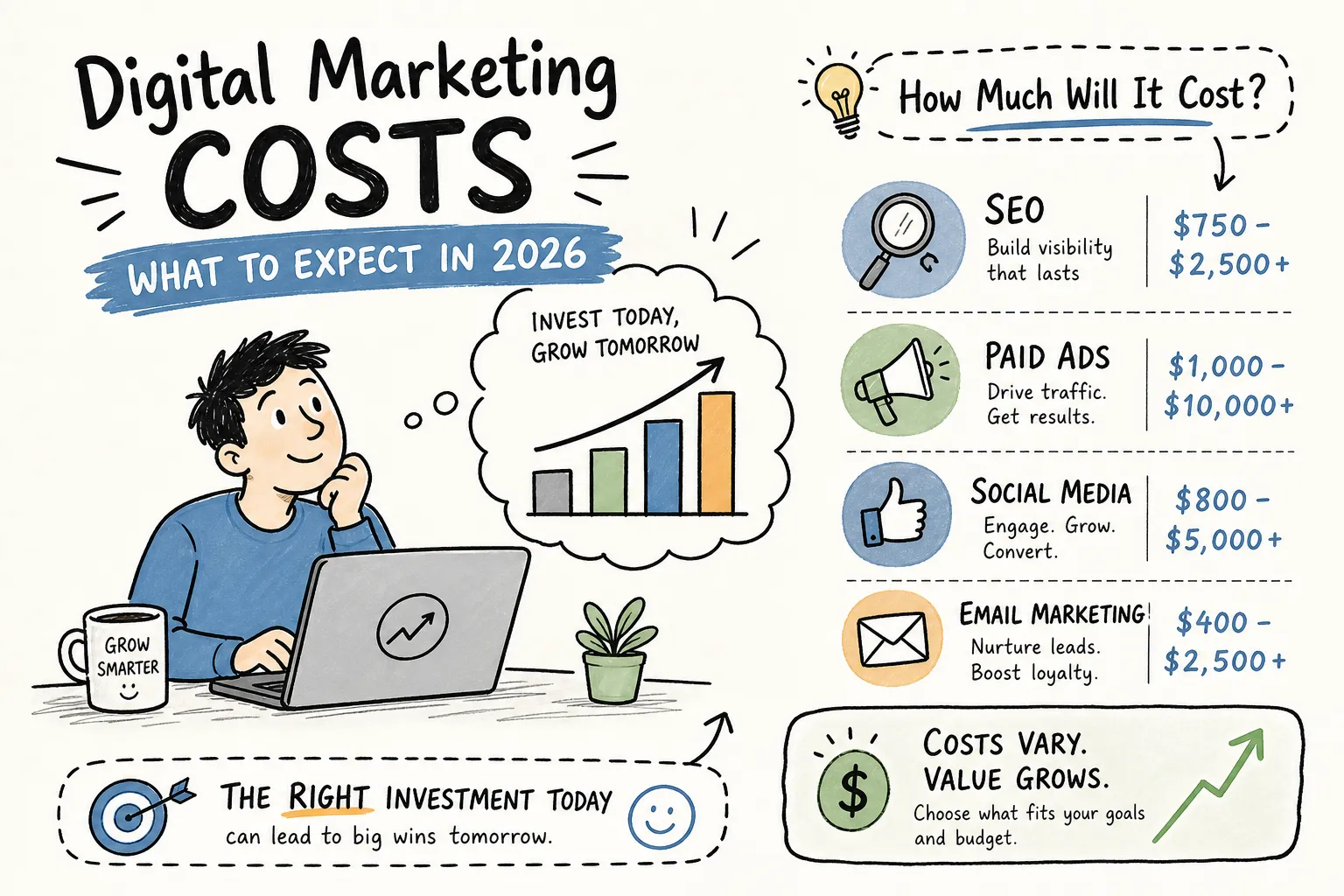
SEO attracts more third-party pricing research than almost any other agency service, and 2026 data shows agencies averaging $3,200 per month for comprehensive programs. Small business SEO campaigns typically land between $2,500 and $5,000 per month, mid-market national campaigns run $5,000 to $10,000, and enterprise or highly competitive verticals start at $10,000 and scale well above $50,000. Standalone technical SEO audits cost $750 to $5,000 depending on site complexity. Local SEO programs for single locations run $500 to $2,000 per month, making them the most accessible entry point for service-area businesses. Content marketing, often paired directly with SEO, typically adds $1,000 to $5,000 per month at the lower end of the market, this range applies to entry-level or limited-output packages covering strategy, writing, and publishing as a combined service; larger content programs can run considerably higher.
PPC management, social media, and web development rates
PPC management fees layer on top of your actual ad spend. Agencies typically charge 15 to 20 percent of monthly spend, with a minimum flat fee of $1,000 to $2,500 for smaller budgets. For a $10,000 monthly ad budget, that means $1,500 to $2,000 in management fees alone, before creative or landing page costs. Social media management runs $1,000 to $5,000 per month for most small-to-mid-market brands, the lower end reflects limited-platform or lower-volume packages, while the upper range reflects full content production and paid social management across multiple channels. Web development is almost always project-based: a business website or e-commerce build from a digital agency typically runs $5,000 to $30,000 or more, depending on complexity and custom functionality, with ongoing maintenance and conversion rate optimization support adding $500 to $2,000 per month. These figures represent industry-typical estimates for agency-delivered projects rather than freelance rates.
Hidden Digital Marketing Agency Costs to Watch
The retainer number in a proposal is rarely the full number. Most billing disputes trace back to fees that were buried in contract language but never discussed in the sales conversation. Knowing where to look is half the protection.
Setup, onboarding, and technology costs to ask about
Some agencies, particularly full-service or strategy-led firms, charge a one-time onboarding fee covering account setup, audit work, strategy documentation, and initial tool access. When they do, these fees can range from $500 to several thousand dollars and are frequently absent from the headline proposal number. Other agencies fold setup into the first month’s retainer or waive it entirely; the key is to ask directly so you know what you’re comparing. Some agencies also pass through the cost of third-party platforms such as SEO software, reporting dashboards, and ad management tools as separate line items, sometimes with a markup applied on top. Before you sign anything, ask this question directly: “What do I pay in the first month beyond the retainer?” The answer will tell you more than the proposal itself.
Ad spend markups, handling fees, and scope creep red flags
On paid media campaigns, agencies sometimes apply a handling fee of 10 to 20 percent on top of vendor costs for creative production, stock assets, or third-party data tools. Some agencies also mark up media placements, particularly in programmatic or display channels, without disclosing the spread between what they pay and what they invoice. Scope creep is the most systemic cost risk in ongoing retainer relationships: requests that fall outside the written scope often trigger additional hourly billing, which can quietly add hundreds or thousands of dollars to a monthly invoice. Protect against this with a detailed scope-of-work document before signing, and confirm explicitly whether the contract includes a defined revision policy and change-order process.
How to evaluate proposals and get more value from your budget
Turn these 2026 benchmarks into a repeatable evaluation process before you sign anything. The goal isn’t just finding the lowest price, it’s identifying whether the number in front of you reflects real value or undisclosed costs.
The questions to ask before you sign anything
Every agency proposal deserves a consistent set of questions before you commit. Work through this list with any agency you’re seriously considering:
- Does the proposal separate strategy time from execution time, or are they bundled?
- Are ad spend fees and media markups disclosed as separate line items?
- What is the minimum notice period required to cancel or pause the engagement?
- Who owns the ad accounts, website assets, and data if the relationship ends?
- Is your account managed by a senior strategist, or is it handed off to a junior team after onboarding?
These questions expose the hidden cost layers and reveal how the agency thinks about accountability. An agency that deflects on asset ownership, bundles strategy and execution without explanation, or can’t name the senior lead on your account is signaling exactly the kind of opacity that produces billing disputes later. One that answers directly and specifically is showing you how they’ll operate month to month.
What to look for in an integrated agency
Working with a single agency that handles SEO, PPC, content, and web development under one roof eliminates a layer of cost and complexity that most businesses never account for. When services are siloed across multiple vendors, each one adds its own management fee, markup, and communication gap, a fragmentation pattern that commonly results in higher total spend than a single integrated retainer, even when the individual line items look cheaper. Ask directly whether services are executed in-house or outsourced to contractors. Subcontracting is common and not inherently a problem, but it always adds a markup layer that should factor into your decision. Brandleap Agency operates as a fully in-house integrated team across all major service channels, no subcontracting markup, no coordination gaps, one accountable team. That’s the model worth benchmarking any proposal against.
What you’ll actually pay an agency isn’t one number, it’s a range shaped by your business size, the specific services you need, the pricing model you agree to, and how transparent the agency is about what sits outside the base retainer. The digital marketing agency cost benchmarks in this article give you the context to evaluate any proposal you receive in 2026 with confidence. The biggest mistake businesses make isn’t paying too much. It’s signing a retainer without understanding what it actually covers, then discovering the gaps three months in when results haven’t materialized and the invoice has grown.
If you’re currently comparing proposals or starting your agency search, consider our Top 5 Digital Marketing Agencies to Consider in 2026, or Brandleap Agency offers a free growth audit so you can see exactly what your digital marketing investment would cover before committing. Request your free audit and walk into your next agency conversation knowing what to expect.