If you need to outsource digital marketing, the first challenge isn’t finding an agency, it’s knowing which functions to delegate, what it will actually cost, and how to measure whether the investment pays off. Right now, you’re running your business, managing your team, and handling client calls, while somewhere in the middle of all that, you’re supposed to be posting on LinkedIn, optimizing your Google Business Profile, and figuring out why your traffic dropped last month. It’s not sustainable. Meanwhile, competitors who locked in their marketing engine six months ago are pulling ahead in search rankings, collecting leads on autopilot, and spending their time on growth instead of guesswork.
The decision to hand off your digital marketing to an outside team isn’t just about saving time. It’s about whether a specialized external partner can execute faster, smarter, and more cost-effectively than you can with internal resources. For most small and mid-size businesses, the honest answer is yes, but only when the outsourcing relationship is structured correctly. By the time you finish this article, you’ll know which functions to delegate first, what it will actually cost, how to evaluate agencies without getting burned, and how to measure whether the investment is paying off.
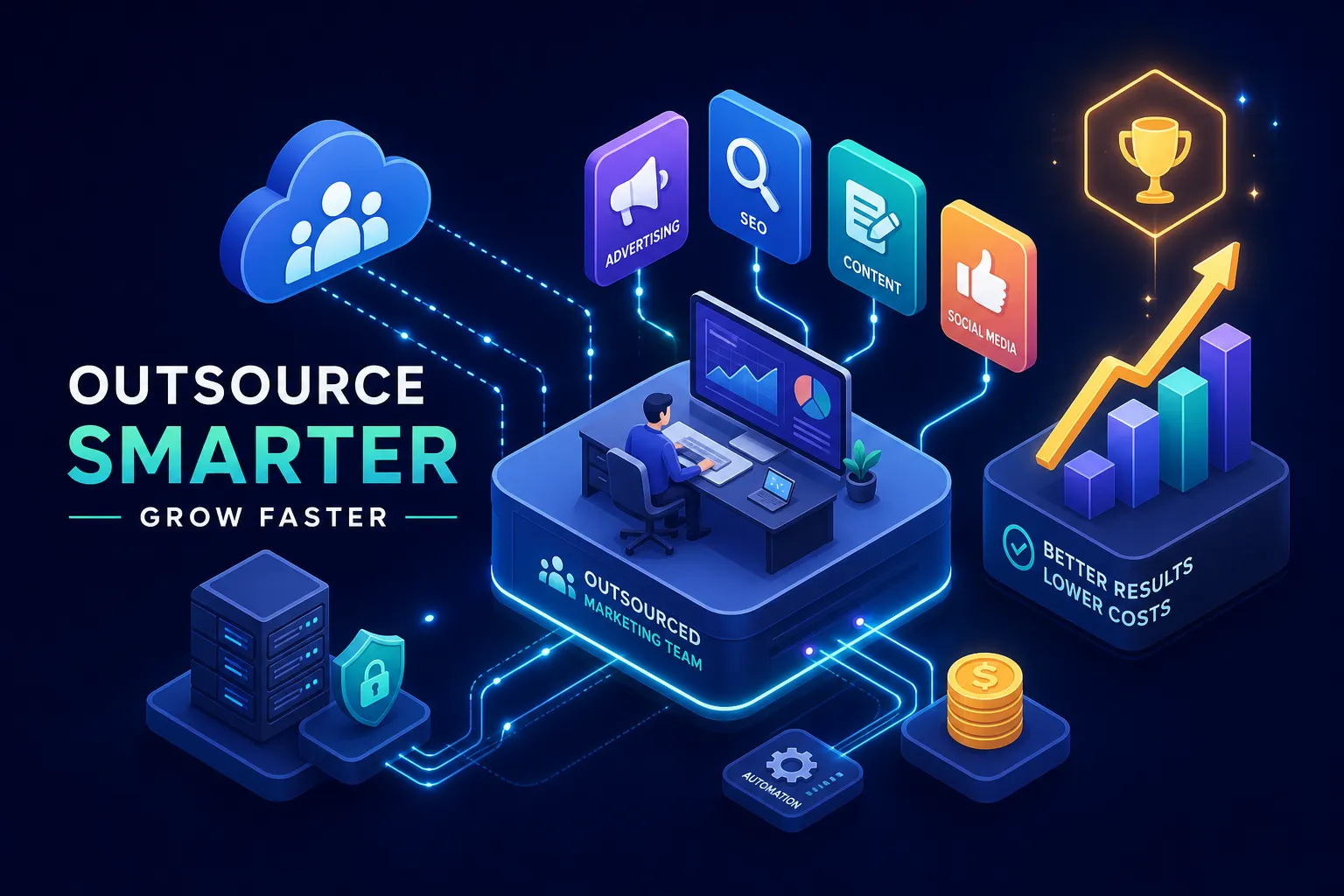
Brandleap Agency is built around this exact problem: eliminating the chaos of managing five separate vendors across five different channels. One team handling SEO, PPC, content, and web development means your campaigns reinforce each other from day one, rather than competing for attention across disconnected spreadsheets.
Is outsourcing digital marketing the right move for your business?
Before going tactical, you need an honest decision framework. Outsourcing isn’t the right answer for every business at every stage. Understanding where you fall on that spectrum will save you significant money and frustration.
When outsourcing makes strategic sense
The conditions that make outsourcing genuinely advantageous are specific. If you have no in-house marketing expertise, if your growth is outpacing your ability to hire fast enough, or if the channels you need, technical SEO, paid media, AI-optimized content, require specialized tools and practitioner relationships you can’t build internally, outsourcing is the right call. The winning model for 2026 looks like this: your internal team owns strategy and business context while an outsourced partner handles execution, optimization, and reporting. You bring the market knowledge; they bring the machinery to act on it at scale. This is the outsource marketing vs. in-house tradeoff that most growing businesses eventually have to confront, and for the majority, a hybrid model wins.
When it’s the wrong call
Be honest with yourself here. If your business has no budget discipline, no internal point of contact who can give clear direction, or an expectation that a new agency will produce results within the first 30 days, outsourcing will fail regardless of which partner you hire. Agencies amplify what’s already there. If your positioning is unclear or your offer needs work, no amount of paid traffic will fix it. Outsourcing works when you’re ready to invest in execution, not when you’re hoping it solves a strategy problem you haven’t defined yet.
How to outsource digital marketing: which functions to hand off first
Most businesses make the mistake of trying to outsource everything at once. They sign a contract covering social media, SEO, paid ads, email, and web maintenance simultaneously, then spend the first three months in coordination meetings rather than seeing results. Start narrow, prove the model, then expand.
The highest-ROI functions to outsource early
The functions that deliver the fastest return when outsourced share one characteristic: they require deep practitioner experience and specialized tools that most businesses simply don’t have in-house. When companies outsource SEO, PPC, and content together under one team, those channels compound rather than conflict. SEO Outsourcing Services are often the most effective starting point because technical SEO and AI visibility optimization top the priority list in 2026, search has shifted well beyond keyword chasing. Ranking now requires topic authority, schema implementation, and optimization for AI-driven search features that demand real expertise. Paid media follows closely; PPC management in 2026 requires Conversions API setup, iOS 14.5+ impact management, and conversion tracking expertise that most business owners haven’t had time to develop. Content marketing and website management round out the list because every channel you run eventually leads back to your website, and that site needs to convert.
The ROI data supports this prioritization. According to a 2023 Conductor analysis, SEO delivers a median return of 748% over three years, or roughly $22 for every $1 spent. Email marketing, often treated as an afterthought, returns $36 per $1 invested based on Litmus’s 2023 State of Email report. These figures explain why outsourcing execution to specialists, rather than stretching a generalist team thin, so consistently outperforms the alternative. For broader industry context, see this SEO ROI statistics report.
The single-vendor advantage most businesses overlook
Most businesses repeat the same structural mistake at this stage: they hire an SEO agency, a separate PPC shop, and a freelance content writer, then wonder why nothing feels cohesive. When strategy, execution, and reporting live across three different vendors, campaigns don’t reinforce each other. Your content team doesn’t know what your paid team is bidding on. Your SEO agency doesn’t know what landing pages your PPC team is sending traffic to. The coordination failure is expensive and slow. This is also where a white-label marketing agency layer can add further confusion, you may be paying one vendor who is quietly subcontracting the work to another, with no direct accountability in the chain.
The alternative is a full-service partner like Brandleap Agency, where SEO, PPC, content writing, and web development operate under one roof. When the same team builds your content strategy, optimizes your pages, and manages your ad spend, those channels compound instead of compete. That integration is the difference between a marketing department and a marketing machine.
What outsourced digital marketing actually costs in 2026
Vague pricing ranges are useless when you’re trying to build a budget, so here’s a breakdown of the real numbers and what they actually buy you at each tier.
Pricing models you’ll encounter
Monthly retainers dominate the industry because they allow continuous optimization across channels. You pay a fixed monthly fee and get ongoing strategy, execution, and reporting. Understanding digital marketing agency pricing before your first call will save you from getting anchored to a number that doesn’t reflect what you actually need. For a comprehensive walkthrough of pricing structures, see this digital marketing agency pricing guide. Project-based fees work for defined deliverables like technical audits ($2,500 to $10,000) or website builds ($5,000 to $50,000). Hourly billing ($75 to $400 per hour) typically appears for consulting or one-off work. Performance-based models, where the agency takes 10 to 30 percent of leads or revenue generated, are growing in 2026, often as a hybrid structure layered on top of a base retainer to align agency incentives with your outcomes.
What your budget actually gets you
Map your budget to agency tier before you start making calls. Boutique agencies typically run $1,500 to $3,000 per month and cover one or two channels with basic reporting. Mid-size agencies run $3,000 to $7,500 per month and offer multi-channel coverage, dedicated account management, and deeper strategy. Enterprise-grade full-stack engagements exceed $20,000 per month. For most US-based small businesses, the realistic sweet spot for meaningful, measurable results sits between $3,000 and $5,000 per month. For examples of current agency tiers and pricing frameworks, see LYFE Marketing’s pricing.
Watch for two hidden cost patterns before you sign anything. First, ad spend markups disguised as “technology fees” or “platform access charges” inflate your true monthly cost without adding value. Second, exit fees buried in contract terms can lock you in regardless of performance. Always ask for a full breakdown of every line item before you commit.
How to hire a digital marketing agency without getting burned
Use the questions below as a working checklist on your next agency call. They’re organized by category so you can move through them systematically rather than improvising during the conversation.
The questions every business owner should ask before signing
Organize your evaluation across four categories. On attribution and methodology, ask: “Can you explain your tracking setup and how you isolate channel impact?” and “Can you walk me through how iOS 14.5+ privacy changes affect your Facebook campaign optimization?” An agency that can’t explain Conversions API implementation or geo-holdout testing methodology is flying blind with your budget. On team transparency, ask: “Who specifically will manage my account, and what is their current client load?” and “Which services do you handle in-house versus through white-label partners?” You need to know who is actually doing the work.
On cost clarity, ask: “What is the full monthly cost including ad spend markup and tool fees?” and “What exit fees or account transition costs are in the contract?” On strategic fit, skip generic questions and ask: “Walk me through how you’d approach my specific situation given my industry, current traffic, and growth goals.” Watch how specific their answer is. Generic responses signal a one-size-fits-all approach that will produce mediocre results for your particular business. If you’re evaluating offshore partners or agencies based in specific markets, our guide on choosing a SEO Agency in India offers a checklist of red flags and sourcing tips.
Red flags that should end the conversation immediately
These patterns appear regularly enough that you need to recognize them before you sign:
- Bait-and-switch staffing: Senior experts pitch the account; junior staff execute it. Ask who specifically will manage your account day to day.
- Attribution blindness: The agency cannot explain how it separates paid channel impact from organic, email, and direct traffic. That means their reporting will tell you nothing useful.
- Hidden ad spend markups: Fees labeled as “technology” or “platform access” that are actually margin on your ad budget.
- Lock-in contracts with high exit fees: If an agency’s retention strategy is contractual rather than results-based, that tells you everything you need to know.
- Generic discovery questions: If the agency’s intake process doesn’t reflect genuine curiosity about your specific business model, their strategy won’t either.
Setting up your outsourced team to deliver real results
Outsourcing relationships fail more often at the integration level than the skill level. The agency might be excellent; onboarding is where the value gets lost.
The 90-day onboarding framework that prevents early failure
Structure your onboarding in three phases. Pre-onboarding covers weeks one and two: define outcomes, not deliverables (tell the agency “increase qualified leads by 20%” rather than “write four blog posts per month”); document your brand guidelines before the brief is sent; and align on success metrics before week one begins. Alignment week is week three: set up your reporting cadence, define roles between your internal staff and the agency, and establish communication protocols, who attends which meetings and at what frequency.
The execution period runs through month three. The most important principle at this stage: define what “working” looks like in numbers before the engagement starts. Set a specific 90-day outcome target, then hold off on any major evaluation until you hit that mark. Pulling the plug at day 45 because you haven’t seen results is one of the most common ways businesses undermine a relationship that would have delivered if given the time it needed. For a practical checklist you can adapt to your onboarding, review this 7-step guide to outsourcing marketing.
Outsource digital marketing ROI timelines: setting realistic expectations
SEO typically delivers positive ROI in six to twelve months, with traffic growth of 20 to 30 percent possible in the first six months when technical issues are resolved quickly and content is published consistently. Three-year returns on well-executed SEO programs range from 3x to 12x your investment. PPC can show results faster, but requires rigorous attribution setup to measure correctly. Without proper GA4 configuration and segmented traffic sources, you won’t know whether your paid spend is generating pipeline or just generating clicks.
Track four core metrics from day one: cost per lead (CPL), conversion rate from organic and paid traffic, total organic traffic growth month over month, and pipeline impact tied to specific channels. Reviewed monthly with your agency, these numbers give you a data-based conversation at your monthly strategy reviews, not a feelings-based one.
Make the decision to outsource digital marketing, then make it work
Real returns materialize when you choose the right functions to start with, find a partner who can prove their methodology before you sign, and treat the onboarding process as a priority rather than an afterthought. Miss any one of those and you’ll be back in the same place six months later, having spent the budget without seeing the results.
The coordination headaches that come from piecing together five different vendors for five different channels are exactly what outsourcing is supposed to eliminate. When your SEO strategy, paid campaigns, content output, and website performance all answer to the same team, your marketing compounds instead of collapsing under its own complexity.
Brandleap Agency is built to be that single accountable partner. Under a founder-led consultancy model, the team handles SEO, paid media, content, and web development as an integrated growth system, not a collection of siloed services. Every client account is treated as a priority, not a number on a roster. If you’re ready to stop managing vendors and start seeing measurable growth, reach out for a growth audit and find out exactly where your biggest opportunities are. For additional reading and case studies, visit the Brandleap Agency Blog | Expert Digital Marketing Insights.