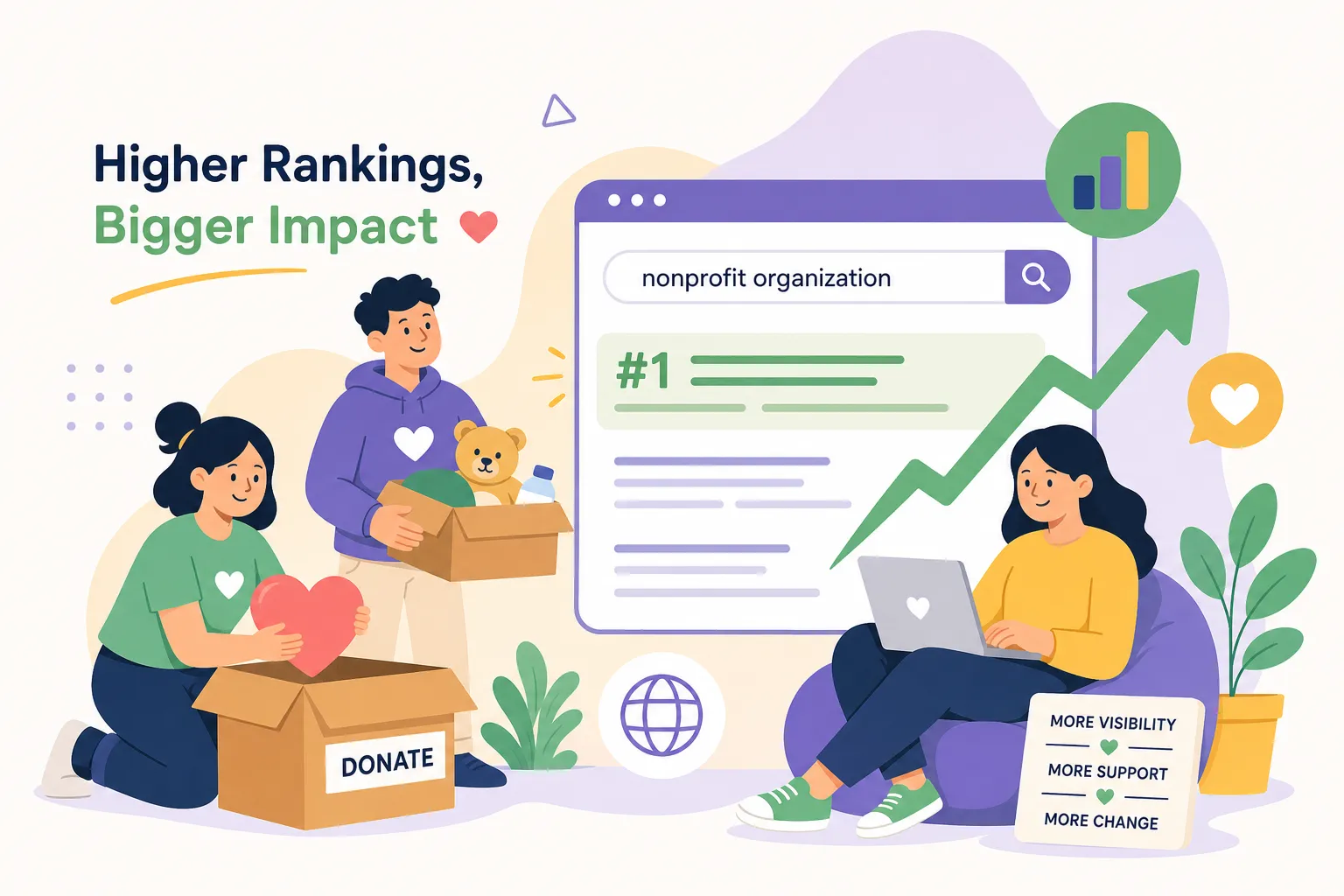
Most nonprofits pour serious energy into social media posts, email newsletters, and fundraising events. Meanwhile, they’re invisible on Google, which is where donors and volunteers are actively searching right now. Every day, people type “food bank in [city],” “donate clothes near me,” or “volunteer with youth programs [state]” into a search bar with real intent behind those queries. If your organization doesn’t appear in those results, someone else gets that click, and that donation or volunteer application. Investing in charity SEO services is how nonprofits close that gap.
Search engine optimization delivers real results without requiring the kind of monthly budget a for-profit company would throw at paid ads. Unlike Google Ads, which stops delivering the moment your budget runs dry, a well-executed SEO strategy builds visibility that compounds over time. This guide covers the tactics that drive donations and volunteer sign-ups, what professional nonprofit SEO services actually cost, and how to measure whether your SEO investment is working.
Why SEO Outperforms Paid Ads for Most Nonprofit Budgets
The core advantage of organic search is straightforward: once you earn a ranking, that ranking continues driving traffic without a cost-per-click attached to every visitor. A donation landing page that ranks on page one for “food assistance [city]” will bring in traffic next month and six months from now, without any additional spend. Compare that to a paid search campaign, where the traffic stops the moment your budget runs out or your grant cycle ends.
For nonprofits with mission-driven budgets, this distinction matters enormously. SEO builds an asset that appreciates over time rather than a tap that closes when funding dries up. That doesn’t mean paid ads have no role in a nonprofit digital marketing strategy, but they work best as a short-term supplement, not a foundation. The organizations that sustain consistent donor and volunteer acquisition through search are the ones that invested in organic visibility first.
Donor and volunteer behavior reinforces this logic. People who are ready to act, not just browse, often start with a Google search before visiting a nonprofit’s website directly. A high-intent search like “donate to animal shelter near me” represents a person who has already made the decision to give. Nonprofit SEO captures that intent at exactly the right moment. Without it, that motivated person lands on a competitor’s page instead of yours.
Keyword Research for Cause-Based Searches That Drive Action
Not all search traffic is created equal. Informational searches like “what does a food bank do” attract curious readers who may never donate. Action-oriented searches like “donate food [city]” or “volunteer with youth program [state]” attract people who are already motivated to engage. Nonprofits with limited content capacity should prioritize the second category, because that’s where the conversions happen.
Finding these high-intent keywords doesn’t require a paid subscription. Google Keyword Planner surfaces search volume data for cause-specific and location-specific terms. Google’s Autocomplete and “People Also Ask” features reveal the exact phrases real people are typing. Answer the Public organizes question-based queries around any topic in seconds. Working through these three tools for your specific cause and geography can surface a usable keyword list quickly.
Once you have those keywords, map them to separate landing pages rather than routing all traffic to a generic homepage. Your donation page should be optimized for donation-intent keywords. Your volunteer page should target volunteer-intent searches. Each program you run deserves its own page built around the searches people use to find that type of help. This is the foundation of on-page optimization for nonprofits: put the target keyword in the page title, main heading, meta description, and URL slug so search engines understand what each page is for. For example, a food assistance page might use a title like “Free Food Assistance in [City] | [Org Name]” and a URL such as /programs/food-assistance-[city].
Local SEO for Community Nonprofits: Your Highest-Leverage Channel
Most charities serve a defined geography. Local search connects them directly to people in that area who are ready to engage. Searches like “shelter near me,” “food pantry [zip code],” and “volunteer opportunities [city]” generate some of the most conversion-ready traffic available, especially for food banks, community health organizations, and social service providers. If your organization isn’t visible in local results, you’re missing the audience with the highest probability of becoming a donor or volunteer.
Optimizing Your Google Business Profile
Your Google Business Profile is the single most important local SEO asset you control. Claim and verify it if you haven’t already, then work through this checklist:
- Accurate name, address, and phone number (consistent with your website and all directories)
- Correct service categories (e.g., “Non-Profit Organization,” “Food Bank,” “Social Services Organization”)
- Current hours, including any seasonal or program-specific variations
- Photos of your facility, staff, and programs
- A description that clearly states what you do, who you serve, and where
Reviews from past donors and volunteers signal trust and activity to Google. They influence whether your organization appears in the map pack, the cluster of three local results that shows up above standard organic listings. Ask satisfied volunteers and donors to leave a review after a positive interaction; even a modest increase in review count can move you into that top three.
If you’d like a step-by-step external guide on optimizing profiles specifically for nonprofits, see how to optimize your Google Business Profile for nonprofits.
Location Landing Pages and Directory Listings
For nonprofits serving more than one city or region, dedicated location-based pages extend local authority across your service area. Each page should include the city or region name in the title tag, H1, meta description, and URL (e.g., /locations/food-assistance-springfield). Consistent listings on platforms like Charity Navigator, Idealist, GuideStar, and local chambers of commerce build citation consistency, which tells search engines your organization is a legitimate, established presence in each area you serve. This geographic authority compounds over time and directly supports fundraising SEO efforts in competitive local markets.
Technical SEO Fundamentals Every Charity Website Needs
A nonprofit can rank for the right keywords and still lose donors at the last step if the website is slow, broken on mobile, or difficult to navigate. Visitors abandon donation forms when pages take more than three seconds to load, and this is especially pronounced on mobile devices, where a large share of search traffic now originates. Google also factors page experience into rankings, making speed improvements a dual win: you rank better and convert more of the traffic you already have. Google’s PageSpeed Insights is a free diagnostic tool that shows exactly where your site is losing time.
Site structure and internal linking are equally important, and they’re often overlooked by nonprofits focused on content. A well-structured site guides visitors from informational blog posts to donation or volunteer landing pages through logical, well-labeled internal links. A post about the impact of your meal program should link directly to your donation page. A guide on volunteering should connect to your volunteer sign-up form. Think of content as feeding conversion pages rather than existing in isolation.
For nonprofits working with tight budgets, three free tools cover most of the technical baseline. Google Search Console monitors search performance, indexing errors, and click data at no cost. Ahrefs Webmaster Tools provides backlink monitoring and site auditing in its free tier. Screaming Frog’s SEO Spider crawls up to 500 URLs for free, which covers most smaller nonprofit sites, and the paid version offers a reported 20% discount for 501(c)(3) organizations. Together, these tools give you a solid technical foundation without spending a dollar. For a broader list, see top free SEO tools to boost your charity’s website performance.
Choosing Charity SEO Services: Costs and What to Look For
In 2026, freelance SEO consultants typically run $1,000 to $3,000 per month for ongoing support, while agency retainers range from $3,000 to $10,000 per month depending on scope and content needs. Most nonprofits with local or regional goals land in the $1,500 to $5,000 per month range for a program that includes technical SEO, content, and local optimization. One-time audits and strategy builds generally cost $750 to $5,000 as standalone projects, which can be a practical entry point if you’re not ready for an ongoing retainer. For more detailed pricing studies, consult how much local SEO costs in 2026.
The choice between a generalist full-service agency and a specialist nonprofit SEO consultant involves real tradeoffs. Specialists often bring deep familiarity with cause-based search behavior and nonprofit compliance considerations. Agencies like Brandleap (Achieve Better Rankings With Proven SEO Solutions, 2026) offer the advantage of integrated campaigns where SEO, content, and technical work are handled under one engagement rather than billed as separate services. For organizations that want both strategy and execution without managing multiple vendor relationships, that integration tends to produce more cohesive results, and clearer accountability. For examples of industry-specific approaches, see our post on Boost Your Business: SEO for Financial Services, 2026.
Before you sign any contract, ask these five questions:
- Do they track organic donation conversion rate, not just traffic volume?
- Can they show case study results from comparable organizations?
- Do they build deliverables your team can own if you part ways?
- How do they divide responsibility between technical work and content creation?
- What does a typical monthly reporting cadence look like, and what metrics appear in that report?
The KPIs That Tell You Whether Your SEO Is Actually Working
Rankings and traffic are the metrics most SEO providers lead with in their reporting. They’re useful directional signals, but they don’t tell a nonprofit board whether charity SEO services are earning their budget. The metrics that actually answer that question connect organic search to your bank account and your volunteer roster.
A lean, decision-ready dashboard for nonprofits includes five core metrics: organic sessions, organic donation conversion rate, donations per organic visitor, total donation value attributed to organic search, and SEO ROI. These five were chosen deliberately, total donation value and ROI ground every other number in financial reality, while conversion rate and donations per visitor isolate whether your pages are persuasive, not just visible. Track these consistently and you can show your board exactly how much the SEO program returned relative to what it cost. If you need examples or templates, see SEO KPI examples.
Setting up this tracking doesn’t require a data analyst on staff. In GA4, create a conversion event for donation form submissions, then filter your reports by organic traffic as the source. Google Search Console shows which queries are driving clicks so you can connect specific keyword wins to conversion performance. The setup takes roughly 30 minutes, and it pays off every reporting cycle by giving you concrete evidence of what’s working and what needs adjustment.
Start Where You Are, Then Build From There
Effective charity search engine optimization is not reserved for organizations with large marketing budgets or dedicated digital teams. The nonprofits that rank well in 2026 are the ones that started with clear keyword intent, fixed their technical basics, optimized for local discovery, and tracked the metrics that connect search traffic to real-world donor and volunteer outcomes. None of those steps require enterprise resources.
Start with your Google Business Profile if you haven’t already optimized it. Identify five high-intent keywords tied to your top conversion goals. Create dedicated landing pages for donations, volunteer sign-ups, and your highest-traffic programs. From there, layer in technical fixes and content as your capacity allows. If you want external support, look for charity SEO agencies that can demonstrate results for organizations like yours and report on outcomes, not just keyword positions.
The cost of staying invisible online is higher than the cost of getting started. The donors and volunteers searching for your cause right now are going to find someone, make sure it’s you. Whether you take the first steps yourself or bring in a partner like Brandleap to accelerate the process (How to Improve Website Rankings Without Paid Ads, 2026), the organizations that act early will own the search visibility that turns intent into action.