
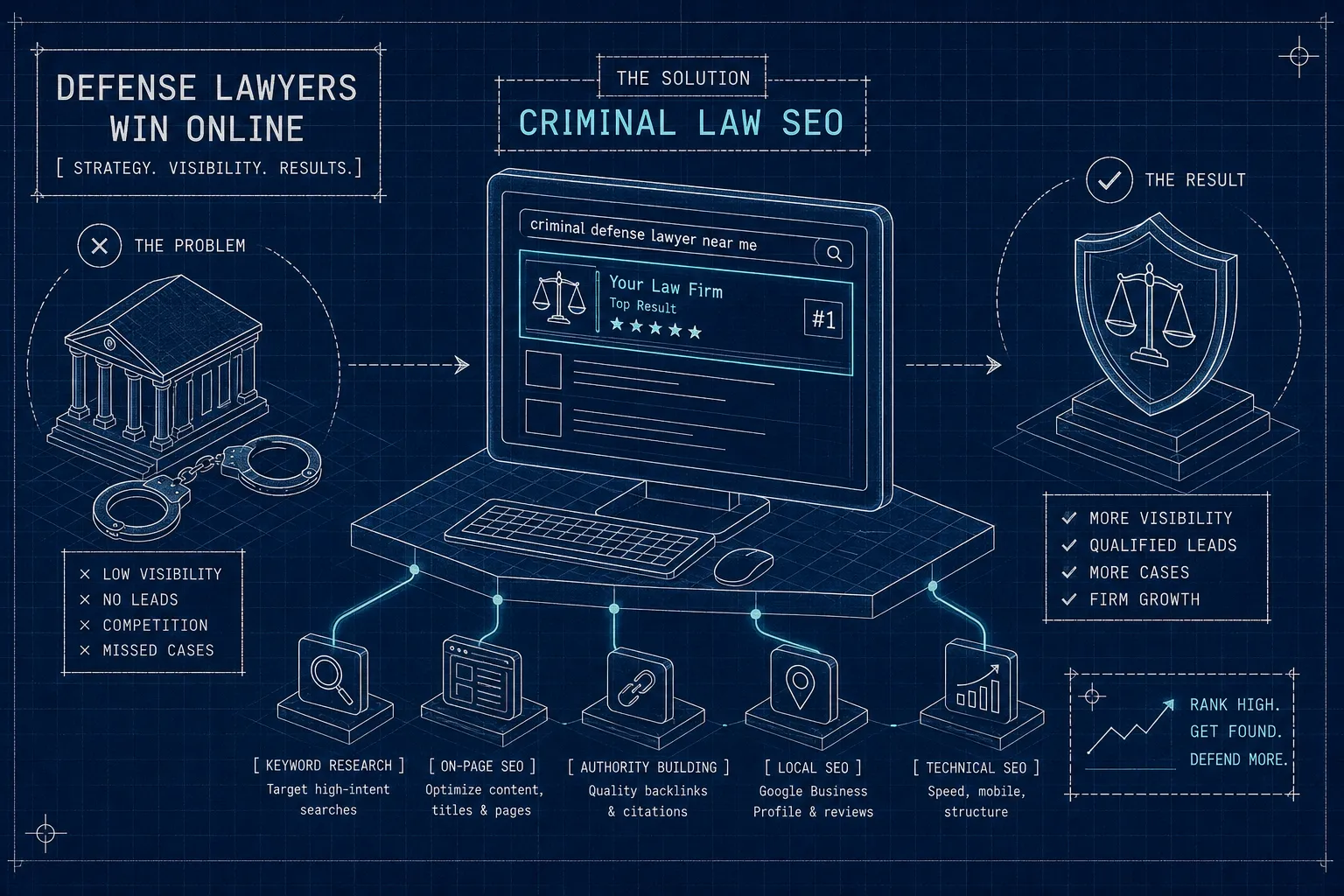
Someone searches “DUI lawyer near me” at 11:42 pm. They were just arrested, or their spouse was. They’re not browsing. They’re ready to hire whoever shows up first and looks credible. If you’re evaluating criminal law SEO services for your firm, that midnight moment is exactly why urgency and local visibility matter more here than in almost any other practice area. The question isn’t whether to invest, it’s whether you’ll rank before the attorney three blocks away who started six months ago.
Criminal defense attorney SEO isn’t the same as general law firm marketing. The search intent is urgent, competition in most metro markets is fierce, and a generic “optimize your website” approach delivers essentially zero return. This guide breaks down what specialized legal marketing for criminal defense actually covers, what results you can realistically expect, what it costs in 2026, and how to evaluate providers before you commit.
Brandleap Agency works with professional service firms, including law offices, and has seen firsthand that technical SEO alone doesn’t win criminal defense clients. Winning requires local visibility, credible content, and a site built to convert after a terrifying midnight phone call, all three, working together.
Why criminal defense searches carry unusually high hiring intent
Many general search queries are exploratory, people gathering information with no immediate need to act. Criminal defense queries work differently. When someone types “criminal defense attorney” or “felony attorney near me,” they have an immediate, high-stakes problem and are actively comparing options to solve it. Research on keyword intent consistently shows that charge-specific and location-modified criminal defense queries skew heavily toward transactional intent, which is what makes attorney SEO services for this niche such a high-return investment compared to virtually any other legal practice area.
The search volume data makes the case
The numbers are hard to ignore: “criminal defense attorney” generates roughly 33,100 searches per month in the U.S., while “DUI lawyer” adds another 27,100. Charge-specific terms like “drug crime lawyer,” “probation violation lawyer,” and “assault attorney” each contribute thousands more monthly searches on top of that. These aren’t passive informational queries. They’re signals from people in crisis who need legal representation now, and they’re choosing from whoever appears at the top of the results page. For practitioners building targeted pages, resources that list high-intent SEO keywords for lawyers can be a useful starting point when mapping charge-specific content.
Why generic approaches miss this audience
A general law firm SEO strategy often targets broad, low-intent keywords or produces content designed to inform rather than convert. Criminal defense clients don’t need an explainer on court procedures. They need a firm that looks authoritative, ranks prominently for their specific charge and city, and makes it frictionless to call or book a consultation right now. A content strategy that doesn’t address that specific psychology will underperform regardless of how technically sound the site is.
Criminal law SEO services: the three core pillars
Effective SEO for criminal lawyers isn’t a single service, it’s a coordinated set of activities that builds visibility, authority, and trust at the same time. A provider that pitches only one piece of this (only link building, or only content writing) is selling you an incomplete solution. The three pillars that every serious criminal defense SEO plan requires are practice area pages, technical SEO, and local search authority.
Practice area pages built around charge-specific keywords
Generic “criminal defense services” pages rarely rank competitively in established markets. What works is a dedicated page for each practice area: DUI defense, drug possession, assault and battery, federal criminal defense, and so on. Each page should target a specific keyword cluster such as “DUI lawyer [city],” address the charge directly, explain your firm’s approach, and include a clear call to action. These pages are your primary conversion assets, they’re where consultation leads originate, and they form the backbone of any serious criminal law SEO services campaign. For ideas on which attorney phrases to prioritize when building those pages, consult lists of the best attorney keywords that tend to drive high-intent traffic.
Technical SEO for criminal law SEO services
Page speed, mobile responsiveness, structured data markup, and crawlability all affect how Google evaluates your site. For criminal defense specifically, LegalService schema markup with your office location, hours, and practice areas helps search engines surface your firm in relevant local results. A technical SEO audit should be the starting point for any new campaign, before a single piece of content is written.
Local SEO as the lead engine
Most criminal defense clients come from the same city, county, or nearby suburbs, the exact radius depends on market density, but proximity is nearly always the deciding factor. That makes local search visibility, including the Google Map Pack and “near me” results, the highest-leverage area of the entire campaign. Focusing only on organic rankings while neglecting local SEO is one of the most common and costly mistakes defense firms make with their digital marketing budget.
Local authority building: ranking for “criminal lawyer near me”
The Map Pack is often where criminal defense clients make their first decision. Three firms show up. One has 140 reviews and a complete profile. One has 12 reviews and a sparse listing. One has no reviews at all. The math is predictable, and it plays out thousands of times a day across every metro market in the country. Winning the Map Pack isn’t a bonus, for most firms, it’s the primary source of inbound leads.
Google Business Profile optimization
Your Google Business Profile is not a set-it-and-forget-it asset. The primary category should be “Criminal Defense Attorney” or “Criminal Justice Attorney,” not a generic “Lawyer” designation. Services, photos, hours, office address, and a compelling business description all contribute to local rankings. Consistent posting and prompt responses to reviews signal active engagement to Google’s local algorithm, two tactics that require minimal effort but are frequently neglected by competing firms.
Citation consistency across legal directories
Your firm’s Name, Address, and Phone (NAP) information needs to match exactly across your website, Google profile, and every directory listing. Legal-specific directories like Avvo, Justia, FindLaw, Super Lawyers, and HG.org carry high domain authority and reinforce your local trust signals. Inconsistent NAP data across these sources can suppress your local rankings even when everything else is well-optimized. For a practical overview of how directories factor into local lead generation, see this primer on legal directories.
Location-specific landing pages
If your firm serves multiple cities or counties, each location deserves its own dedicated page. A page targeting “DUI lawyer in [county name]” or “criminal defense attorney in [suburb]” captures geo-specific demand that a single homepage cannot address. Pair these pages with local schema markup to maximize visibility in search results, and include genuinely location-specific content rather than just swapping out a city name in an otherwise identical template. Local SEO principles apply across industries; for a vertical-specific example see our Local SEO for Real Estate: Rank Higher in Your Market, 2026 guidance.
Reputation management and bar-compliant content
Criminal defense attorneys operate under advertising constraints that most SEO providers don’t fully understand. Bar association rules, largely modeled on ABA Model Rules 7.1 through 7.5, prohibit false or misleading statements, guaranteed outcomes, and unsubstantiated claims of specialization. An SEO provider who writes “we’ll get your charges dropped” on a landing page is putting your bar license at risk, not just your marketing budget.
Writing content that ranks and stays compliant
Effective criminal defense content explains your approach to a charge type, outlines the legal process, and demonstrates competence without making outcome promises. Case results can be referenced with proper disclaimers, and testimonials can be used where permitted by your state bar, but they must be accurate and include required caveats. The strongest content writers in this niche know that being credible and compelling doesn’t require bending compliance rules, in fact, transparency tends to build more trust with potential clients than inflated promises ever could.
Managing online reviews within ethical boundaries
Reviews are one of the strongest local ranking signals available, but how you solicit them matters. Asking satisfied clients for honest reviews is generally permissible under ABA guidelines, while offering incentives or selectively publishing only positive feedback in misleading ways can violate both bar rules and Google’s policies. A sound reputation management strategy for a defense attorney should prioritize volume over time, consistency across platforms, and genuine client experiences, not manufactured social proof.
Timelines, KPIs, and realistic costs
Criminal defense attorneys are accustomed to measuring outcomes against effort, and SEO is no different. The key is going in with realistic expectations about what each phase of the engagement actually produces.
When results typically appear
Months one through three are largely foundational: technical fixes, GBP optimization, citation cleanup, and initial content production. Months four through six typically produce early ranking movement and a measurable uptick in organic traffic. By months seven through twelve, firms with consistent investment commonly report significant organic traffic growth and a meaningful increase in call and consultation volume, based on industry benchmarks reported by legal SEO practitioners. Once rankings stabilize, cost per lead from organic search tends to run substantially lower than paid search, often by a multiple that makes a compelling long-term case for criminal defense digital marketing over continued PPC dependence.
Pricing benchmarks for 2026
Expect to pay $2,500 to $7,500 per month for a comprehensive criminal defense SEO retainer in mid-sized markets. Competitive metro markets often require $5,000 to $15,000 per month or more for meaningful results. Project-based work, including audits, site migrations, and one-time content sprints, typically runs $3,000 to $15,000 depending on scope. Be cautious of providers pricing well below these ranges: at sub-$1,000 per month, there simply isn’t enough labor to execute the volume of work this discipline demands. For a detailed look at current channel-level recommendations and campaign scope in 2026, consult this digital marketing for criminal defense attorneys, 2026 guide.
KPIs worth tracking
The metrics that matter are organic traffic growth, Google Business Profile call clicks, consultation form submissions, keyword ranking improvements for target charge-specific terms, and cost per consultation. Rankings alone are a vanity metric if traffic isn’t converting to booked calls. Any provider who leads every reporting cycle with rankings while burying lead volume data is measuring the wrong thing, or hoping you don’t notice the difference.
How to choose a criminal defense SEO provider
Not every SEO agency understands the legal industry. Within legal, criminal defense has its own dynamics: urgent search intent, bar compliance constraints, intense local competition, and reputation sensitivity that goes well beyond most professional services. Choosing a provider with specific experience in this niche shortens the learning curve and reduces the risk of costly compliance mistakes early in the campaign. We also work across other professions, see our Boost Your Business: SEO for Financial Services, 2026 examples, to demonstrate how industry-specific approaches change tactical priorities.
Questions to ask before signing
Before committing to any vendor, ask directly: Have you worked with criminal defense or professional service firms before? Can you show me examples of practice area pages you’ve built and ranked? How do you handle bar compliance in content creation? What does your monthly reporting include, and which KPIs do you prioritize? Vague or evasive answers to these questions are a red flag worth acting on before you sign anything.
What a solid criminal law SEO services audit should cover
A credible audit goes well beyond a list of broken links. It should assess your current keyword rankings by practice area, your GBP standing relative to local competitors, your citation consistency, your site’s technical health, and your content gaps against high-intent charge-specific queries. Brandleap Agency structures its Law Firm SEO Services for Increased Case Inquiries initial audits for professional service firms, including law offices, to surface the highest-leverage opportunities before any work begins, so you understand exactly what you’re investing in and why before a contract is signed.
Red flags to walk away from
Guaranteed first-page rankings, vague “proprietary methods,” contracts with no performance review milestones, and portfolios with zero legal industry experience are all signs to look elsewhere. Criminal defense SEO is a specialized discipline that requires knowledge of bar compliance, local search dynamics, and conversion-oriented legal content. A generalist agency with no professional services background will cost you time, budget, and rankings before you can undo the damage.
Start before your competitor does
Criminal defense is one of the highest-stakes, highest-intent verticals in legal search. The attorneys who invest in specialized criminal law SEO services, built on solid practice area pages, strong local authority, and compliant content, don’t just rank higher. They get the calls while competitors wait for referrals.
The timeline requires patience, but the cost-per-lead math over twelve months is hard to argue with. Start with a technical audit, clean up your local presence, and work with a provider who understands both the SEO mechanics and the professional rules that govern how defense attorneys can market themselves online.
The next person searching “criminal defense attorney near me” at midnight is choosing someone. Make sure it’s you. Request a growth audit from Brandleap Agency and find out exactly where your firm stands before your competitors do.