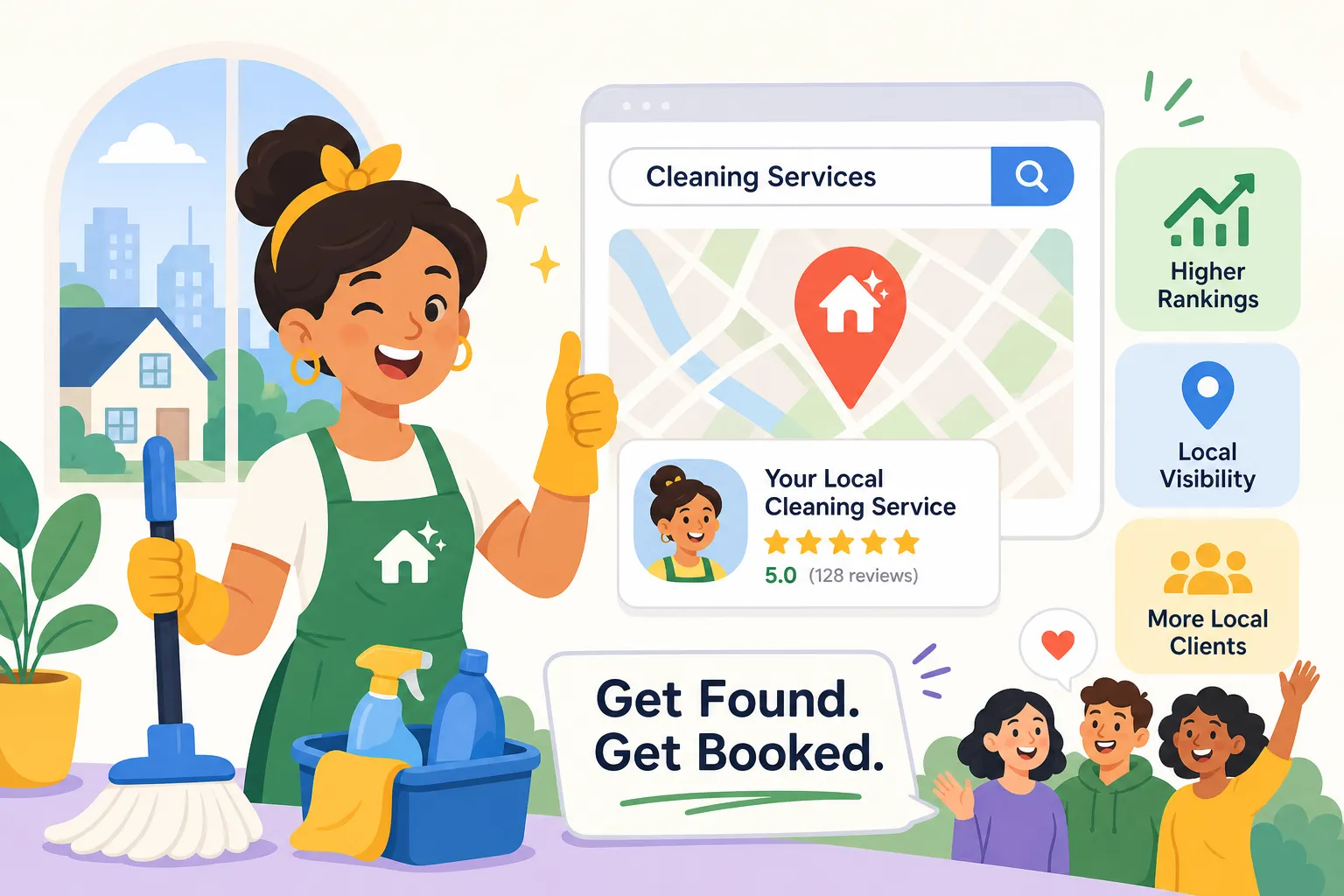
Most cleaning businesses run on referrals, and that’s fine until the referrals slow down. Right now, people in your area are searching “house cleaning near me” and “maid service [your city]” with their credit cards ready. If your business doesn’t show up, a competitor’s will. That’s exactly the gap housekeeping SEO services are built to close, getting your cleaning company in front of high-intent local searchers before they ever call anyone else.
The cleaning businesses dominating those searches aren’t bigger or more experienced than yours. They’ve made the right moves with local search optimization. Brandleap Agency works specifically with local service businesses to build the kind of consistent lead pipeline that word-of-mouth alone can’t sustain, combining maid service SEO, Google Maps optimization for cleaning businesses, and content strategy into one integrated approach.
This guide covers the tactics that move the needle fastest for cleaning companies, what a real SEO package should cost and deliver, the KPIs that prove results, and the exact questions to ask any agency before you sign a contract.
Why local search is your most valuable booking channel
When someone searches “house cleaning near me,” Google surfaces a Local Pack: three map-based business listings that appear above every organic result on the page. These three spots capture the majority of clicks for service-based searches. If your cleaning business isn’t in one of those spots, most searchers never scroll far enough to find your website.
Google determines which businesses appear in the Local Pack using three signals: relevance, distance, and prominence. Relevance is how well your profile matches the search query. Distance is how close your business is to the searcher. Prominence is how well-known and trusted your business appears online, measured through reviews, citations, backlinks, and profile completeness. Each of these signals is controllable with the right SEO work.
There’s an important distinction between Local Pack rankings and the organic results below the map. The Local Pack is driven by your Google Business Profile, your reviews, and your proximity signals. Organic rankings are driven by your website’s content, authority, and service-area pages. Both channels matter, but the Local Pack produces faster calls and bookings while organic results build a longer-term pipeline. A well-run cleaning company SEO strategy treats these as two parallel tracks that reinforce each other. For a deeper look at location-focused strategies, see our guide on Local SEO for Real Estate, which covers many of the same local-search fundamentals applied to service-area businesses.
Housekeeping SEO Services: Local Pack & “Near Me” Wins
Google Business Profile: the highest-leverage starting point
A complete, accurate Google Business Profile with the right service categories, photos, a defined service-area radius, a detailed business description, and an active posting schedule is the single biggest driver of Local Pack visibility. Most cleaning businesses leave this profile half-finished, which hands an immediate competitive advantage to whoever takes the time to optimize it properly.
For service-area businesses without a physical storefront, your GBP settings matter even more. Google uses your declared service areas and your profile’s underlying location to estimate proximity to searchers. Stronger relevance and prominence signals compensate when apparent distance is a disadvantage, so every field in your profile counts. This is a core reason why Google Maps optimization for cleaning businesses delivers such outsized results relative to the effort involved; practical how-to tips for dominating Maps are available in guides that explain how to rank #1 on Google Maps for your local service business.
Building a review acquisition system
Positive reviews function as both a ranking factor and a conversion driver. When someone is choosing between two cleaning companies, they almost always book the one with more recent and substantive reviews. Star rating alone isn’t enough, recency and response rate signal to both Google and potential clients that your business is active and accountable.
The most effective approach is systematic: send a direct review link immediately after a completed job, time the request when client satisfaction is highest, and respond to every review whether it’s positive or negative. This process doesn’t need to be complicated, but it does need to be consistent. In competitive local markets, cleaning businesses with 30 recent reviews routinely outrank those with only 5 older ones, even when those 5 are all five-star ratings.
Service-Area Pages for Housekeeping SEO Services
One generic homepage cannot rank for “house cleaning in Austin” and “house cleaning in Round Rock” at the same time. Each city or neighborhood you serve needs its own dedicated page with localized content, the specific services you offer in that area, and trust signals relevant to that location. Without these pages, you’re invisible in every market except the one Google associates with your primary profile location.
Structurally, each service-area page should include an H1 with the city and service name, a localized intro, a services section, local reviews or testimonials, and a clear booking CTA. Schema markup using LocalBusiness and Service types helps Google understand what the page is about and where it applies. A well-built location page for “maid service in [City]” can begin ranking within three to six months in low-to-moderate competition markets. This is the foundation of effective local SEO for cleaners operating across multiple zip codes.
Citation consistency across directories
Google checks that your business name, address, and phone number match across Yelp, Angi, HomeAdvisor, BBB, Thumbtack, Apple Maps, and other directories. Inconsistencies, even minor ones like “St.” versus “Street”, suppress local rankings by introducing doubt about your business’s legitimacy. Cleaning up these citations is foundational work that has to happen before other SEO efforts reach full effectiveness.
Targeting keywords that bring ready-to-book clients
Three keyword types drive the highest-intent traffic for cleaning businesses. “Near me” searches (“deep cleaning services near me”) capture searchers at the moment of decision. City-based searches (“maid service Dallas”) target local awareness and comparison shoppers. Service-specific searches (“move-out cleaning Houston”) attract clients looking for a specialized job with a defined need. These terms generate anywhere from 10 to 200 monthly searches per city depending on market size, but the intent is transactional: these are people ready to book, not browse.
Higher-ticket service terms like “deep cleaning” and “move-out cleaning” are often less competitive than broad terms like “cleaning services” and convert at higher rates because the searcher already knows what they need. Targeting these terms in competitive markets is a smarter entry point than fighting for the broadest keywords from day one. For concrete keyword ideas, review lists of local cleaning service keywords customers actually search for to help prioritize your service-area pages and blog topics.
Each keyword type maps to the right page differently. GBP and location signals handle “near me” queries. Service-area pages target “service + city” combinations. Your homepage handles branded queries and broad category terms. Without this mapping, multiple pages compete against each other for the same keyword, splitting your ranking potential and weakening every page involved.
What cleaning service SEO packages should include and cost
A legitimate housekeeping SEO services package should cover GBP management, on-page optimization for service and location pages, content creation, citation audits and cleanup, local link building, review strategy guidance, and monthly reporting tied to actual KPIs. If an agency’s deliverables list is vague or heavy on rankings reports but light on GBP work and location pages, that’s a red flag before you sign anything. For additional reading on practical SEO tactics tailored to cleaning businesses, see resources that focus on SEO for cleaning companies.
Realistic pricing in 2026 breaks down roughly like this:
- $500, $1,000/month: This tier covers very basic local SEO, useful for new businesses in low-competition markets with limited deliverables and minimal content work.
- $1,000, $2,500/month: The realistic range for most small cleaning businesses wanting foundational local visibility, covering GBP management, on-page optimization, and citation cleanup.
- $2,500, $5,000/month: Competitive markets, multiple service areas, or businesses aiming to dominate city-wide with aggressive content and link-building programs.
For timelines, expect months zero through three to focus on technical fixes, GBP optimization, and early ranking movement on lower-competition terms. Months three through six bring page-one potential for “service + city” keywords and the first measurable lead signals if tracking is set up correctly. Months six through twelve and beyond are when competitive city-wide terms become reachable and organic traffic compounds into a reliable pipeline. Don’t expect overnight results, but do expect visible progress within the first 90 days.
KPIs that tell you whether your SEO spend is working
Start tracking these metrics from month one so you have baseline data to measure against. GBP Insights shows calls, direction requests, and website clicks directly from your Business Profile. These are the most immediate signals of local visibility. Google Search Console tracks how many people land on your site from unpaid search and which pages they’re landing on. Keyword ranking movement for your “service + city” targets tells you whether your location pages are gaining ground.
Bounce rate and time-on-page for those location pages reveal whether the content actually matches what searchers want. At the business level, track your close rate on inbound calls from SEO, your one-time to recurring client conversion rate, and your monthly churn rate. A close rate around 50% on inbound SEO calls suggests your pricing and trust signals are working; significantly lower than that points to a conversion problem, not an SEO problem. Recurring clients are where the real long-term ROI lives, because the same SEO investment that acquired them keeps paying as long as they stay. Calculate customer lifetime value against your monthly SEO spend to understand the true return over time, not just cost per lead.
Questions to ask before signing with any cleaning SEO agency
Any agency that guarantees “#1 rankings in 60 days” is either inexperienced or dishonest. No ethical SEO agency makes promises like that because Google’s algorithm isn’t a vending machine. Walk away from that pitch and evaluate the agency on what it can actually control: deliverables, process, and reporting. If you want a template for the kinds of services and deliverables a specialized agency should provide, review our page on SEO Services for Real Estate Agents for a comparable deliverables structure tailored to service-area verticals.
Ask every agency these specific questions before you commit:
- “How many service-area pages will you build in the first 90 days?”
- “What does your review acquisition process look like, and how do you document it?”
- “How do you report on Local Pack visibility versus organic traffic separately?”
- “Have you worked with service-area businesses that have no physical storefront?”
- “What KPIs are included in your monthly reporting, and which ones are tied to our contract deliverables?”
The last question matters more than most business owners realize. A generic agency that works primarily with product brands or national retailers doesn’t approach cleaning company SEO the way a specialist does. Service-area businesses have no storefront, which changes how GBP is configured, how location pages are structured, and how proximity is handled in the local algorithm. Specialists understand these distinctions and build campaigns around them. Brandleap Agency focuses specifically on building local lead pipelines for service businesses through integrated housekeeping SEO services strategies, which means the approach is built for your business model from day one, not adapted from a template designed for someone else. If you’re evaluating agencies and want to understand the commercial side of packaging and selling SEO, our article on How to Sell SEO explains client conversations and deliverable framing that keep expectations aligned.
Build the foundation, then let it compound
Local SEO for cleaners works when the right tasks are executed in the right sequence: GBP first, reviews second, service-area pages third, citation cleanup fourth, and all of it measured against real business outcomes rather than just keyword ranking reports. Shortcuts in any of these steps create gaps that limit how far the campaign can go.
The compounding effect of these four levers is what makes housekeeping SEO services worth the investment. Organic traffic keeps coming whether or not you’re running ads that month. A well-built location page for a city you serve keeps generating leads years after it was published. Reviews accumulated over six months keep converting new visitors into clients. None of that happens with paid ads the moment you pause the campaign.
Start by auditing your current Google Business Profile and Google Search Console data to establish your baseline. Then use the questions in this guide to evaluate any agency that pitches you. If you’re improving on-site conversion as part of your program, consider implementing the 10 must-have elements for a cleaning service landing page to make your service-area pages convert at higher rates. The cleaning business owners winning locally made a deliberate choice: they invested in the right SEO foundation early, tracked the right metrics, and held their agency accountable to real deliverables. Audit your GBP today and contact a specialist in housekeeping SEO services to start capturing the local bookings your market already has on the table.