Introduction
Businesses across the US are pouring real money into Google Ads and walking away with thin returns. The frustrating part is that PPC campaigns work. The 2026 industry average sits around 200% ROAS, and well-structured campaigns in verticals like e-commerce and home services routinely hit 350, 400% ROAS. The campaigns that fall short aren’t failing because pay-per-click advertising doesn’t work. They’re failing because the structure is wrong.
After managing paid search campaigns across multiple verticals for US businesses, the team at Brandleap Agency sees the same structural mistakes appear consistently: audiences that are too broad, bid strategies that don’t match campaign maturity, landing pages that break the user’s expectation, and attribution models that hide where revenue actually comes from. In most accounts, correcting these four areas closes the performance gap meaningfully, sometimes within a single billing cycle.
This article walks through each of the four pillars: audience targeting, bidding strategy, ad and landing page alignment, and ROI measurement. It also includes a prioritized 90-day roadmap to implement them in the right order.
Why Most PPC Campaigns Bleed Money Before the First Click
Underperformance in paid search is often not a budget problem. Campaigns that convert poorly at $3,000 per month frequently convert just as poorly at $10,000 per month, they just waste more money doing it. Increasing spend before fixing structure doesn’t improve results; it scales the inefficiency. The root cause is almost always structural: wrong audience, wrong bid strategy, wrong message, or wrong measurement setup.
The Benchmark Gap You Need to Know About
The 2026 paid search benchmarks break down sharply by vertical. According to industry benchmark data, e-commerce averages 400% ROAS with a $28.30 CPA. Home services sits at 350% ROAS with a $32.50 CPA. B2B SaaS lands at 180% ROAS, and legal services at 160% ROAS with a $144.30 CPA. These figures are representative of well-structured accounts in each vertical. Campaigns without proper targeting and tracking often land below the vertical floor, not because the channel is weak, but because they’re missing the structural elements that drive those numbers.
Knowing your vertical benchmark is the first diagnostic step. If you’re in home services and your ROAS is sitting at 150%, that’s a structural signal, not a signal to cut budget.
The Four Levers That Determine Paid Search ROI
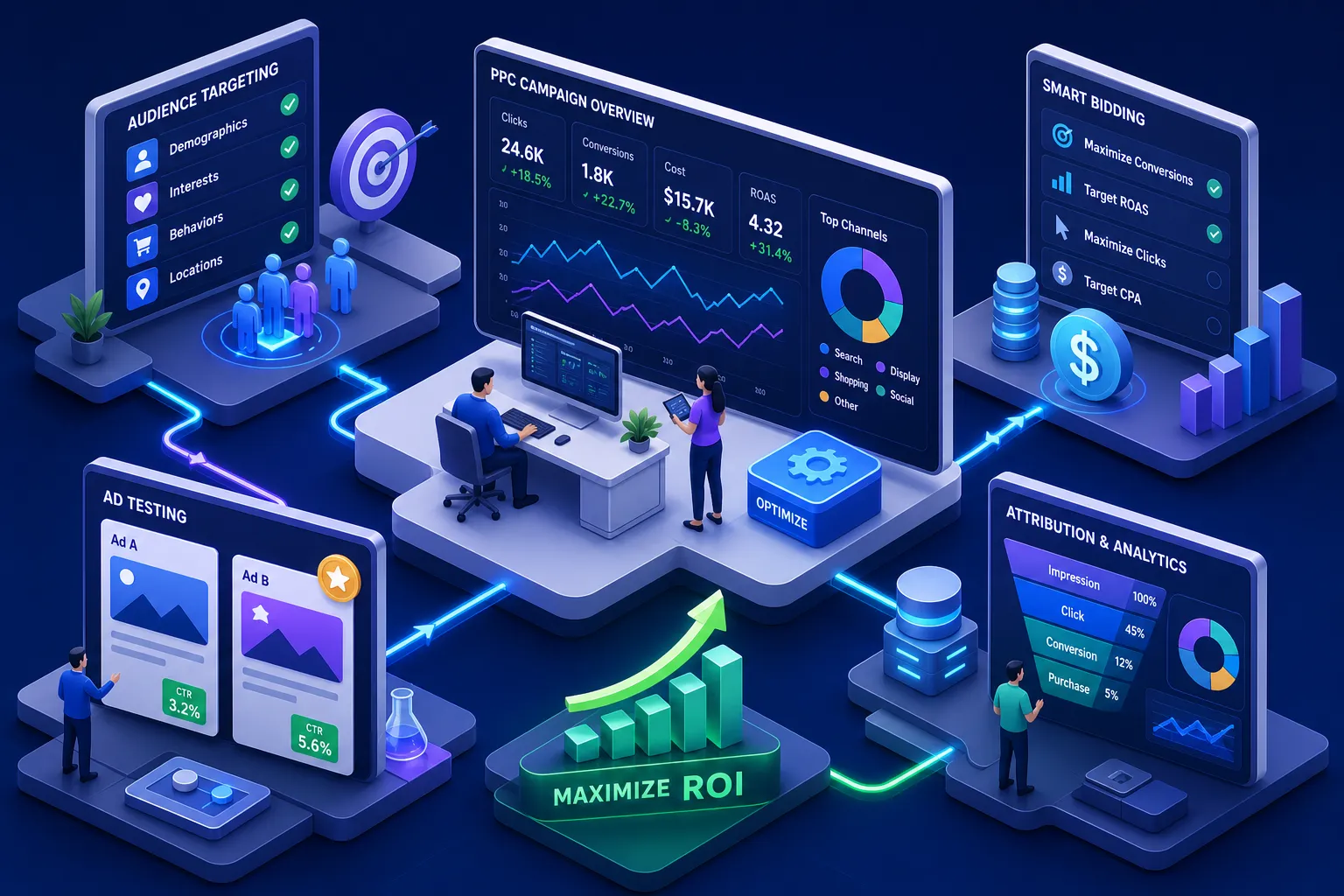
Every high-performing paid search account is optimized across four connected levers: audience segmentation, bid strategy, ad and landing page alignment, and attribution. The critical word is “connected.” Tightening your audience without fixing your landing page produces better clicks that still don’t convert. Improving your landing page without fixing attribution leaves you making budget decisions on incomplete data. Each lever has to be calibrated in relation to the others.
Audience Targeting: Reach Buyers, Not Browsers
The wrong audience is the fastest way to drain a paid search budget. You can have excellent ad copy and a strong landing page, but if the campaign is showing to people who were never going to buy, the conversion math never works.
Why Remarketing Is Your Highest-ROI Audience Layer
Remarketing lists consistently produce strong ROI on both Google Ads and Microsoft Ads because they target users who already demonstrated intent by visiting your site or engaging with your content. Research into audience performance across both platforms ranks remarketing as the top-performing audience type for direct-response campaigns.
The targeting structure should be layered by depth of interaction: past site visitors, cart abandoners, and users who reached a specific page or spent significant time on a product page represent progressively higher intent. Apply bid multipliers to these segments on search campaigns, with the largest multipliers going to cart abandoners and bottom-of-funnel page visitors. Typical multiplier ranges and the right testing approach will vary by account, but the directional logic holds across verticals.
In-Market and Custom Intent for Cold-Traffic Acquisition
In-market audiences are the strongest cold-traffic targeting option for both lead generation and e-commerce because they capture users who are actively researching a purchase, not just passively interested in a topic. Contrast this with affinity audiences, which are interest-based and typically produce weaker ROI for direct-response goals because interest doesn’t equal purchase intent. Custom intent audiences sharpen this further: you can build them from competitor URLs, high-converting keywords, and product category pages, which lets you define the audience by commercial behavior rather than demographic proxy.
The B2B Lead-Gen Advantage on Microsoft Ads
Microsoft Ads carries a targeting capability Google Ads simply can’t replicate: LinkedIn profile data. B2B campaigns on Microsoft can target by job title, company size, and industry, layered directly onto search intent. For professional services, B2B SaaS, and consulting firms, this combination of search intent and professional identity targeting improves lead quality and lowers cost per qualified lead. Google wins on volume; Microsoft tends to win on B2B lead quality.
The practical approach for most B2B accounts is to use Microsoft Ads for decision-maker targeting and Google Ads for intent capture and remarketing at scale. For a deeper comparison of platform strengths for lead generation, see this Google Ads vs Microsoft Ads for lead gen analysis.
Smart Bidding Strategies That Cut CPA Without Killing Scale
One of the most common mistakes in PPC Campaigns management is using the wrong bid strategy for the campaign’s current stage. The result is a campaign that’s either too aggressive without enough data to support it or too conservative to grow.
The Maximize Conversions to Target CPA Progression
For new campaigns with limited conversion history, Maximize Conversions is the right starting point. The algorithm gathers data without being constrained by a CPA target it can’t yet hit efficiently. Once a campaign reaches roughly 30, 50 conversions per month, transitioning to Target CPA gives the system a directional goal without suppressing volume the way an overly tight target does. The transition point matters: switching too early starves the algorithm of the signal it needs, and the performance instability that follows gets misattributed to the bid strategy rather than the timing.
When making the switch, set the initial target CPA at or slightly above your recent actual average. Aggressive targets reduce impressions as the system works to protect the number, which collapses conversion volume. Start permissive and tighten incrementally as performance data accumulates. For a practical bidding-strategy reference, review this PPC bidding strategies guide.
When to Use Target ROAS and How to Set Realistic Targets
Target ROAS is the correct strategy for e-commerce and any campaign where conversion value varies, because optimizing for value rather than count produces better revenue outcomes. Smart Bidding uses auction-time signals, including device, location, time of day, and operating system, in every auction.
This is why realistic targets matter: if the ROAS target is set too high, the system reduces impression share to protect the target and volume collapses. Set your initial target ROAS close to actual recent performance, then move it up in 10, 15% increments as the campaign proves it can sustain the efficiency gain.
Ad Copy and Landing Page Alignment: Where Conversions Are Won or Lost
A well-targeted campaign with the right bid strategy still fails if the ad and landing page break the user’s expectation. Message match is what holds the conversion path together from click to form fill or purchase.
What to Test in Your Ad Copy and in What Order
A/B testing for paid search ads should follow a specific priority sequence rather than testing everything simultaneously. Start with headlines, which carry the most weight in determining click-through rate and setting the conversion expectation.
Once a headline winner is established, test CTA wording, then description lines. Each test should isolate one variable, and each test needs enough impression and conversion volume to produce a statistically meaningful result before you declare a winner. Benefit-led, specific headlines tend to outperform vague or feature-heavy messaging in most paid search tests. “Get a Same-Day HVAC Quote” is a stronger headline than “Professional HVAC Services” because it answers the buyer’s immediate question rather than describing the business.
The Five Landing Page Elements That Move Conversion Rates
For PPC traffic, the landing page is a separate conversion system from the homepage and should be built and tested as such. The five highest-impact elements are:
- Message match between the ad headline and the landing page headline
- A single prominent CTA with action-oriented copy
- Benefit-led above-the-fold copy that answers the question: what’s in it for me?
- Trust signals such as reviews and security badges
- Fast load speed, conversion rate drops approximately 12% for every additional second of load time, which means a page loading in four seconds instead of two is already operating at a significant disadvantage before a single word is read
Headline A/B tests on paid search landing pages have shown an average 15% conversion lift in reported practitioner benchmarks. That number compounds. A 15% lift on a campaign converting at 3% moves it to 3.45%, and at meaningful spend levels, that difference translates to substantial revenue. Mailchimp’s PPC landing page guide outlines these elements and the priorities for landing page testing.
Measuring True PPC ROI With Multi-Touch Attribution
The biggest measurement mistake in paid search is treating last-click conversions as the complete picture. Last-click attribution ignores every touchpoint except the final one before conversion, which means PPC campaigns that assist conversions get zero credit. For B2B and high-consideration purchases, this systematically understates the value of paid search and leads to budget cuts in channels that are actually driving revenue.
The Multi-Touch ROI Formula, Including Offline Conversions
The correct formula for PPC ROI is (Attributed Revenue minus Total PPC Cost) divided by Total PPC Cost, multiplied by 100.
The key word is “attributed,” meaning revenue credit distributed across the full buyer journey using a model like time-decay or data-driven attribution in GA4, not just revenue from last-click online conversions. For most B2B and service businesses, this also means importing offline conversions back into the platform. Calls, in-person meetings, and CRM-closed deals need to be matched back to the original click identifier and uploaded so paid search gets credit for the revenue it influenced but didn’t directly close online.
A practical example: $20,000 in PPC spend against $60,000 in attributed revenue, including offline closes, equals 200% ROI. That same account measured on last-click online conversions alone might show $25,000 in revenue and appear to be losing money.
Attribution isn’t an analytics detail. It’s the difference between cutting a channel that’s working and doubling down on one that isn’t. For practical guidance on calculating PPC ROI and attribution, see this resource.
Your 90-Day PPC Optimization Roadmap
Most businesses try to fix everything simultaneously and end up making incremental progress on everything rather than meaningful progress on anything. The roadmap below sequences the four pillars in order of impact and dependency.
Days 1, 30: Fix the Foundation
The first 30 days focus on eliminating waste before adding spend. The top priorities are audience structure and negative keyword cleanup, which represent the fastest ROI wins available in most accounts. Alongside audience cleanup, set up proper conversion tracking including offline import so every decision going forward is made on complete data. Run a bid strategy audit to confirm campaigns are using the right strategy for their conversion volume and maturity stage.
Days 31, 60: Test and Learn
With the structural foundation in place, this phase shifts to systematic testing. Launch ad copy A/B tests with isolated variables, starting with headline variants. Begin landing page tests, prioritizing headline and CTA changes because those carry the highest expected lift. Review attribution data to identify assisted conversion paths that currently show zero credit in last-click reporting. These insights will reshape how you evaluate channel performance and budget allocation going into the final phase.
Days 61, 90: Scale What Works and Bring In the Right Support
The final phase scales confirmed audiences, tightens bid targets based on real performance data from the first 60 days, and expands to new audience segments where intent signals are strong. This is also the point where fast-growing accounts start to require more active management than a part-time operator can give them.
For business owners who know PPC campaigns is a revenue lever but don’t want to manage audience segmentation, bid transitions, and attribution modeling on top of running their business, working with a dedicated paid search team is often the highest-leverage decision in the entire process. Brandleap Agency runs a management cycle structured around this same sequence for clients across e-commerce, B2B, and service verticals. Read more on the Brandleap Agency Blog.
The Structure Is the Strategy
Maximizing your ROI with targeted PPC campaigns isn’t about spending more. It’s about eliminating structural waste and putting every dollar where the data points. The four pillars covered here, audience targeting, bidding strategy, ad and landing page alignment, and accurate ROI measurement, are interdependent. Coordinating all four typically improves performance significantly and removes the ceiling effects that hold individual optimizations back. Work on only one while ignoring the others, and the remaining gaps will limit how far it can go.
Campaigns built on this framework don’t just perform better in month one. They build on compounding performance data, tighter audience definitions, and attribution clarity that makes every subsequent decision more accurate. That’s what separates paid search accounts that plateau from ones that scale.
If you want the expertise without the operational overhead, Brandleap Agency Blog and our managed services are built around exactly this framework. For local businesses looking to combine paid search with local visibility, consider our Best Local SEO Service, Brandleap Agency, and if you’re operating in the region, check our Results-Driven SEO Services in New York, Brandleap Agency.
Contact us to find out what a structured paid search program looks like for your business.