Introduction
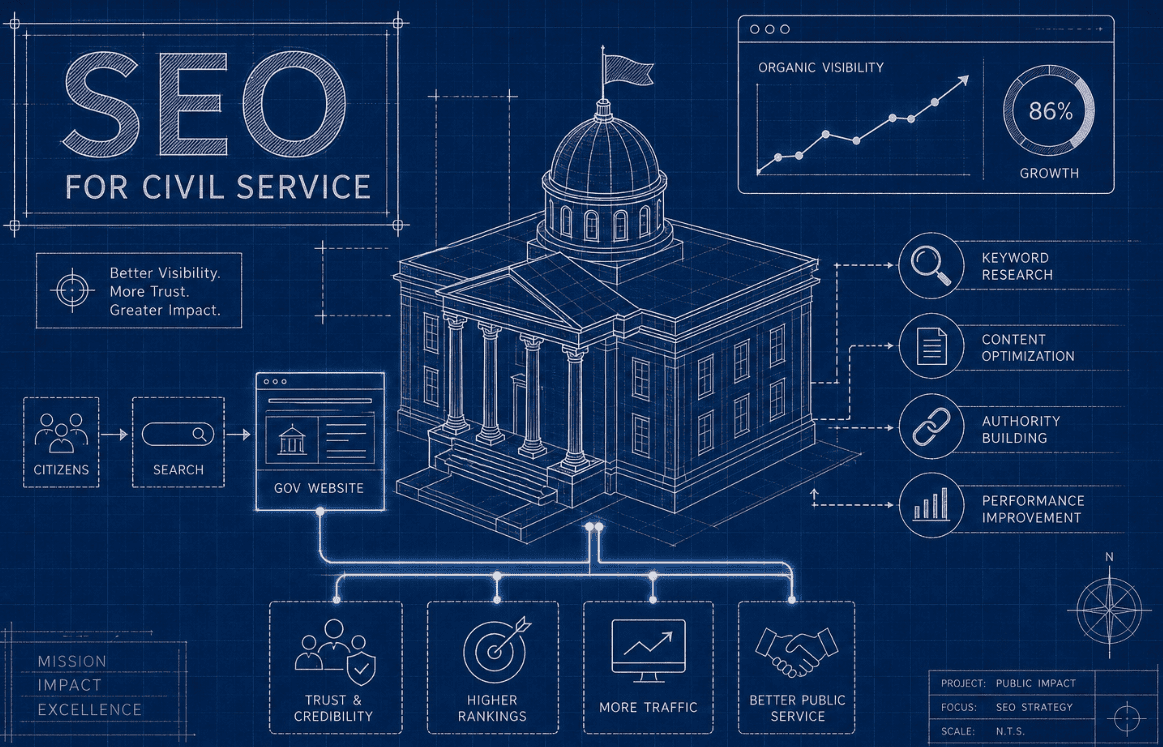
Government and SEO for Civil Service websites hold some of the most important information available to the public. Benefits guidance, planning permits, public consultations, safety notices. Yet much of it receives low visibility in search results, many users rarely look beyond the top results. When the right page isn’t there, citizens often call a helpline, find an unofficial source, or abandon the search entirely. Effective SEO for civil service teams and public sector organisations exists precisely to close that gap.
At Brandleap, we’ve worked with government-adjacent and nonprofit organisations that face exactly this problem: credible, well-researched public content that no one can find because the SEO foundation was never built. We’ve seen this pattern repeatedly across departments, content teams producing thorough policy guidance that sits unread because page titles and structure were never aligned to how citizens actually search. The information exists. The audience exists. What’s missing is the connection between them. This guide breaks down how civil service teams and public sector organisations can use search engine optimisation to close that gap, covering keyword strategy, content structure, and technical SEO in plain terms. No in-house SEO team required.
Why government websites struggle with search visibility
The structure problem, not the content problem
Most civil service content is written for internal compliance rather than public search behaviour. Pages are organised around departmental hierarchies instead of how a citizen phrases a question. A page titled “Environmental Impact Assessment Submission Portal” is unlikely to rank for someone searching “how to apply for planning permission near a river,” even if it contains the exact answer they need, the mismatch between official page titles and common query language is a documented pattern in public sector web analytics. The result is accurate content that search engines simply can’t match to real search queries.
This isn’t a writing quality problem. SEO for Civil Service teams produce thorough, well-researched material. The gap is structural: content gets built around how departments are organised rather than how citizens think and speak. Senior Executive Officers and communications leads managing digital teams often inherit legacy structures that compound this problem over years. For context on how roles and grades are structured across the service, see the Institute for Government explainer on SEO for Civil Service grades. Until that gap closes, even excellent content stays invisible.
What poor discoverability actually costs
When public-facing information doesn’t rank, the cost isn’t lost revenue, it’s lost trust and increased service pressure. Phone lines get overwhelmed, consultation participation may drop, and the public turns to unofficial sources for guidance that could be outdated or wrong. Search visibility is a civic function, not just a marketing metric. Each well-ranked page can reduce helpline demand and help citizens find accurate information more easily, without friction.
Building an SEO civil service keyword strategy
Start with intent, not terminology
Civil service language and citizen language rarely match. GOV.UK analytics data shows that users consistently prefer informal, colloquial language over official terminology. Citizens search “scrappage” instead of “vehicle discount scheme.” They search “10p tax” instead of “removal of the 10% starting rate of tax.” According to GDS usability research, government platforms recorded over 300,000 searches per week across more than 125,000 different phrases, revealing a massive long tail of queries that official page titles never address. Effective SEO for SEO for Civil Service organisations starts by mapping the plain-language questions real people type into search engines against the official content that answers them.
Using free tools to find the right search terms
Google Search Console, Google’s autocomplete, and the “People also ask” box are practical starting points for any public sector team. They surface the exact phrasing citizens use, which often differs dramatically from departmental language. Google Search Console is free and accessible to any team managing a verified property, though filtering and interpreting query data does benefit from some familiarity with the platform. Prioritising high-volume, lower-complexity queries gives government content the best chance of reaching the people who need it most. The insights generated can be applied directly to page titles, headers, and meta descriptions with no specialist tooling required.
Grouping related content into topic clusters
Rather than publishing isolated pages, SEO for Civil Service websites benefit from clustering related content around a central topic. A housing benefits hub, for example, should link out to eligibility pages, application guides, and appeals processes. This structure signals topical authority to Google and helps users navigate naturally from one related question to the next. It also reduces the chance of internal pages competing against each other for the same queries, a common issue on large government sites with duplicated content across departments.
Content structure for SEO civil service pages
Writing for people first, then search engines
Plain language and SEO are not in conflict. Short sentences, clear headers, and front-loaded answers are good for accessibility, good for readability, and good for search rankings. Front-loaded answers tend to perform better in search because they align with how Google evaluates content relevance, putting the answer early signals that the page directly addresses the query. The Plain Writing Act of 2010 is both a compliance requirement and an SEO opportunity: writing at an accessible reading level serves citizens and satisfies search engine quality signals at the same time.
One practical rule: write as if the first sentence of your page is the only sentence a citizen will read. If it answers their question, everything else on the page is a bonus. If it doesn’t, Google will find a page that does, and your content stays buried regardless of how thorough it is.
Using headers and page structure as navigational signals
H2 and H3 headers do double duty on public sector pages. They help screen readers navigate the page and they tell Google what each section covers. Structuring pages around specific sub-questions, rather than generic departmental categories, improves how well a page ranks for long-tail citizen queries. A header like “How to appeal a benefits decision” is more likely to outperform “Appeals Process” because it mirrors how a citizen phrases the question before they even type it. This mirrors the guidance on descriptive headings from GOV.UK content design patterns, which consistently supports plain, question-led heading structures, see the GOV.UK Design System for content patterns and examples.
Keeping content current and authoritative
Government content ages quickly. Policy changes, deadlines shift, and outdated pages create both ranking problems and public trust issues. Google actively deprioritises stale content on topics where freshness matters, which includes almost everything on a SEO for Civil Service website. Building a regular review cycle into content governance is as much an SEO decision as it is an editorial one. A quarterly content audit that flags outdated pages for refresh or removal will have a measurable impact on organic visibility over time, in line with standard content maintenance guidance from the Government Digital Service, see their guidance on SEO for GOV.UK.
Technical SEO essentials for public sector websites
Page speed and mobile performance
A significant portion of citizens access government websites from mobile devices, often with inconsistent connections. As of 2026, Google’s mobile-first indexing means that the mobile version of every page is the baseline Google uses to decide how to rank it, for both mobile and desktop searches. Pages that load slowly on mobile rank lower and frustrate users at the exact moment they need help. Compressing images, reducing unnecessary scripts, and enabling browser caching are basic technical fixes with measurable ranking impact, though implementation typically requires developer time. Google’s PageSpeed Insights and Search Console Mobile Usability report identify the specific issues causing the most damage, and both are free to use.
Older public sector sites built for desktop and adapted poorly to mobile are especially vulnerable. If the mobile version of a page has less content, fewer internal links, or missing structured data compared to the desktop version, Google ranks the site based on that weaker mobile experience, affecting traffic across all devices, not just mobile.
Structured data and schema markup
Schema markup allows government websites to tell search engines exactly what a page contains: a form, a deadline, a public notice, a contact number. When implemented correctly in JSON-LD format, this can generate rich results in Google’s search listings, increasing click-through rates and surfacing the right information faster. For civil service sites, schema types like GovernmentOrganization, FAQPage, and Event are particularly useful. Implementation involves inserting a structured JSON-LD block into the page’s HTML head section, then validating it using Google’s Rich Results Test. It requires initial development effort and periodic updates when page content, contact details, or organisational information changes, but the long-term visibility gains are well supported by the official GOV.UK guidance on content schemas and structured data.
Crawlability and internal linking
On many legacy government CMS platforms, deep folder structures and inconsistent navigation mean Google’s crawler struggles to follow links between pages, and content it can’t reach can’t be indexed. Many government websites also have broken internal links and orphaned pages that never get crawled. A technical SEO audit, run using tools like Screaming Frog or Sitebulb, identifies these issues and creates a clear map of how pages connect, ensuring the entire site benefits from whatever authority the domain has built. Internal linking also distributes page authority across the site, helping newer or lower-traffic pages rank faster when they cover queries citizens are actively searching.
Measuring SEO civil service success and knowing when to bring in outside support
The right metrics for public sector SEO
Commercial SEO measures revenue and leads. Public sector SEO measures reach, task completion, and reduced service pressure. The metrics that matter are organic search traffic to key service pages, average position for priority queries, and the volume of users reaching a form or confirmation page. Bounce rate can serve as a supporting signal for page relevance, though it works best when read alongside task completion rates and form submission data rather than in isolation. These numbers tell a clear story about whether citizens are finding what they need, without requiring any commercial analytics infrastructure.
Why most civil service teams don’t have in-house SEO capacity
SEO for civil service teams requires a combination of content strategy, technical knowledge, and ongoing analysis that most government communications teams aren’t staffed to handle. It isn’t a one-time project. It requires consistent attention across keyword research, content updates, and technical maintenance. That’s a real resource gap for public sector teams operating under budget and headcount constraints, including middle management civil service roles that carry communications responsibility without dedicated digital support. The skills needed to run a technical audit are different from the skills needed to produce policy content, and most departments don’t have both on the same team. If you’re deciding whether to hire external help, our guide on How to Choose the Right SEO Services for Small Businesses, 2026 can help frame the decision and shortlist the capabilities you need.
How a full-service agency fills that gap
Organisations that need a results-driven SEO foundation without building an internal team benefit from working with a full-service agency that handles strategy, content, and technical implementation together. Brandleap Agency works with government-adjacent and nonprofit organisations to build exactly that kind of integrated SEO foundation, from keyword research and content structure through to technical audits and ongoing reporting. For public sector teams that know their content has value but can’t get it found, that kind of end-to-end support makes a practical difference: one partner, one strategy, measurable outcomes. Learn more about our approach in our Unlock Success with Enterprise SEO Service: A Beginner’s Guide, 2026.
The real cost of getting this wrong
Civil service and government organisations are sitting on valuable public information that too often goes undiscovered because SEO has never been treated as a core function. The fix isn’t complicated, but it requires intention: a keyword strategy grounded in how citizens search, content structured for clarity and relevance, and a technical foundation that lets Google actually find and rank the pages that matter.
SEO for civil service and public sector websites isn’t about gaming an algorithm. It’s about making sure the right information reaches the right person at the right moment. Organisations that invest in that foundation see measurable improvements in organic reach and user task completion, outcomes consistently reported by public sector teams that have undergone structured SEO programmes. The principles in this guide give internal teams and outside partners alike a clear starting point to improve public-facing search visibility in a way that actually serves citizens.
If your organisation has credible public content that isn’t ranking where it should, Brandleap Agency can run a technical and content audit that identifies exactly where the gaps are and what to fix first. Start there, and the path forward becomes straightforward. We also publish sector-specific resources, for example our guide Boost Your Business: SEO for Financial Services, 2026, which illustrates how a focused SEO programme can deliver measurable outcomes in regulated sectors.
FAQ For – Hiring an SEO Consultant
1. What is SEO for civil service websites?
SEO for civil service refers to optimizing government or public sector websites so citizens can easily find accurate information through search engines. It focuses on accessibility, clear structure, and delivering trustworthy, user-focused content.
2. Why is important for SEO for Civil Service organizations?
SEO helps public service websites reach more people, improve transparency, and ensure critical information—like policies, services, and announcements—is easily accessible to citizens when they search online.
3. What are the key strategies for SEO for Civil Service websites?
Important strategies include using clear and simple language, optimizing for relevant keywords, improving website speed, ensuring mobile-friendliness, and following accessibility standards. Structured content and proper metadata also play a big role.
4. How does content quality impact SEO in the public sector?
High-quality, accurate, and regularly updated content builds trust and authority. Search engines prioritize reliable information, especially for public service topics, making content quality essential for better rankings.
5. What challenges are common in civil service SEO?
Common challenges include outdated content, complex approval processes, limited technical resources, and the need to comply with strict regulations and accessibility guidelines while still maintaining SEO performance.